Swensen's
Swensen's at 1999 Hyde Street occupies a singular position in San Francisco's ice cream history, sitting at the corner where Russian Hill meets the city's cable car lines. Compared to the high-concept dessert bars that now crowd the Mission and Hayes Valley, this original outpost operates on a different register entirely, one rooted in neighbourhood ritual rather than culinary spectacle.
Pearl is the En Primeur Club membership app — saves, bookings, and concierge access live there. Same editors, same standards.
- Address
- 1999 Hyde St, San Francisco, CA 94109
- Phone
- +14157756818
- Website
- swensensofsf.com
- Directions
- Get directions
 Saves & bookings on Pearl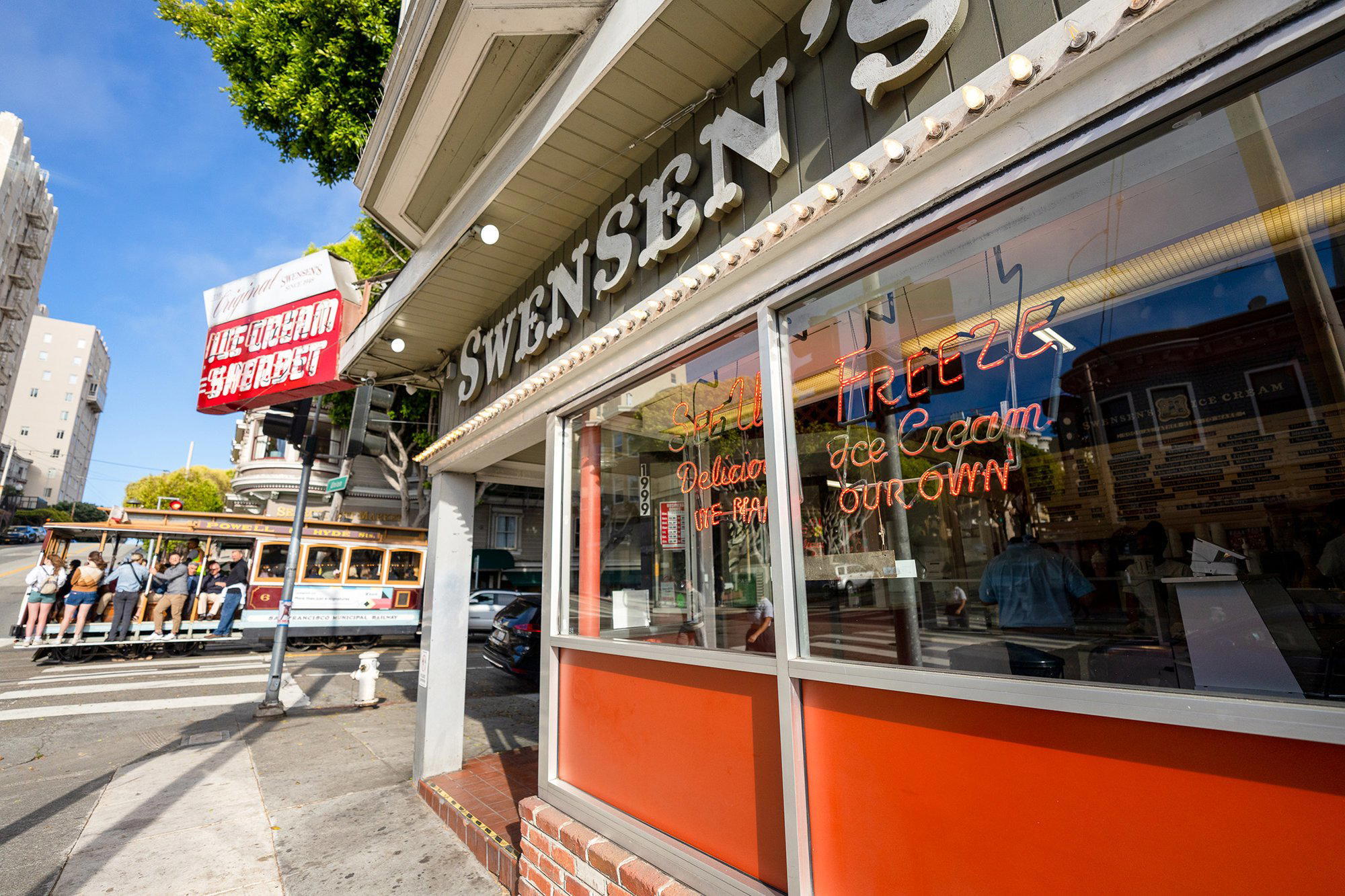
The Corner That Stayed Put
Russian Hill has absorbed decades of San Francisco reinvention, artisan coffee, natural wine bars, omakase counters, and Swensen's at 1999 Hyde Street is a classic American ice cream parlour in San Francisco, known for its walk-in format and casual setting. It has watched most of it from the same corner. The cable car lines of Hyde and Union mark this intersection as one of the city's most photographed blocks, and the ice cream parlour that opened here in 1948 is part of what that picture has always included. Where much of the American dessert category has moved toward liquid nitrogen theatrics or single-origin chocolate bars priced like cocktails, the neighbourhood ice cream parlour format has remained its own category, defined by consistency, accessibility, and a kind of deliberate ordinariness that is harder to sustain than it looks.
Across San Francisco's broader dining spectrum, the contrast is sharp. A short cable car ride south or a few blocks east, the city's contemporary fine dining tier, represented by places like Lazy Bear, Atelier Crenn, and Benu, operates at the $$$$ tier with tasting menus, reservation windows measured in months, and culinary frameworks built around technique signalling. Swensen's occupies a different axis entirely, which is precisely what gives it editorial interest: it represents the other pole of what a city's food identity can mean.
Ice Cream as American Vernacular
The American ice cream parlour is one of the more durable vernacular food formats the country has produced. Unlike the tasting menu restaurant, which arrived as a European import and was refined through French and later Nordic influence, the soda fountain and ice cream parlour evolved domestically, shaped by dairy economics, immigration patterns, and the mid-century American expectation that dessert should be democratic. By the late 1940s, when Earle Swensen established the Hyde Street location, San Francisco already had the infrastructure, the dairy supply chains from the Central Valley, the Italian-American confectionery tradition carried by North Beach families, the working-class neighbourhood grid that made a corner shop economically viable.
That intersection of local product and adopted technique is worth noting. California's dairy industry, concentrated in the Central Valley and the coastal counties north of San Francisco, has long supplied the fat-rich milk and cream that ice cream requires. The editorial angle that connects indigenous product to imported method applies here as much as it does at Quince or Saison, it simply operates at a different price point and cultural register. The soda fountain format itself arrived from East Coast pharmacy culture and was adapted into a West Coast neighbourhood institution by operators like Swensen, who used California cream to build a product suited to local taste.
How It Positions Against the Contemporary Dessert Bar
The San Francisco dessert category has fragmented considerably since the early 2000s. High-concept patisseries, Japanese-influenced mochi shops, and European-style gelaterias now compete in a market that the mid-century parlour format never anticipated. In cities like New York, where Le Bernardin and Atomix represent the upper ceiling of technique-driven dining, the dessert bar has similarly split between the ceremonial and the casual. Chicago's Alinea turned dessert into a performance art category. New Orleans' Emeril's treats it as a Southern tradition with Creole inflection.
The original Swensen's sits outside all of those competitive frames. It is not competing with the dessert bar format on the dessert bar's terms. What it competes on, neighbourhood permanence, format legibility, and the particular comfort that comes from a menu that has not been reimagined in response to trend cycles, is a different proposition. For a visitor moving through San Francisco's dining circuit, which might include The French Laundry in Napa or Single Thread Farm in Healdsburg on the same trip, the Swensen's stop represents a deliberate gear-change: from maximum culinary ambition to something closer to the city's residential grain.
Russian Hill as Context
Neighbourhood provides as much of the experience as the product itself. Russian Hill is not a dining destination in the way that the Mission or Hayes Valley function for food tourists, it is a residential district with a low density of buzzy openings and a high density of people who actually live nearby and return regularly. That resident-to-visitor ratio shapes how a place like Swensen's operates: the customer base is not primarily driven by social media discovery or out-of-town recommendation lists. The parlour's longevity on Hyde Street is partly a function of that neighbourhood dynamic, where the format that works is one locals can visit without ceremony.
This stands in contrast to farm-to-table destinations like Blue Hill at Stone Barns in Tarrytown or destination restaurants like Providence in Los Angeles, Addison in San Diego, and Bacchanalia in Atlanta, all of which draw audiences willing to build a visit around the restaurant itself. The restaurant works the other way: the visit is built around being in the neighbourhood, and the parlour is where that visit lands.
The Franchise Question and the Original Location
The restaurant grew into a global franchise chain from this Hyde Street origin point, with locations across Southeast Asia and the Middle East that have since outpaced the American footprint in commercial scale. That global expansion is a familiar American food story: a format developed for a specific neighbourhood context gets systematised, exported, and adapted for markets that have no connection to the original conditions. At 8 1/2 Otto e Mezzo Bombana in Hong Kong or at any number of internationally transplanted American concepts, the tension between the original and the franchise version is a recurring editorial theme in food writing. The Hyde Street location represents the fixed point against which those variations are measured.
For visitors who track those threads, the relationship between an original venue and its global descendants, the 1999 Hyde address carries a specific kind of historical interest. It is the place where the format was first assembled, before it became a system. That distinction matters less to the regular who stops in after a cable car ride and more to the reader trying to understand what San Francisco's food culture has exported to the world and what it has kept for itself. A comparable American institution framing also connects to The Inn at Little Washington, where the relationship between a founding location and a long-accumulated identity raises similar questions about what permanence means in American hospitality.
Planning Your Visit
The Hyde Street location sits at the intersection of Hyde and Union, accessible via the Hyde Street cable car line, which makes it a natural stop on any Russian Hill or Fisherman's Wharf circuit. No advance booking is required for a walk-in ice cream parlour format. Timing is dictated by neighbourhood foot traffic patterns rather than reservation availability, so weekday afternoons carry a different energy than weekend evenings. Current hours are Tue-Sun 12-10 PM, with Monday closed.
Just the Basics
Comparable venues nearby, for context on price, style, and recognition.
| Venue | Cuisine | Price | Notes |
|---|---|---|---|
| Swensen'sThis venue — the venue you are viewing | Not listed | $ | Not listed |
| Peter Kettle Corn | Laurel, Gourmet Kettle Corn | $ | Not listed |
| Portico | Not listed | $ | Financial District/South Beach, American Deli Quick Bites |
| Jerry’s Roast Pork | Not listed | $ | Financial District/South Beach, Philly-Style Roast Pork Sandwiches |
| Mama's On Washington Square | Not listed | $$ | North Beach, Classic American Breakfast & Brunch |
| Duboce Park Cafe | Not listed | $$ | Castro/Upper Market, Fresh California Cafe |
Continue exploring
More in San Francisco
Restaurants in San Francisco
Browse all →
Bars in San Francisco
Browse all →
Hotels in San Francisco
Browse all →
At a Glance
- Classic
- Cozy
- Well Known
- Family
- Casual Hangout
- Historic Building
Current opening hours
- Monday
- Closed
- Tuesday
- 12–10 PM
- Wednesday
- 12–10 PM
- Thursday
- 12–10 PM
- Friday
- 12–10 PM
- Saturday
- 12–10 PM
- Sunday
- 12–10 PM
Hours can change for holidays and private events. Last verified .
Homey 50s-era ice cream parlor with a classic, nostalgic atmosphere.