
Tabelog 100 #37
Our verdict
Yokohama’s serious sushi scene is quieter than Tokyo’s, but the ritual is no less exacting. Sushi Tsugu belongs to the city’s compact counter culture: a 16-seat, counter-led Edomae restaurant in Bashamichi, selected for Tabelog Sushi EAST “Tabelog 100” 2025, with private-room capacity that makes it more flexible than many small sushi rooms.

Pearl is the En Primeur Club membership app, where members save venues, book tables and use the concierge.
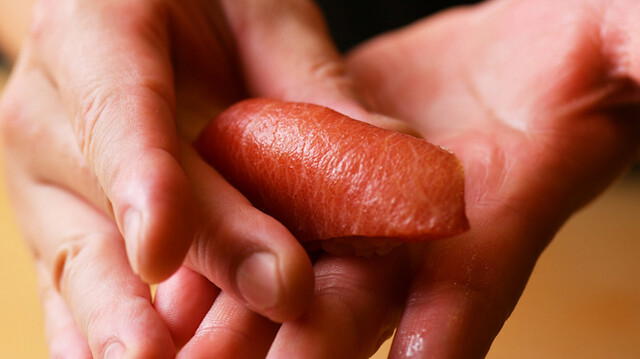
The menu
What to order
- Omakase sushi course
- Lunch omakase
- Seasonal sashimi selection
- Anago (sea eel) nigiri
- Tuna nigiri trio
Around Yokohama’s sushi counters, the port-city’s openness narrows into concentration. The city has grand hotels, banquet rooms, kissaten, curry houses and late-night bars, but serious sushi often works at smaller volume: fewer distractions, tighter timing and a meal shaped around attention. Sushi Tsugu fits that pattern, placing it in a focused sushi register rather than the high-turnover seafood-restaurant category.
A Yokohama sushi reservation is not a substitute for the most famous sushi districts elsewhere; it is different. Major prestige counters carry international-demand pressure, while Yokohama’s stronger sushi rooms can feel more local, drawing business diners, Kanagawa residents and travellers who know the city’s dining culture is more than a stop on a wider route. Selection for Tabelog Sushi EAST “Tabelog 100” 2025 gives Sushi Tsugu a clear external credential, and its Tabelog score of 3.77 puts it in the serious-reviewer conversation rather than the casual neighborhood bracket.
A counter-led sushi rhythm in Yokohama
Sushi is sequence as much as product. The grammar matters: small portions, temperature control, vinegared rice, fish handling and quiet negotiation between chef and guest. In a counter-led setting, pacing is visible. Guests are not just ordering fish; each piece lands inside a controlled arc, and the room’s scale keeps that arc from turning theatrical.
That scale is the point. A focused sushi restaurant can hold a business dinner or serious meal for sushi regulars without losing counter discipline. Many sushi counters are awkward for group conversation because the counter demands forward attention; here, the attraction is a meal where the kitchen’s sushi program stays central. For travellers choosing between Yokohama dining formats, that matters as much as cuisine type.
The drinks question is part of how to read the meal. Across higher-end sushi dining in Japan, sake remains important, while other beverages may also be chosen with care. Better programs avoid making drinks a separate performance; pairings work when they support the rice and fish rather than compete. At a sushi counter, restraint is usually more valuable than spectacle.
The restaurant is listed in the sushi category, with a price range that signals a premium but still Yokohama-grounded meal: dinner is listed at JPY 15,000 - JPY 19,999, while lunch is listed at JPY 4,000 - JPY 4,999. Plain language signals the real work: sourcing, cutting, seasoning and restraint. A counter grounded in sushi fundamentals does not need an invented signature; success depends on whether the sequence holds its tension from beginning to end.
How Yokohama's sushi tier differs from the city's broader dining map
Yokohama is often read through large-format dining traditions: banquet rooms, hotel dining, waterfront restaurants, Western-style legacy rooms, curry, tonkatsu and grilled food. Across the city, the contrast is sharp. Tonkatsu Aoki Yokohama bashamichi ten sits in a different lane and serves a different appetite; Bashamichi Jubankan carries an old-Yokohama café-and-Western-food identity; The Bar CASABLANCA belongs to the cocktail circuit. Sushi Tsugu occupies the quieter, higher-commitment lane, where the format itself asks for attention.
That comparison defines the decision. Visitors seeking breadth can move from regional dining to coffee rooms to bars. Those using one meal to understand serious Japanese dining in Yokohama should think in counter-culture terms. The sushi counter compresses the city’s coastal identity, wider metropolitan adjacency and local business dining habits into a restrained room: less performative than many destination restaurants, more formal than everyday seafood spots.
Its recognition in the 2025 Tabelog Sushi EAST “Tabelog 100” places it among restaurants that serious local reviewers are watching. The listed score of 3.77 is not just decoration; in Yokohama, it helps separate a meal planned around sushi from a casual stop for seafood. Reservations and timing should be approached with the same respect expected at any compact sushi room working with perishable product and a paced meal.
For a wider Yokohama itinerary, contrast is useful. Other Yokohama dining rooms point to grilled food, Chinese cooking, curry and everyday formats across the city’s range. The sushi counter is the tighter, more ceremonial end of that spectrum, and Sushi Tsugu is best understood as part of that focused side of Yokohama rather than as an all-purpose restaurant.
Who should choose this meal
This suits diners who know sushi etiquette is mostly attention. Arrive ready for a paced meal, mention allergies or dislikes in advance, and do not treat the counter as a photo set. The meal is built around sushi, so guests should be comfortable with that premise before booking. A good counter does not redesign itself at the table; it asks diners to meet the format halfway.
The restaurant may be more adaptable than some highly rigid sushi rooms, but the core experience remains counter-led in spirit. For business, that can be an advantage: formal enough to carry weight, not so grand that the room overtakes the food. For a solo diner or pair, the appeal is especially clear because it preserves rhythm and proximity to the work.
Travellers should read Sushi Tsugu within Yokohama’s dining logic. The meal can sit before or after a waterfront evening, hotel stay, or bar crawl elsewhere in the city. Broader planning is better handled by the city guides: Our full Yokohama restaurants guide, Our full Yokohama hotels guide, Our full Yokohama bars guide, Our full Yokohama wineries guide and Our full Yokohama experiences guide.
For a longer Japan dining route, Yokohama’s sushi counter can pair with casual or regional stops rather than another formal omakase. Nearby and further afield, the contrast might run from grilled beef, sukiyaki and other cooking styles to tuna, charcoal-grilled dishes, café culture and curry. Even outside Japan, Japanese dining formats travel in narrower, more specialized forms, from sake bars to onigiri counters. Sushi Tsugu’s appeal is that it keeps the ritual compact: fish, rice, counter, sequence, and a room small enough in spirit that timing still matters.
Frequently asked questions
Where is Sushi Tsugu in Yokohama?
Yokohama.
What does dinner at Sushi Tsugu typically cost?
Dinner at Sushi Tsugu is listed at JPY 15,000 - JPY 19,999; lunch is listed at JPY 4,000 - JPY 4,999.
When can I go to Sushi Tsugu?
Check directly with Sushi Tsugu for current opening times and reservation availability.
What is Sushi Tsugu known for?
Sushi Tsugu is known for sushi in Yokohama. It was selected for Tabelog Sushi EAST 2025 in the Tabelog 100 and has a listed Tabelog score of 3.77.
Cuisine Context
Comparable venues by cuisine and price in the same metro.
| Venue | Cuisine | Price | Awards | Notes |
|---|---|---|---|---|
| Sushi TsuguThis venue (the venue you are viewing) | Edomae Sushi Omakase | $50–100 | Tabelog 100 #37 | Not listed |
| Bashamichi Okawa | Kaiseki Japanese | $100–150 | Tabelog 100 #36 | Naka |
| Arai Ya Honten | Traditional Japanese Gyunabe / Sukiyaki | Not listed | Tabelog 100 #31 | Naka |
| RAMAI Yokohama isezaki mo-ru ten | Hokkaido-style soup curry & Indonesian-inspired curry | $10–20 | Tabelog 100 #87 | Naka |
| Ribatei | Traditional Yakitori Omakase | $50–100 | Tabelog Bronze #368 | Naka |
| Teuchi Soba Fuurai Kyo | Seasonal Handmade Soba & Soba Kaiseki | $20–30 | Tabelog 100 #89 | Aoba |
Recognition history
Dated appearances from independent guides and award organizations, with the underlying list record or original source where available.
Tabelog 100 #37 · No. 37
Tabelog · Tabelog 100 - Sushi - EAST - 2025
Continue exploring
More in Yokohama
Restaurants in Yokohama
All restaurants in Yokohama →


Bars in Yokohama
Browse all →



Details
- Intimate
- Elegant
- Cozy
- Quiet
- Date Night
- Business Dinner
- Celebration
- Special Occasion
- Group Dining
- Family
- Chefs Counter
- Private Dining
- Standalone
- Sake Program
- Omakase
- Counter Dining
- Tasting Menu
- Set Menu
- Sake
- Beer
- Shochu
- Pescatarian Friendly
- Allergy Accommodating
Current opening hours
- Monday
- Closed
- Tuesday
- 5–11 PM
- Wednesday
- 5–11 PM
- Thursday
- 5–11 PM
- Friday
- 5–11 PM
- Saturday
- 5–11 PM
- Sunday
- 5–11 PM
Hours can change for holidays and private events. Hours as of .
A small, quietly elegant sushi bar with a calm, refined atmosphere; guests sit mainly at the counter or in a private room, enjoying focused omakase service in a serene, softly lit setting suitable for special occasions and business dinners.