Sushi Noz








2 Michelin Stars · La Liste Top Restaurants · Star Wine List
Our verdict
A two-Michelin-star Edomae-style omakase on the Upper East Side, Sushi Noz operates at the precise end of New York's high-end sushi market. Chef Nozomu Abe presides over a 200-year-old hinoki counter in a hushed, temple-like room, where seasonal otsumami give way to nigiri of considerable technical discipline. Ranked 29th in North America by Opinionated About Dining in 2025, it belongs to a small peer group of counters where Tokyo-calibre sourcing meets Manhattan pricing.

Pearl is the En Primeur Club membership app, where members save venues, book tables and use the concierge.
Where Edomae Tradition Meets New York's Most Demanding Counter
New York's premium omakase market has expanded sharply over the past decade, moving from a handful of counters to a tiered ecosystem that now runs from accessible neighbourhood spots to rooms priced above $400 per head before wine. At the upper end of that spectrum, a small cohort of restaurants competes on the same terms as Tokyo's leading sushi-ya: sourcing precision, Edomae technique, and an interior aesthetic that signals ceremony rather than dining. Sushi Noz, at 181 East 78th Street on the Upper East Side, sits firmly within that cohort.
The Kaiseki Influence: Seasonal Sequence as Structure
Edomae sushi and kaiseki are distinct traditions, but they share a governing logic: the meal is a sequence calibrated to season, and every course exists to advance that sequence rather than stand alone. At Sushi Noz, this philosophy shapes the meal's architecture from the first otsumami to the final nigiri. The kitchen opens with cooked preparations, sea perch with fresh ponzu, ice fish served in slender, yielding pieces, before moving through a miso soup course that uses eel worked into noodle form with salted egg yolk cream and crispy tofu. These are not amuse-bouches signalling what follows; they are substantive courses in their own right, establishing the meal's tempo and demonstrating the range of technique that precedes the sushi sequence.
That progression matters because it reframes what the nigiri are asked to do. By the time the sushi arrives, the diner has already encountered the kitchen's approach to texture contrast, acidity, and restraint. The nigiri, described by La Liste, which awarded the restaurant 88 points in 2025 and 84 points in 2026, as "jewel-like", land in a context already shaped by what preceded them. This is kaiseki logic applied to a sushi format: the whole meal is the statement, not any individual piece. For comparison, counters like Kosaka in the West Village take a similar multi-act approach, while Sushi Nakazawa keeps the structure tighter and more nigiri-forward. The choice between formats is a matter of how much cooked-course depth the diner wants before the fish-focused sequence begins.
The Room: Hinoki, Ceremony, and the Upper East Side Address
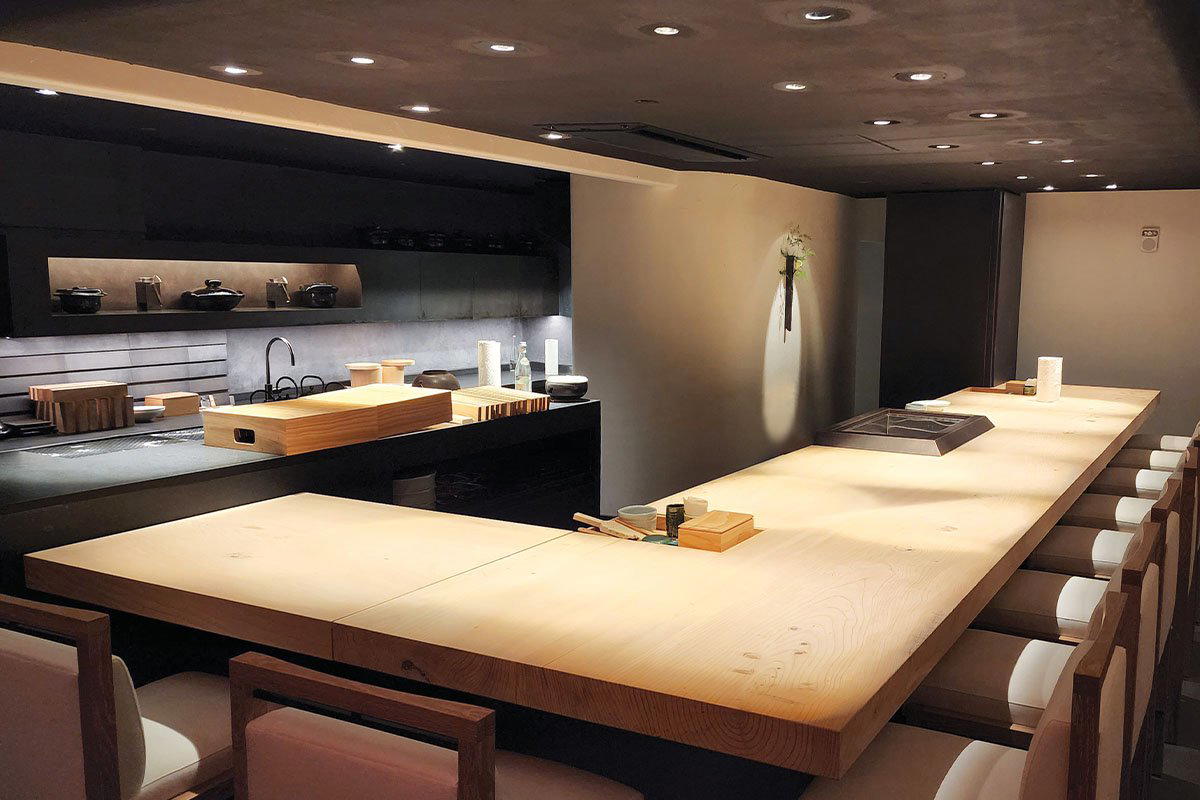
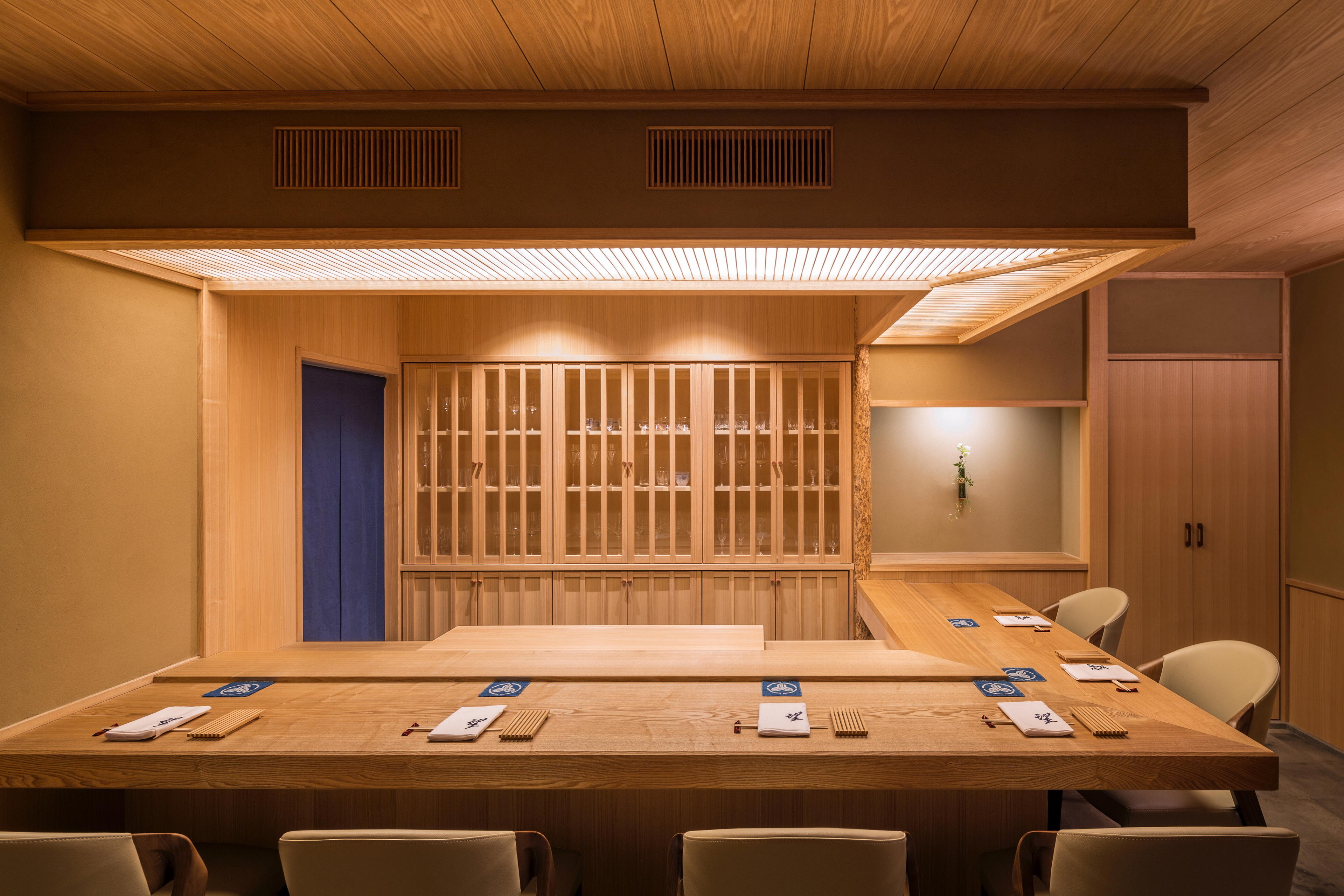
The physical environment at Sushi Noz operates as an extension of the food's aesthetic. The counter is cut from hinoki cypress that is, according to documented sources, approximately 200 years old, a material choice that carries both sensory and symbolic weight. Hinoki has a faint, clean cedar-like character and a warmth that synthetic surfaces cannot replicate; in traditional Japanese construction, it is associated with purity and longevity. The room around it has been described as temple-like, which is less metaphor than description: the atmosphere is deliberate, quiet, and oriented entirely around what happens at the counter.
Staff dress in kimono, and the service convention includes the chef and front-of-house seeing guests out at the close of the meal, a Japanese hospitality practice (omotenashi) that is rarely preserved in full in Western restaurant contexts. On New York's Upper East Side, where the neighbourhood's dining character tends toward the formal and understated rather than the scene-driven, this register fits. The address places Sushi Noz away from the density of Midtown omakase and closer to the residential pace of the 70s blocks, which suits a room that functions better as a destination than as a drop-in.
The Wine Program: Burgundy-Weighted, Seriously Scaled
The wine list at Sushi Noz is one of the more substantial in the New York omakase category. The inventory runs to 3,400 bottles with 1,100 selections, weighted toward Burgundy and Champagne, two regions whose acidity profiles pair more coherently with fish than the tannic structure of most New World reds. Wine pricing sits at the $$$ tier, meaning many bottles exceed $100, and the corkage fee is set at $200. Wine Director Tira Johnson oversees the list, supported by sommeliers Haden Riles, Chris Gomez, Michael Chung, and Heidi Kim, a staffing level for the wine program that reflects the seriousness of the list itself.
The Burgundy focus aligns Sushi Noz with a pattern visible across high-end Japanese counters globally: the recognition that white Burgundy, particularly from the Côte de Beaune, handles raw and lightly dressed seafood without overwhelming it. The Champagne component, typically blanc de blancs from the Côte des Blancs, serves a similar function. Diners who want to bring their own wine face one of the higher corkage fees in the New York market, which is worth factoring into budget calculations at this price tier.
Where Sushi Noz Sits in New York's Omakase Hierarchy
New York now supports more high-end Japanese counters than any city outside Japan, and the differentiation between them has become genuinely meaningful rather than marginal. Sushi Yasuda in Midtown represents the long-established, more accessible end of the spectrum. Masa at the Time Warner Center operates at the absolute ceiling of the market. Sushi Noz occupies a position between those poles, with two Michelin stars and a traditional Edomae commitment that places it closer to Masa's philosophy than to the mid-market wave, but within a price range that, at the $$$$ tier, is high without reaching Masa's documented extremes.
The Opinionated About Dining trajectory is notable: ranked 19th in North America in 2023, 25th in 2024, and 29th in 2025. That modest decline in ranking does not reflect deterioration so much as the competitive expansion of the category, as new counters have entered and the list has grown more contested. Internationally, the model has parallels in Sushi Masaki Saito in Toronto and Endo at The Rotunda in London, both of which operate traditional Japanese counter formats in non-Japanese cities at comparable price points.
For diners weighing Sushi Noz against other high-investment dinner options in New York, the relevant comparisons are not just within the Japanese category. Rooms like Alinea in Chicago, The French Laundry in Napa, Single Thread Farm in Healdsburg, Lazy Bear in San Francisco, Providence in Los Angeles, and Emeril's in New Orleans all operate in the same bracket of serious, multi-course, credential-heavy dining. What distinguishes the Sushi Noz proposition is the specificity of its tradition: this is a room where the entire format, from the aged hinoki counter to the otsumami sequence, exists in service of a single culinary lineage rather than a chef's personal interpretive vision.
Planning Your Visit
Sushi Noz serves dinner Tuesday through Saturday from 5:30 pm to 11:30 pm, and also on Mondays at the same hours, with Sunday the only closed day. The Upper East Side location is accessible from the 6 train at 77th Street. Given the demand profile for two-Michelin-star omakase counters in New York, reservations should be secured well in advance. Cuisine pricing: $$$ (two-course equivalent above $66, with the full omakase considerably higher). Wine list: $$$ (many bottles above $100; 1,100 selections from a 3,400-bottle inventory). Corkage: $200. Wine strengths: Burgundy, Champagne. Meals: Dinner only.
For a broader picture of where Sushi Noz sits within the city's full dining spectrum, see our full New York City restaurants guide. For accommodation near the Upper East Side, our New York City hotels guide covers options across the borough. Cocktail bars, wine bars, and late-night options are mapped in our New York City bars guide, and further context on the city's food and drink scene is available through our wineries guide and our experiences guide.
Frequently asked questions
Is Sushi Noz a family-friendly restaurant?
Sushi Noz is a two-Michelin-star omakase counter operating in a hushed, ceremony-driven room. The format is a fixed multi-course sequence with no à la carte options, and the pacing and environment are calibrated for adult diners with an interest in traditional Edomae sushi. It is not a practical choice for young children.
What should I expect atmosphere-wise at Sushi Noz?
The room is spare and intentional: a 200-year-old hinoki cypress counter, kimono-dressed staff, and an atmosphere Pearl describes as 'a sacred space' that 'recreates an intimate Japanese refuge.' Conversation happens, but quietly. Chef Nozomu Abe works directly in front of guests at 181 E 78th St, and the overall register sits closer to a Tokyo counter than a New York dining room.
Has Sushi Noz won any awards?
Sushi Noz has received recognition including: La Liste Top Restaurants (2026): 84pts; New York is the kind of town where a person looking to splash out hundreds of dollars on a sushi omakase dinner has a long list of fine options. But those who like their sea creatures pristine and lar….
What do regulars order at Sushi Noz?
There is no ordering at Sushi Noz. The meal is a fixed omakase sequence that opens with otsumami, cooked appetizers, before moving into nigiri. La Liste cited the sourcing and execution as 'about as close as you'll come to the real thing, short of hopping on a flight out to Tokyo,' scoring it 88 points in 2025. The kitchen follows seasonal availability, so the progression shifts across the year.
What kind of cuisine does Sushi Noz serve?
At-a-Glance Comparison
| Venue | Cuisine | Price | Awards | Notes |
|---|---|---|---|---|
| Sushi NozThis venue (the venue you are viewing) | Edomae Omakase | $500+ | 2 Michelin Stars · La Liste Top Restaurants | Not listed |
| Le Bernardin | French Seafood Fine Dining | $300–500 | 3 Michelin Stars · World's 50 Best #13 | French, Seafood |
| Atomix | Modern Korean Tasting Menu | $300–500 | 2 Michelin Stars · World's 50 Best #7 | Modern Korean, Korean |
| Masa | Seasonal Hokkaido Tempura Omakase | $150–200 | Tabelog 100 #34 | Sushi, Japanese |
| Per Se | French Fine Dining Tasting Menu | $300–500 | 3 Michelin Stars · World's 50 Best #40 | French, Contemporary |
| Eleven Madison Park | Contemporary Plant-Based Fine Dining | $300–500 | 3 Michelin Stars · World's 50 Best #4 | French, Vegan |
Recognition history
Dated appearances from independent guides and award organizations, with the underlying list record or original source where available.
Michelin 2 Stars
Michelin
La Liste Top Restaurants
La Liste
Star Wine List
Star Wine List
Opinionated About Dining Top Restaurants in North America Ranked #38
Opinionated About Dining
Wine Spectator Best of Award of Excellence
Wine Spectator
Full recognition history (15 entries)
La Liste Top Restaurants
La Liste
New York Times Best Restaurants in New York City
New York Times
OpenTable Top 100 Restaurants
OpenTable
Opinionated About Dining Top Restaurants in North America Ranked #29
Opinionated About Dining
Wine Spectator Best of Award of Excellence
Wine Spectator
World's Best Wine Lists Awards WBWL 3-Star
World's Best Wine Lists Awards
Michelin 2 Stars
Michelin
Opinionated About Dining Top Restaurants in North America Ranked #25
Opinionated About Dining
Opinionated About Dining Top Restaurants in North America Ranked #19
Opinionated About Dining
Robb Report 100 Greatest American Restaurants of the 21st Century #97
Robb Report