


1 Michelin Star · Tabelog Silver #56
Our verdict
Operating since July 2005 from a nine-seat counter in Setagaya's Futako Tamagawa district, Sushi Kimura holds a Michelin star, consecutive Tabelog Silver awards through 2026, and placement in the Opinionated About Dining Top 50 in Japan for 2024 and 2025. Chef Toomo Kimura runs one of Tokyo's most consistently decorated omakase counters outside the central wards, with review-based spending averaging JPY 50,000–59,999 per head.

Pearl is the En Primeur Club membership app, where members save venues, book tables and use the concierge.
The menu
What to order
- Aged swordfish
- Japanese amberjack
- Watarigani crab
A Counter in the Suburbs That Earns Its Place Among Tokyo's Finest
When Sushi Kimura opened on 7 July 2005 in Tamagawa, Setagaya, it set up in a residential pocket of southwest Tokyo that most international visitors would not think to associate with serious omakase dining. Nearly two decades on, that address reads less as an anomaly and more as a statement about how Tokyo's premium sushi scene actually works. The city's most closely watched counters are not confined to Ginza or Minami-Aoyama; a sustained record of awards and consistently high review scores can anchor a destination counter almost anywhere the city's train network reaches.
The pattern at this level of Tokyo sushi is familiar: nine seats, a single counter, evenings structured around a set course, and a booking system that operates entirely by reservation. What distinguishes one counter from another in this tier is less the format than the accumulated evidence of consistency. Sushi Kimura has that evidence in quantity. Tabelog Silver awards in 2018, 2020, 2021, 2022, 2023, and 2026, framing two Gold wins in 2017 and 2019, represent a decade-long run of peer recognition on Japan's most data-rich restaurant platform. The restaurant has also been selected for the Tabelog Sushi TOKYO "Tabelog 100" in 2021, 2022, and 2025, placing it among a defined shortlist of the city's hundred most notable sushi counters.
Where the Room Positions You
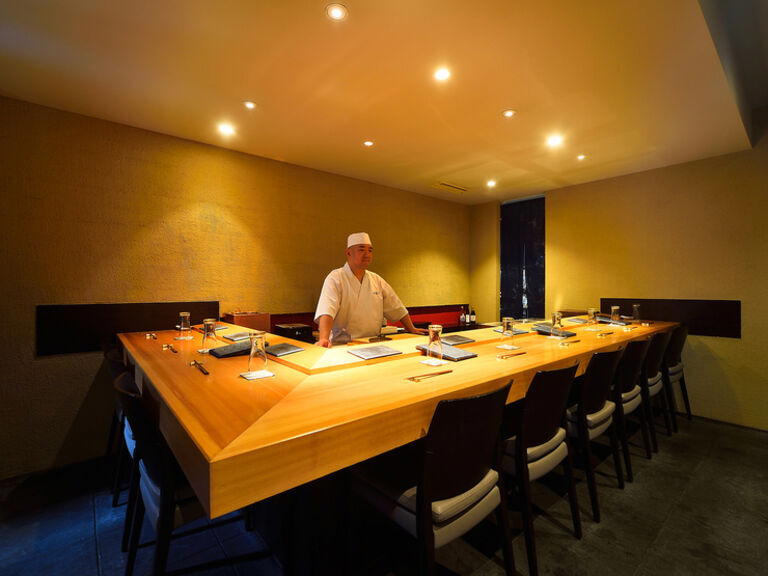
Counter sushi at this price point is as much about atmosphere as fish. The nine-seat format at Sushi Kimura means the room is small enough that temperature, sound, and pace are perceptible in the way a larger restaurant cannot manage. The counter surface, the movement of the chef, the rhythm of nigiri placed and consumed, the sake programme described as something the kitchen takes seriously: these are the sensory coordinates of the experience. There are no private rooms and no large-party configurations. The room is configured for individual attention across a short run of seats, which is the dominant format among Tokyo's top-tier omakase operations.
The sake list is a deliberate programme rather than an afterthought. The venue data flags that the kitchen is "particular about sake (Nihonshu)," a distinction that separates counters with genuine beverage intent from those treating drinks as a margin exercise. At a counter where the food course runs 30,000 yen excluding tax on listed pricing, a considered sake pairing is part of what the seat is designed to provide.
The Numbers Behind the Recognition
Sushi Kimura holds a Michelin one-star rating (2024) and appears in the Opinionated About Dining rankings across multiple years: Leading Restaurants in Japan at position 47 in 2025 and 38 in 2024; Leading Restaurants in Asia at position 100 in 2024 and 62 in 2023. OAD rankings are built from the assessments of experienced diners and culinary professionals rather than anonymous mass reviews, which gives them a different but complementary signal to Tabelog scores. A counter that scores consistently across both systems is doing something that holds up to scrutiny from multiple critical frameworks.
The Tabelog score of 4.25 sits in a tier where the gap between 4.20 and 4.35 represents a meaningful competitive distinction. The listed course price of JPY 30,000 excluding tax places Sushi Kimura in the mid-to-upper range of Tokyo omakase; the review-based average spending of JPY 50,000–59,999 reflects what guests actually spend once beverages and tax are included. That gap is consistent with the sake programme's depth and the counter's beverage emphasis.
For comparative context: Harutaka and Sushi Kanesaka operate in a similar award tier from central Tokyo locations, while Sukiyabashi Jiro Roppongiten represents the more prominent Roppongi branch of one of Tokyo's most recognised names. Edomae Sushi Hanabusa and Hiroo Ishizaka round out the set of Tokyo counters worth considering alongside Kimura when mapping the city's sushi scene. What distinguishes Sushi Kimura within this peer group is its location outside the central wards and its unusually long award record, which covers nine consecutive Tabelog award cycles from 2017 to 2026.
Tokyo Sushi Beyond the Central Wards
Setagaya is a large, largely residential ward, and Futako Tamagawa is a well-developed commercial hub within it, seven minutes on foot from Futako Tamagawa Station. The station sits on the Den-en-toshi and Oimachi lines, making it accessible from Shibuya in around fifteen minutes. That commute is short enough that the address stops being a deterrent for any diner willing to move slightly off the conventional luxury circuit. In practice, counters operating at this recognition level in non-central locations often draw a different kind of regular: local residents for whom the neighbourhood placement is a convenience, and destination seekers specifically motivated by the awards record.
The geography also connects Sushi Kimura to a broader map of serious dining in Japan. For those building an itinerary across the country, the EP Club guides to HAJIME in Osaka, Gion Sasaki in Kyoto, akordu in Nara, Goh in Fukuoka, 1000 in Yokohama, and 6 in Okinawa offer further reference points. For sushi specifically in wider Asia, Sushi Shikon in Hong Kong and Shoukouwa in Singapore are the regional benchmarks most often cited alongside Tokyo's leading counters.
EP Club's guides to Tokyo restaurants, Tokyo hotels, Tokyo bars, Tokyo wineries, and Tokyo experiences provide broader itinerary context for the city.
Planning Your Visit
Reservations: Reservation only; no walk-ins. Domestic bookings through OMAKASE; international bookings through TABLEALL. No inquiries accepted by other methods. Hours: Dinner from 18:30; lunch from 12:00; closed days not fixed. Seats: 9 counter seats. Budget: Course listed at JPY 30,000 excluding tax; review-based average spend JPY 50,000–59,999 including beverages. Payment: Card only (VISA, Mastercard, JCB, AMEX, Diners) since October 2020; no electronic money or QR code payments. Address: 3 Chome-21-8 Tamagawa, Setagaya, Tokyo; seven minutes on foot from Futako Tamagawa Station. Parking: One space available; confirm at time of booking.
Frequently asked questions
What do regulars order at Sushi Kimura?
The format at Sushi Kimura is omakase, meaning the course is set by the chef rather than selected by the diner. There is no à la carte ordering at this kind of counter. What the kitchen's emphasis on fish sourcing and the sake programme suggest is that the experience is built around seasonal fish choices and sake pairing across the course, with Chef Toomo Kimura directing both. The Tabelog data notes the kitchen is "particular about fish," which at this award level typically means sourcing decisions are made daily based on what is available at the highest quality rather than from a fixed supplier list. Regular guests at nine-seat omakase counters of this calibre tend to engage with the beverage programme as fully as the food course, and the sake selection at Sushi Kimura is positioned as a genuine part of the offering rather than an incidental list. For further reference on what distinguishes Kimura's approach within Tokyo's sushi scene, see our guides to [Sushi Kanesaka](https://www.enprimeurclub.com/restaurants/sushi-kanesaka-tokyo-restaurant), [Harutaka](https://www.enprimeurclub.com/restaurants/harutaka-tokyo-restaurant), and [Edomae Sushi Hanabusa](https://www.enprimeurclub.com/restaurants/edomae-sushi-hanabusa-tokyo-restaurant).
City Peers
| Venue | Cuisine | Price | Awards | Notes |
|---|---|---|---|---|
| Sushi KimuraThis venue (the venue you are viewing) | Aged Sushi Omakase | $150–200 | 1 Michelin Star · Tabelog Silver #56 | Not listed |
| Harutaka | Edo-Style Omakase Sushi | $200–300 | 3 Michelin Stars · World's 50 Best #76 | Sushi |
| RyuGin | Modern Kaiseki | $500+ | 3 Michelin Stars · World's 50 Best #41 | Kaiseki, Japanese |
| L'Effervescence | Modern French with Japanese Influences | $200–300 | 3 Michelin Stars · World's 50 Best #69 | French |
| HOMMAGE | Modern French with Japanese Influences | $150–200 | 2 Michelin Stars · World's 50 Best #78 | Innovtive French, French |
| MAZ | Innovative Peruvian-Japanese Fusion | $150–200 | 2 Michelin Stars · World's 50 Best #28 | Innovative |
Recognition history
Dated appearances from independent guides and award organizations, with the underlying list record or original source where available.
Michelin 1 Star
Michelin
Opinionated About Dining Top Restaurants in Japan Ranked #61
Opinionated About Dining
Tabelog Silver #56
Tabelog
Full recognition history (9 entries)
Opinionated About Dining Top Restaurants in Japan Ranked #47
Opinionated About Dining
Tabelog 100 #30 · No. 30
Tabelog · Tabelog 100 - Sushi - TOKYO - 2025
Opinionated About Dining Top Restaurants in Japan Ranked #38
Opinionated About Dining
Opinionated About Dining Top Restaurants in Asia Ranked #100
Opinionated About Dining
Opinionated About Dining Top Restaurants in Japan Ranked #41
Opinionated About Dining
Opinionated About Dining Top Restaurants in Asia Ranked #62
Opinionated About Dining
Continue exploring
More in Tokyo
Restaurants in Tokyo
All restaurants in Tokyo →


Bars in Tokyo
All bars in Tokyo →




Details
- Intimate
- Elegant
- Sophisticated
- Quiet
- Minimalist
- Special Occasion
- Date Night
- Chefs Counter
- Sake Program
- Omakase
- Counter Dining
Current opening hours
- Monday
- Closed
- Tuesday
- 5:30–9:30 PM
- Wednesday
- 5:30–9:30 PM
- Thursday
- 5:30–9:30 PM
- Friday
- 5:30–9:30 PM
- Saturday
- 5:30–9:30 PM
- Sunday
- 5:30–9:30 PM
Hours can change for holidays and private events. Hours as of .
Calm, intimate counter seating with hinoki wood tables, warm and casual atmosphere focused on the chef's craft.