

Operating from Via Materdei since 1901, Starita sits at the heart of Naples' pizza tradition, applying the techniques of the Arte Bianca across generations of continuous practice. The kitchen works within the strict grammar of Neapolitan method while allowing measured innovation to keep the ritual current. For anyone tracing the city's pizza lineage, this address in the Materdei quarter is a primary reference point.
 Discover on Pearl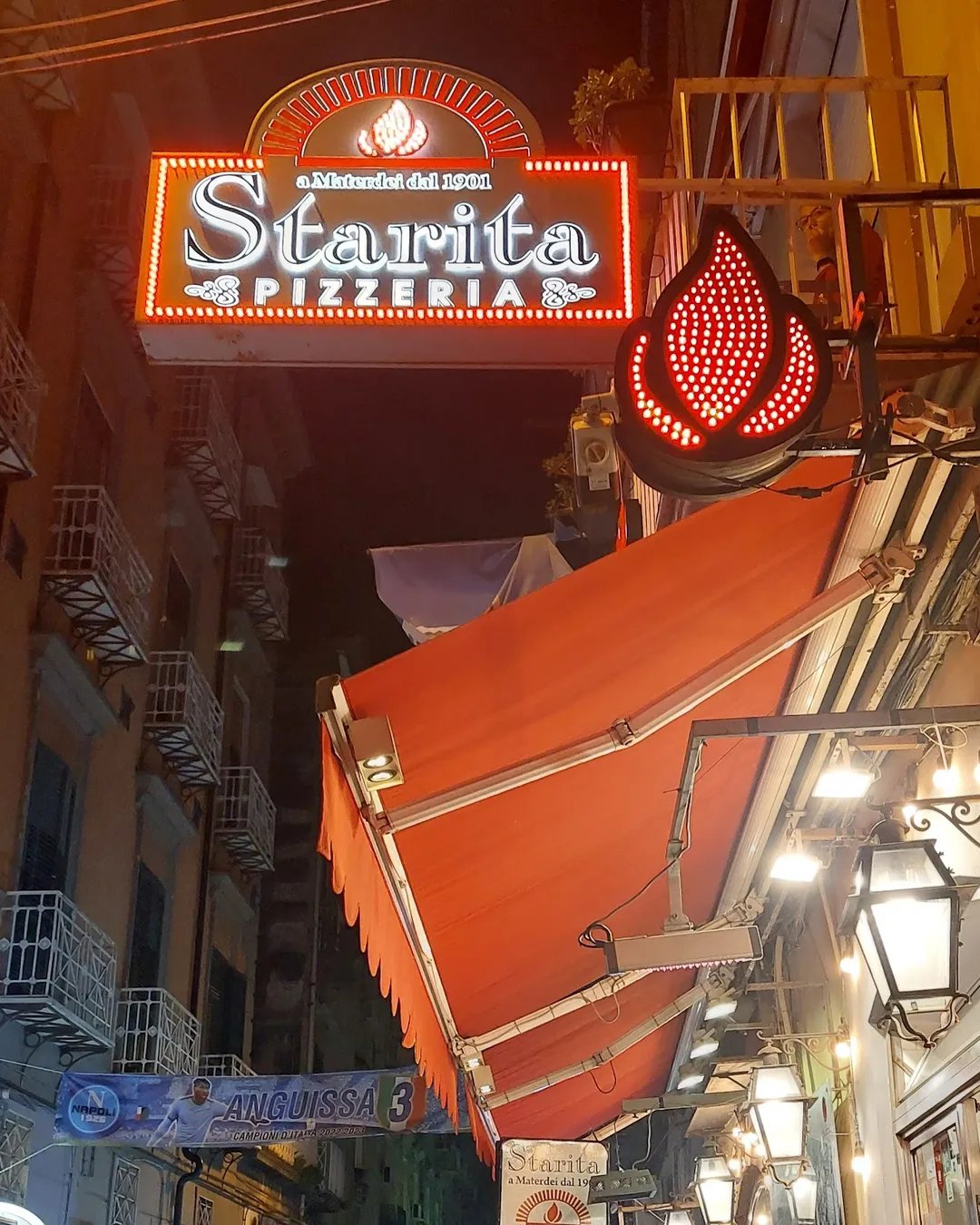
Where the Arte Bianca Has Its Address
In Naples, pizza is not a category of food so much as a civic institution, governed by technique, memory, and a set of unwritten standards that the city's leading pizzerias either uphold or answer for. The Materdei quarter sits away from the tourist-dense centro storico, and the pizzerias that have taken root here over the past century tend to work for a local audience first. Starita, at Via Materdei 27/28, has occupied that position since 1901, making it one of the oldest continuously operating pizza addresses in a city that invented the form.
More than twelve decades of operation places Starita inside a peer group that barely exists. Most of Naples' celebrated pizza names date from the postwar decades or later. The addresses that predate the First World War number in single figures, and they carry a different kind of authority: not the authority of a critical accolade, but the authority of institutional survival through multiple generations, two world wars, and the continuous pressure of a city that holds its pizza to exacting standards.
The shortlist, unlocked.
Hard-to-book tables, cellar releases, and concierge-planned trips.
Get Exclusive Access →The Language of the Arte Bianca
The Arte Bianca, literally the art of white dough, is the technical tradition that underpins Neapolitan pizza-making. It is a discipline of fermentation timing, hydration ratios, and wood-fired temperature management that produces the characteristic leopard-spotted crust: charred at the edge, soft and yielding toward the centre, with a crumb structure that holds moisture without collapsing under the weight of the topping. Starita's practice sits inside this tradition rather than departing from it, which is a deliberate editorial stance in a city where the tradition itself is the standard against which everything is measured.
The Associazione Verace Pizza Napoletana, which codifies and certifies authentic Neapolitan pizza method, sets precise requirements for dough composition, fermentation time, oven temperature, and ingredient sourcing. Pizzerias operating at Starita's tenure carry those requirements not as external constraints but as inherited practice, the institutional memory of a craft transmitted from one generation to the next within the same kitchen walls.
The Team as Custodian
Editorial angle of the Arte Bianca tradition is inseparable from the question of how it gets transmitted. At long-established Neapolitan pizzerias, the relevant collaboration is less between a named chef and a sommelier, and more between the pizzaiolo at the stone, the forno operator managing wood and temperature, and the floor team that sequences tables through a format where the pizza arrives at the correct moment in the heat cycle. These roles are distinct and interdependent: a perfectly fermented dough base yields a different result if it sits waiting for a delayed oven window, and the dining room pace determines how many of those windows the kitchen can exploit in a service.
At a house with over a century of continuous operation, this coordination becomes a form of institutional knowledge rather than a series of individual decisions. The team dynamic at Starita is less about a single named figure and more about the accumulated competence of a kitchen that has absorbed, refined, and passed on its methods across multiple generations. That is a different kind of authority from the kind that attaches to a chef who has staged at notable European kitchens, and it belongs to a smaller, older category of establishment. For context on how other high-ambition kitchens in Italy approach the question of craft transmission and culinary authority, you might compare the approaches at Osteria Francescana in Modena, Dal Pescatore in Runate, or Atelier Moessmer Norbert Niederkofler in Brunico, where generational continuity takes a different but comparably weighted form.
Materdei and the Naples Pizza Circuit
Naples' pizza circuit has reorganised itself several times over the past two decades. A generation of pizzaioli trained in the post-Enzo Coccia era brought technical experimentation to the fore, producing establishments like 50 Kalò di Ciro Salvo and Diego Vitagliano Pizzeria, which have attracted international critical attention alongside strong local followings. La Notizia has similarly positioned itself within a premium research-led tier, while Bro. Ciro e Antonio Tutino Pizzeria and Ciro Cascella 3.0 represent newer entrants bringing their own competitive framing to the category.
Starita operates in a different register from this newer cohort. It is not competing on the basis of dough innovation, ingredient sourcing provenance, or critical-list positioning. Its competitive frame is institutional authority: the claim that a house practicing for 124 years carries the tradition more deeply than one that has been refining its method for ten or fifteen. Whether a visitor weighs that kind of authority above the technical ambition of newer addresses is a genuine editorial question without a single correct answer. It depends on what you are looking for from the city's pizza tradition.
For visitors building a broader picture of what Naples offers across dining, drinking, and experience, the full Napoli restaurants guide, Napoli bars guide, Napoli hotels guide, Napoli wineries guide, and Napoli experiences guide provide city-wide context. For comparable Italian dining authority at other price and format tiers, Enoteca Pinchiorri in Florence, Enrico Bartolini in Milan, and Quattro Passi in Marina del Cantone sit in distinct but informative peer positions. For international fine-dining reference points, Le Bernardin in New York City and Atomix in New York City illustrate the range of approaches to long-tenured craft authority in other culinary traditions.
Planning a Visit
Starita is at Via Materdei 27/28 in the Materdei neighbourhood, reachable by metro (Line 1, Materdei station) and a short walk from the Spanish Quarters. The address is not in the main tourist circuit, which keeps the atmosphere oriented toward neighbourhood diners rather than passing visitors. Phone and booking details are not listed in EP Club's current database; checking directly with the venue or arriving early in the evening service is the practical approach for first-time visitors. Dress is informal, in keeping with the register of a long-established neighbourhood pizzeria rather than a fine-dining room.
The shortlist, unlocked.
Hard-to-book tables, cellar releases, and concierge-planned trips.
Get Exclusive Access →Frequently Asked Questions
Category Peers
Comparable venues for orientation, based on our database fields.
| Venue | Cuisine | Awards | Notes |
|---|---|---|---|
| Starita | Starita is a Neapolitan institution since 1901, famous for its traditional pizza… | This venue | |
| 50 Kalò di Ciro Salvo | |||
| Bro. Ciro e Antonio Tutino Pizzeria | |||
| Ciro Cascella 3.0 | |||
| Diego Vitagliano Pizzeria | |||
| La Notizia |
Need a table?
Our members enjoy priority alerts and concierge-led booking support for the world's most difficult tables.
Get Exclusive AccessThe shortlist, unlocked.
Hard-to-book tables, cellar releases, and concierge-planned trips.
Get Exclusive Access →