Tabelog 100 #93
Our verdict
Osaka’s spice-cuisine conversation is not limited to curry shops and South Asian canteens. Spice Ryori Nallamanam sits in a narrower lane: a compact Sakaisuji Hommachi room where South Asian, Indian curry, and Sri Lankan references are organized around a changing spice-plate format, backed by repeated Tabelog 100 recognition for curry and Asian-ethnic cooking.

Pearl is the En Primeur Club membership app, where members save venues, book tables and use the concierge.
The menu
What to order
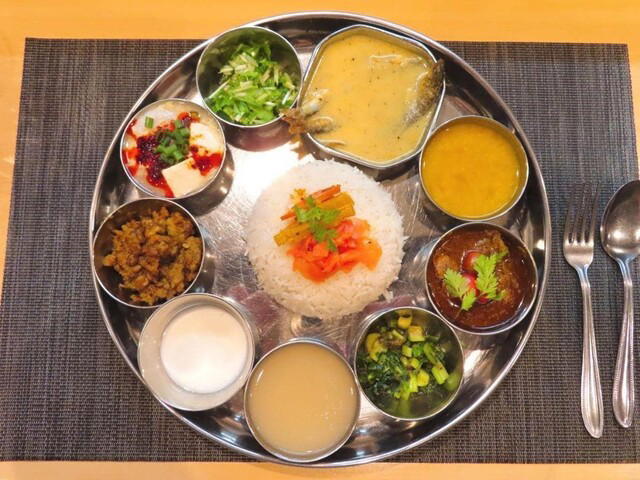
- Banana-leaf wrapped spice bento (バナナ包み弁当 / バナナリーフ弁当)
- Ezo venison vindaloo banana-leaf bento (エゾ鹿ビンダルーのバナナ包み弁当)
- Hotaru-ika spice mixed-rice banana-leaf bento (ホタルイカのスパイス混ぜご飯バナナ包み弁当)
- Seasonal assorted banana-leaf bento sets
In Osaka, the approach to a small spice restaurant says much about the dining room. Office rhythms, side-street lunch demand, and low-key rooms set a tone far from the city’s more performative eating. Spice Ryori Nallamanam fits that quieter register: compact in feeling, category-focused, and built for diners who read a menu as structure, not spectacle.
Osaka’s curry culture has long exceeded standard Japanese curry-rice. The city absorbs South Asian, Sri Lankan, and Kansai preferences, then filters them through formats for office workers, solo diners, and small groups. Here, the public categories point to spice cuisine rather than one narrow label: South Asian, Indian curry, and Sri Lankan sit together in the restaurant’s profile. The point is not authenticity theatre, but several spice traditions gathered into a format Osaka understands.
A spice plate built for Osaka's lunch grammar
The strongest way to read this restaurant is through the plate format. Osaka lunch counters reward clarity: a defined main idea, quick turnover, and enough variation for repeat visits. Spice Ryori Nallamanam uses that grammar while moving from ordinary curry expectations toward spice layering and broader South Asian vocabulary. In a city where curry can mean late-night comfort or specialist cooking, this sits in the serious middle: affordable enough for repeat eating, focused enough to matter beyond a single casual stop.
The public menu language signals a restaurant whose identity is organized around spice rather than a fixed comfort-food cliché. For Osaka diners, that matters: rice, spice, texture, and temperature must feel coherent whether the meal is quick or lingered over. For a spice specialist, that constraint reveals discipline. The appeal lies in how clearly the restaurant’s categories and price range set expectations before the first plate arrives.
Recognition has followed the format rather than a chef narrative. Spice Ryori Nallamanam is listed in the Tabelog Hyakumeiten source for 2024, with a score of 3.78 and budget guidance of Dinner: JPY 3,000 - JPY 3,999; Lunch: JPY 1,000 - JPY 1,999. That places the restaurant in a useful Osaka category for travellers: specific enough to seek out, but not dependent on luxury cues or fine-dining ceremony.
For readers mapping Osaka by category, the distinction helps. Other Osaka dining rooms may express the city through speed, nostalgia, bread, noodles, grilled food, or Western-influenced comfort. This restaurant belongs to the same city logic, but asks diners to follow spice sequencing rather than portion size or tourist shorthand.
The room rewards counter diners and small-group planning
The physical scale shapes the experience, even without turning the room into a spectacle. Spice Ryori Nallamanam works more like a small specialist address than a broad curry hall. Solo dining and small-group planning both make sense in this kind of setting, where the point is not an expansive menu for every possible appetite but a focused identity. In Osaka, modest rooms often carry stronger culinary identities because the menu need not satisfy every diner at once.
The price tier matters without turning this into a booking manual. Lunch at JPY 1,000 to JPY 1,999 and dinner at JPY 3,000 to JPY 3,999 place it below many tasting-menu counters but above the cheapest casual curry stop. That middle band matters in Osaka: repeat local demand and specialist ambition can meet without fine-dining ceremony.
Compared with in-city peers in similar spending territory, the distinction is category discipline. Yoshoku Bistro Awano occupies a Western-influenced comfort lane. Mashino Ken, Sumibi Yakitori Nakao, Yoshitora, and エニェ each point diners toward different Osaka priorities. Spice Ryori Nallamanam’s case is narrower: South Asian, Indian curry, and Sri Lankan references, presented through a small-format service model that makes the restaurant feel edited rather than expansive.
Osaka visitors building a food day should not treat spice cuisine as filler between sushi, okonomiyaki, and bars. The city’s better casual meals often sit in modest-format specialists. The planning logic that applies across other Osaka dining applies here as well: choose the venue for the format, not a generic neighbourhood box to tick.
How it fits a wider Japanese spice map
Japan’s specialist curry and spice-cooking scene is increasingly regional rather than Tokyo-dominated. Osaka has its own momentum, shaped by Japanese curry evolution, independent operators, and diners willing to treat spice cooking as a category in its own right. Comparing Spice Ryori Nallamanam with other unnamed small-format specialists around Japan is not comparing identical cuisines. The useful comparison is how each city supports focused restaurants with strong menu identities.
That frame explains why the recognition matters more than a single casual impression. Tabelog’s Hyakumeiten lists are category-based and useful for sorting crowded fields; the 2024 listing gives travellers a concrete signal without requiring a luxury narrative. The restaurant has not built its reputation on imported fine-dining language, but on a compact spice format that Japanese diners can understand through category, budget, and repeatability.
For a broader Osaka itinerary, place this meal alongside the city’s other low-friction pleasures, not against formal restaurants. Use Our full Osaka restaurants guide to map the food day, then separate after-dinner drinking through Our full Osaka bars guide. Travellers making the city a longer base can cross-check stays in Our full Osaka hotels guide, while category completists can scan Our full Osaka wineries guide and Our full Osaka experiences guide for trip elements outside restaurants.
The appeal is not that this room tries to represent all South Asian or Sri Lankan cooking in Osaka. It is that the restaurant makes a precise argument: spice can be compact, lunch-friendly, and serious without fine-dining signals. That is an Osaka kind of intelligence.
For cross-city context, EP Club readers can compare how compact Japanese and Japanese-adjacent formats travel outside Kansai through unnamed small restaurants, counters, and casual specialists. The common thread is not cuisine type, but how small formats communicate priorities quickly, then let repetition do the serious work.
Frequently asked questions
What part of town is Spice Ryori Nallamanam in?
Osaka.
What price level is Spice Ryori Nallamanam?
Pricing at Spice Ryori Nallamanam is listed as Dinner: JPY 3,000 - JPY 3,999; Lunch: JPY 1,000 - JPY 1,999.
Can I walk in to Spice Ryori Nallamanam?
Availability can vary, so diners should check directly with the restaurant before planning around a walk-in. The listed phone number is +81-6-6484-5799.
What has Spice Ryori Nallamanam built its reputation on?
Its profile rests on its 2024 Tabelog Hyakumeiten recognition, a listed score of 3.78, and its categories: South Asian, Indian curry, and Sri Lankan cooking in Osaka.
Comparison Snapshot
Comparable venues side-by-side for orientation.
| Venue | Cuisine | Price | Awards | Notes |
|---|---|---|---|---|
| Spice Ryori NallamanamThis venue (the venue you are viewing) | Modern South Asian–inspired spice curry & banana-leaf bento | $10–20 | Tabelog 100 #93 | Not listed |
| STUN.S | Innovative Japanese | $30–50 | Tabelog 100 #68 | Miyakojima |
| Meganeya | Creative Yoshoku & Wine Bar | $30–50 | Tabelog 100 #71 | Yodogawa |
| Pres | Modern standing wine bar & bistro | $30–50 | Tabelog 100 #80 | Kita |
| MAKE ONE TWO | Asian Stand Bar / Izakaya | $10–20 | Tabelog 100 #97 | Chūō |
| Chaos Spice Diner Yotsubashi amerikamura ten | Spice curry & Asian fusion dining bar | $10–20 | Tabelog 100 #14 | Nishi |
Recognition history
Dated appearances from independent guides and award organizations, with the underlying list record or original source where available.
Tabelog 100 #93 · No. 93
Tabelog · Tabelog 100 - Asian cuisine / Ethnic cuisine - WEST - 2024