
A Bib Gourmand-recognised stall on Serangoon Road, Singapore Fried Hokkien Mee delivers the braised-noodle tradition at street-food prices, with consecutive Michelin acknowledgements in 2024 and 2025. At the single-dollar price tier, it represents one of the clearest value propositions in Singapore's hawker circuit.
Pearl is the En Primeur Club membership app — saves, bookings, and concierge access live there. Same editors, same standards.
- Address
- 566 Serangoon Rd, Singapore 218181
- Website
- misstamchiak.com
- Directions
- Get directions
 Saves & bookings on Pearl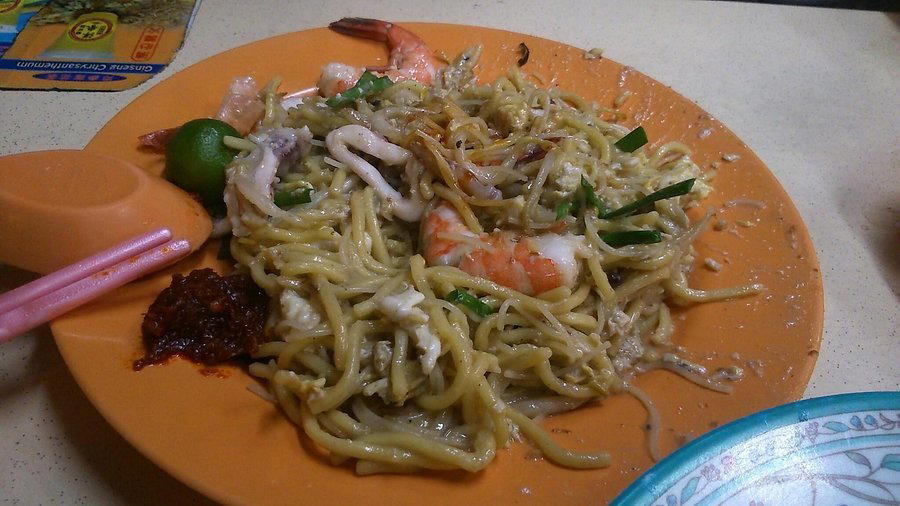
What a Dollar Buys on Serangoon Road
The footpath outside 566 Serangoon Road tells you most of what you need to know before you've ordered anything. Plastic stools, a wok sending smoke sideways, the faint brine of prawn stock settling into the air — this is hawker Singapore at its most functional. There is no menu to study, no reservation to honour, and no dress code to consider. The transaction is simple: you arrive, you queue, you eat. What makes the equation interesting is that the Michelin Guide has now recognised this stall in consecutive years, awarding the Bib Gourmand in both 2024 and 2025, which places it in a specific and meaningful category: food that delivers quality above what its price would predict.
Singapore's hawker circuit is one of the few dining environments in the world where Michelin acknowledgement and a single-dollar price point coexist without irony. The Bib Gourmand was designed precisely for this scenario, identifying places where the quality-to-cost ratio is the story. At the dollar tier, Singapore Fried Hokkien Mee sits in the same conversation as other Bib-recognised hawker stalls across the island, competing not on ceremony but on execution, consistency, and the specificity of a dish done without compromise.
The Dish in Context
Hokkien mee occupies a particular place in Singapore's noodle hierarchy. Distinct from the drier, darker Penang version — which you can compare via 888 Hokkien Mee on Lebuh Presgrave in George Town, the Singapore style is a wet, braised preparation: yellow egg noodles and thick rice vermicelli cooked in prawn-and-pork stock until the liquid is largely absorbed into the noodles rather than pooling beneath them. The result should be glossy, fragrant, and heavy with umami from the stock reduction. Sambal and calamansi on the side are standard, adjusting heat and acidity to taste.
The dish has its roots in the post-war hawker trade, when Hokkien immigrants working in the port districts cooked with the ingredients most readily available: noodles, pork lard, egg, and seafood scraps from the docks. What began as a practical, affordable meal has been refined over decades into something with clear technical markers that separate a well-executed version from a mediocre one. The quality of the prawn stock, the wok hei applied at the right moment, and the ratio of noodle types all affect the outcome in ways that are immediately legible to a regular eater.
Singapore's Bib Gourmand list is a useful map for this kind of noodle tradition. The same recognition framework that covers this stall also applies to institutions like Hill Street Tai Hwa Pork Noodle, which holds a full Michelin star, and prawn noodle specialists such as 545 Whampoa Prawn Noodles and Adam Rd Noo Cheng Big Prawn Noodle. Across these stalls, the common thread is a stock-driven cooking logic where depth comes from long reduction rather than from seasoning shortcuts.
Value as the Editorial Point
The value proposition at a dollar-tier hawker stall is almost self-evident, but it becomes more interesting when placed against the broader range of what Singapore's dining scene charges. At the leading end, tasting menus at venues like Zén or Born run into three-figure territory per head; mid-tier restaurant dining at places like Summer Pavilion or Burnt Ends sits in the $$ to $$$ bracket. The hawker tier, operating entirely outside that pricing logic, offers a different kind of argument: that Singapore's most technically specific and historically grounded dishes are not premium-priced at all. The Michelin nod to this stall is partly a confirmation of that argument.
Consecutive Bib Gourmand recognition across 2024 and 2025 also matters as a consistency signal. A single year's acknowledgement can reflect timing or an inspector's good day; two consecutive years indicates that the standard is held.
For diners who rotate through Singapore's broader noodle circuit, this stall fits naturally alongside kway teow specialists like 91 Fried Kway Teow Mee and modernised noodle formats at A Noodle Story, which takes hawker logic into a more structured restaurant setting. The Serangoon Road stall sits at the traditional end of that spectrum, where the format hasn't moved to accommodate comfort, the food has simply continued to be good enough to draw people regardless.
Comparisons extend regionally too. Street food operating in the Bib Gourmand tier across Southeast Asia, from A Pong Mae Sunee in Phuket to the noodle stalls of George Town, including Ah Boy Koay Teow Th'ng and the broader hawker tradition represented by Air Itam Sister Curry Mee, share a common characteristic: they are single-dish specialists, and the dish has been the same dish for a long time. Specialism and longevity are the proxies for quality in the absence of formal credentials, and both apply here.
Planning Your Visit
The stall is located at 566 Serangoon Rd, Singapore 218181, in a part of the city that sits between Little India and the residential Potong Pasir corridor. Serangoon Road is a functioning commercial strip rather than a tourist destination, which means that outside of meal peaks it operates at a local cadence. Arriving outside the core lunch and dinner windows is the standard advice for any hawker stall with Michelin recognition, since the queue at peak hours will extend the visit significantly.
No booking is possible or expected. Payment at the hawker tier is typically cash-first, though many Singapore stalls now accept PayNow. The dress code is whatever you'd wear to walk around Serangoon Road on a warm afternoon. This is, in operational terms, one of the most accessible dining experiences in the city, the only variable you cannot control is the queue.
For broader planning across Singapore's restaurant, hotel, bar, and experience options, see our full Singapore restaurants guide, our full Singapore hotels guide, our full Singapore bars guide, our full Singapore wineries guide, and our full Singapore experiences guide.
Quick reference: 566 Serangoon Rd, Singapore 218181 | Price tier: $ | Michelin Bib Gourmand 2024, 2025 | No booking | Cash recommended
Budget Reality Check
A small set of peers for context, based on recorded venue fields.
| Venue | Cuisine | Price | Awards |
|---|---|---|---|
| Singapore Fried Hokkien MeeThis venue — the venue you are viewing | Street Food | $ | Bib Gourmand |
| Zén | European Contemporary | $$$$ | Michelin 3 Star |
| Jaan by Kirk Westaway | British Contemporary | $$$ | Michelin 2 Star |
| Burnt Ends | Australian Barbecue, Barbecue | $$$ | Michelin 1 Star |
| Summer Pavilion | Cantonese | $$ | Michelin 1 Star |
| Born | Creative Cuisine, Innovative | $$$$ | Michelin 1 Star |
Recognition history
Dated appearances from independent guides and award organizations, with the underlying list record or original source where available.
Michelin Guide Bib Gourmand
Michelin Guide
Michelin Bib Gourmand
Michelin
Michelin Bib Gourmand
Michelin
Continue exploring
More in Singapore
Restaurants in Singapore
Browse all →
Bars in Singapore
Browse all →
At a Glance
- Classic
- Casual Hangout
- Family
- Open Kitchen
Casual hawker stall in a coffee shop with busy, no-frills atmosphere and charcoal-fired cooking.
Know Before You Go
- Getting there
- 566 Serangoon Rd, Singapore 218181