
Tabelog 100 #12
Our verdict
Shinki is a counter-only yakitori and izakaya address in Yokohama’s Noge area, selected for Tabelog’s Yakitori EAST 100 in 2025 with prior selections back to 2018. Its appeal sits in the small-format end of Japanese grilled-chicken culture: focused sourcing, skewers, drinks, and a room scaled for close attention rather than ceremony.

Pearl is the En Primeur Club membership app, where members save venues, book tables and use the concierge.
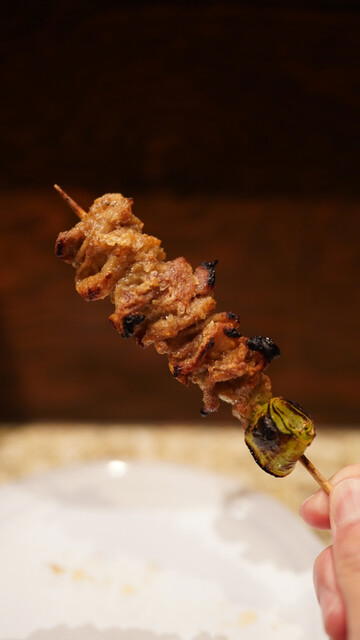
Yokohama’s eating streets work at a different tempo from the city’s waterfront dining rooms. The setting can be compact, low-lit and social, with counters that put the grill closer to the guest than the theatre of a formal dining room. In that setting, yakitori is less about luxury coding than control: the cut, the skewer, the heat, the seasoning, and the drink beside it. Shinki belongs to that counter tradition, where the cooking can define the night.
Yokohama yakitori, read through the counter rather than the menu
Yakitori’s reputation often travels badly outside Japan because the format looks simple from a distance. Chicken on skewers is only the surface. The serious version is a discipline of butchery and timing, separating different parts into distinct textures that cannot be cooked as one generic category. A small counter gives that grammar its natural stage: guests see the sequence, the grill sets the pace, and drinks act as punctuation rather than ornament.
Shinki’s category listing pairs yakitori with izakaya, which matters. In Japan, the izakaya frame gives grilled chicken a looser social function than a tasting-menu counter. Drinks sit inside the same orbit, suggesting a meal built around repeated small decisions rather than a single grand arc. For travellers building a Yokohama food map, that places it closer to the city’s drinking-and-grilling culture than to polished destination dining. For broader city context, Our full Yokohama restaurants guide is the better lens than a single-neighbourhood search.
The ingredient question is central here because yakitori exposes sourcing more directly than many cuisines. Sauces and garnishes can help, but they cannot disguise poor poultry or careless separation of cuts. Good yakitori depends on consistent chicken, clean handling, and a kitchen that understands how fat, skin and lean meat respond to grilling. That is why the format rewards focused rooms: the distance between prep, grill and guest matters, and the cooking can stay responsive rather than industrial.
The Tabelog signal puts this in a narrower competitive bracket
Tabelog Hyakumeiten recognition in 2025 is the clearest external signal attached to Shinki. In a category where many excellent counters are local rather than media-facing, that recognition is useful evidence. It does not mean the room is formal or expensive by default. It means enough Japanese diners and evaluators have treated the cooking as serious within a crowded field.
That distinction is important in Yokohama, where the city has its own hierarchy. The area supports everyday drinking rooms, value-led grills, yoshoku counters and specialist bars. Banri and Noge Highball sit in a similar casual conversation, while Sumire Yokohama ten, Yoshoku Kimura Noge ten and Hoppy Sennin occupy adjacent territory. Against that backdrop, Shinki’s yakitori recognition narrows the comparison from “where to eat in Yokohama” to “which counter justifies planning around grilled chicken.”
There is also a useful contrast with Yokohama’s broader restaurant spread. A traveller might use other Yokohama dining rooms as local reference points, then branch into Chinese, curry, ramen or old-school Western-Japanese cooking through unnamed city options. That variety is the point: Yokohama rewards category-specific choices rather than a single prestige checklist.
How to place it in a Yokohama itinerary
The strongest use case is a focused Yokohama night, not a long cross-city detour stitched awkwardly between sightseeing and late trains. The appeal lies in moving through the city toward smaller dining rooms where counters can carry more weight than signage. The format suits friends and small-party dining better than business entertaining or private-room expectations. Counter-style dining is part of the value proposition: if the grill is the subject, distance from it weakens the experience.
For visitors comparing cities, Shinki also clarifies why Japanese casual dining categories should not be flattened. A yakitori counter in Yokohama is not interchangeable with sukiyaki, charcoal seafood, cafe culture, Vietnamese cooking, curry, or Japanese drinking formats elsewhere. Each belongs to a different food grammar; yakitori’s grammar is the grill and the cut.
Yokohama planning should also account for the city beyond restaurants. A short stay can pair dinner with hotels, cocktail stops, cultural programming and regional drinking routes; those broader layers are mapped in Our full Yokohama hotels guide, Our full Yokohama bars guide, Our full Yokohama wineries guide and Our full Yokohama experiences guide. Within that larger plan, Shinki is the sort of address to choose when the evening’s priority is ingredient-led grilling at counter scale, not a broad survey of Yokohama cuisine.
Frequently asked questions
Where is Shinki located?
Shinki is located in Yokohama.
How much does it cost to eat at Shinki?
Pricing at Shinki is listed as JPY 2,000 - JPY 2,999.
Do I need a reservation for Shinki?
Reservation details are not provided here. Check the venue's official channels for the latest details.
What do critics highlight about Shinki?
The clearest recognition signal is its Tabelog Hyakumeiten listing in 2025. The format matters too: yakitori and izakaya positioning in Yokohama at JPY 2,000 - JPY 2,999.
How does Shinki handle allergies?
Those details are not published here. With yakitori and izakaya service in Yokohama, the safest approach is to check the venue's official channels for the latest details.
In Context: Similar Options
Comparable venues by category and price.
| Venue | Cuisine | Price | Awards | Notes |
|---|---|---|---|---|
| ShinkiThis venue (the venue you are viewing) | Traditional Yakitori & Izakaya Counter | $20–30 | Tabelog 100 #12 | Not listed |
| Ramen Garaku | Japanese Ramen | $10–20 | Tabelog 100 #9 | Aoba |
| TRICK (鶏喰) | Chicken-focused ramen | $10–20 | Tabelog 100 #75 | Yoshinocho |
| Rishiri Ramen Miraku (利尻らーめん 味楽) | Rishiri-Style Yaki Shoyu Ramen | $10–20 | Not listed | Kohoku-Ku |
| Sushi Tsugu | Edomae Sushi Omakase | $50–100 | Tabelog 100 #37 | Naka |
| Bashamichi Okawa | Kaiseki Japanese | $100–150 | Tabelog 100 #36 | Naka |
Recognition history
Dated appearances from independent guides and award organizations, with the underlying list record or original source where available.
Tabelog 100 #12 · No. 12
Tabelog · Tabelog 100 - Yakitori - EAST - 2025
Continue exploring
More in Yokohama
Restaurants in Yokohama
All restaurants in Yokohama →



Bars in Yokohama
Browse all →


Details
- Cozy
- Intimate
- Classic
- After Work
- Casual Hangout
- Solo
- Date Night
- Chefs Counter
- Open Kitchen
- Standalone
- Sake Program
- Beer Program
- A La Carte
- Counter Dining
- Small Plates
- Sake
- Shochu
- Beer
An intimate, counter‑only yakitori bar with just 11 seats, non‑smoking, and a classic Noge hideout feel—buzzy and lively during service but still personal thanks to the close interaction with the chef over the grill.