Shin


1 Michelin Star · Falstaff Restaurant - 92 Falstaff Points
Our verdict
Eight seats, eight courses, one counter: Shin operates at a scale that Zurich's broader restaurant circuit rarely attempts. The kitchen draws on Asian technique with a clear emphasis on seafood, working with seasonal ingredients to produce a concise set menu. Bookings fill fast, Tuesday is the only dark night, and the Münsterhof address puts you steps from the Limmat.

Pearl is the En Primeur Club membership app, where members save venues, book tables and use the concierge.
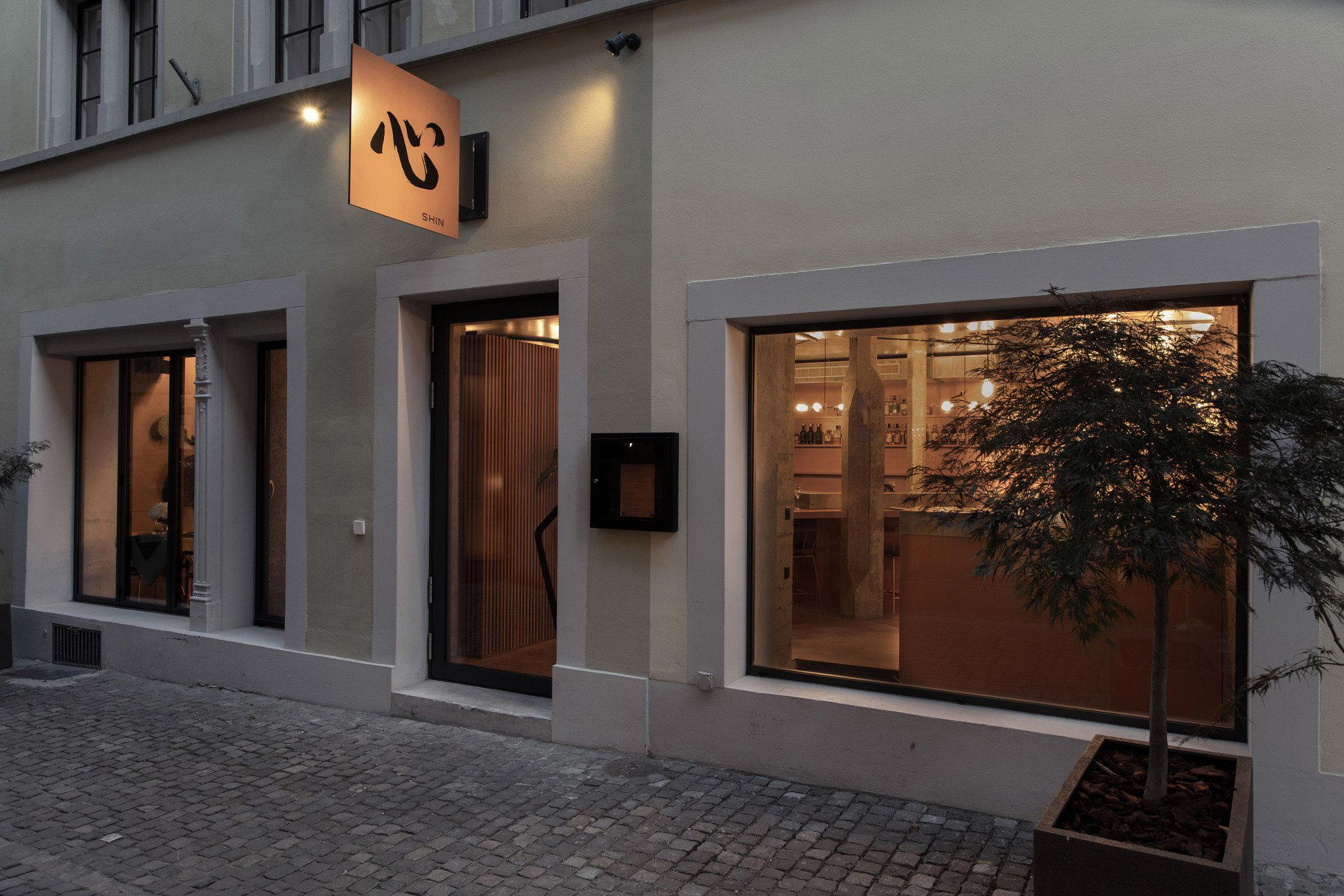
Zinnengasse is the kind of side street that Zurich's old town specialises in: narrow, stone-paved, easy to walk past without registering it. The Münsterhof square sits at one end, the River Limmat a short stroll beyond that. It is into this compressed urban geography that Shin fits eight seats, a counter, and an eight-course set menu built around Asian technique and seasonal European produce. The format is not unique to the city, but it is rare enough at this scale that the booking pressure is immediate and sustained.
Counter Dining in Zurich: What the Format Signals
Counter dining in the Asian tradition carries a specific set of expectations: close sight lines to the kitchen, a fixed progression rather than a menu to negotiate, and a format in which the host or chef controls pace. When capacity is capped at eight, the experience is structurally different from a thirty-cover tasting menu room: there is no ambient hum from other tables, no parallel service to dilute the attention, and the choice of who sits there on a given night shapes the mood of the room entirely.
Globally, counters of this scale have become a preferred format for kitchens that want ingredient quality and technique to do the work without the production overhead of a large brigade. The model is well established in Tokyo and has spread through Copenhagen, New York, and London. In Switzerland, it remains a less common configuration. The country's tasting-menu restaurants tend to operate in grander architectural settings, consider Schloss Schauenstein in Fürstenau or Hotel de Ville Crissier in Crissier, where the room itself is part of the proposition. Shin inverts that logic: the room recedes, the counter and the food come forward.
Asian Technique, European Seasonality
The editorial angle that applies most precisely to Shin is the intersection of imported method and local product. Asian culinary traditions, whether Japanese knife discipline, Korean fermentation logic, or Chinese high-heat wok technique, are not deployed as decorative reference here. The eight-course set menu takes its cue from the seasons, which in Switzerland means a procurement calendar anchored in Alpine and Central European produce even when the cooking grammar is Asian. This is not fusion in the slippery marketing sense; it is a technical approach applied to whatever is good at the time of year.
The seafood emphasis is consistent across the menu. Oysters, langoustine, and similar produce appear in formats that suggest careful sourcing rather than commodity purchasing. Dishes like a golden garlic oyster with a hint of chilli, or a langoustine broth built around corn, sit in a register where balance and restraint carry more weight than volume or richness. Peking duck appears as a more familiar reference point, a dish with a long, codified tradition that arrives here in a context shaped by the eight-course arc rather than a standalone banquet format.
Beverage programme includes sake alongside wine and alcohol-free options. The sake choice is a signal worth reading: it indicates a kitchen that considers the pairing logic from within the Asian frame, not just as a wine-adjacent addition. Sake's umami alignment with seafood-led menus is well documented; including it suggests the kitchen is thinking about harmony across the full progression, not only on the plate.
Hostess, Pacing, and the Architecture of the Evening
At eight covers, the front-of-house operation is necessarily intimate. Hostess Lin Wang manages both the pace and the explanation of dishes and ingredients, a role that in this format carries more weight than a conventional floor manager position. When the counter is the only surface and the menu is fixed, the person mediating between kitchen and guest shapes the entire texture of the evening. At larger restaurants like The Restaurant or Widder, that mediation is distributed across a team. Here, it concentrates.
The two-sitting format (Wednesday through Monday, 6 PM to 11 PM, with Tuesday as the dark night) means the kitchen turns the eight seats twice in an evening. Each sitting is therefore a self-contained event with a defined beginning, middle, and end. The compressed capacity and the fixed menu mean that any deviation, an early arrival, a late cancellation, ripples through the room in a way that a fifty-cover restaurant would absorb without difficulty. Book early, confirm, and arrive on time. These are not suggestions shaped by etiquette; they are structural requirements of the format.
Where Shin Sits in the Zurich Dining Circuit
Zurich's leading end has diversified over the past decade. The traditional Swiss fine-dining model, classical technique, substantial portion architecture, wine lists built around Bordeaux and Burgundy, coexists with a newer wave of smaller, technique-led operations that draw on non-European culinary traditions. Eden Kitchen and Bar operates at a similar price point with an Italian orientation; the comparison illuminates how the city's €€€€ tier now spans a wide range of culinary philosophies rather than converging on a single model.
For context beyond Zurich, the counter-plus-Asian-technique format has reached a high level of recognition elsewhere. Atomix in New York City runs a tasting counter with Korean-influenced technique and has held two Michelin stars; Le Bernardin in New York City built its reputation on French seafood technique and still holds three. Both sit in a tradition of counter-adjacent, ingredient-led tasting formats where the kitchen's point of view is non-negotiable. Shin operates at a much smaller scale, but the structural logic is continuous with that tier. Elsewhere in Switzerland, Memories in Bad Ragaz, Cheval Blanc by Peter Knogl in Basel, Colonnade in Lucerne, and 7132 Silver in Vals represent the broader Swiss ambition in tasting formats, most of them operating in more conventionally grand settings than a side-street counter in the old town.
Planning Your Visit
Shin is at Zinnengasse 7, 8001 Zürich, in the old town adjacent to Münsterhof square. The River Limmat is within easy walking distance, and the neighbourhood rewards time before or after dinner. Service runs Wednesday through Monday, 6 PM to 11 PM, in two sittings; Tuesday is closed. The eight-seat capacity makes advance booking non-optional, the restaurant operates at full capacity as a matter of design, and a walk-in approach will not work here. The €€€€ price tier places it at the top of Zurich's restaurant spectrum, in line with the fixed-menu format and ingredient quality. The beverage programme spans sake, wine, and alcohol-free options, giving flexibility without undermining the pairing logic. For a broader survey of Zurich's dining, hotel, bar, winery, and experience options, the full EP Club guides cover the city in depth: our full Zurich restaurants guide, our full Zurich hotels guide, our full Zurich bars guide, our full Zurich wineries guide, and our full Zurich experiences guide.
Frequently asked questions
What do regulars order at Shin?
The menu is set, so the choice is not about individual dishes, it is about which sitting to book and whether to pair with sake, wine, or alcohol-free options. Regulars who know the format tend to lean into the seafood progression: the oyster and langoustine courses are consistent reference points in the eight-course arc, and the Peking duck arrival mid-or-late sequence functions as a pivot toward richer, more textured territory. Engaging with Lin Wang's explanations of ingredients and technique is part of the return visit logic; the context she provides changes how the dishes read.
What makes Shin worth seeking out?
The Michelin Guide has flagged Shin specifically, citing the counter format, the seasonal eight-course structure, the seafood emphasis, and the quality of ingredients. In Zurich's €€€€ tier, that recognition places it in a competitive set where format discipline and sourcing rigour carry as much weight as cooking technique. The eight-seat limit means the kitchen is never running at a scale that compromises attention. Whether that proposition suits a given traveller depends on appetite for fixed-format dining and tolerance for a booking window that requires planning ahead, but for those who engage with the counter tradition, the format here is applied with evident seriousness.
Comparison Snapshot
A small set of peers for context, based on recorded venue fields.
| Venue | Cuisine | Price | Awards | Notes |
|---|---|---|---|---|
| ShinThis venue (the venue you are viewing) | Michelin-Starred Japanese Omakase | $300–500 | 1 Michelin Star · Falstaff Restaurant - 92 Falstaff Points | Not listed |
| IGNIV Zürich by Andreas Caminada | Modern Swiss Fusion Sharing | $150–200 | 2 Michelin Stars · La Liste Top Restaurants | Sharing |
| KLE | Modern Vegan Fine Dining | $100–150 | 1 Michelin Star · The Best Chef One Knife | Vegan |
| Kronenhalle | Classic Swiss Fine Dining | $100–150 | Michelin Plate · World's 50 Best #32 | Swiss, Traditional Cuisine |
| The Counter | Modern Cosmopolitan Omakase with East Asian Influences | $300–500 | 2 Michelin Stars · La Liste Top Restaurants | Creative |
| Eden Kitchen & Bar | Mediterranean-Italian | $100–150 | 1 Michelin Star · Falstaff Bar - 94 Falstaff Points | Italian |
Recognition history
Dated appearances from independent guides and award organizations, with the underlying list record or original source where available.
Michelin 1 Star
Michelin
Falstaff Restaurant - 92 Falstaff Points
Falstaff
Shin
Featured Guides
Continue exploring
More in Zürich
Restaurants in Zürich
All restaurants in Zürich →
Bars in Zürich
All bars in Zürich →

Details
- Intimate
- Elegant
- Sophisticated
- Modern
- Date Night
- Special Occasion
- Chefs Counter
- Open Kitchen
- Sake Program
- Extensive Wine List
- Omakase
- Counter Dining
- Sake
- Wine
Current opening hours
- Monday
- 6–11 PM
- Tuesday
- Closed
- Wednesday
- 6–11 PM
- Thursday
- 6–11 PM
- Friday
- 6–11 PM
- Saturday
- 6–11 PM
- Sunday
- 6–11 PM
Hours can change for holidays and private events. Hours as of .
Sophisticated yet informal counter seating with a focus on intimate, personalized service and direct chef interaction.