DAR


DAR brings Spanish-Moroccan plant-based cooking to Zurich's Kreis 4, where Chef Zineb Hattab's sharing menu puts vegetables and dairy at the centre of the table. Two consecutive Michelin Bib Gourmand awards signal quality at a price point that undercuts most of its Zurich peers. The bread alone justifies the trip; the small menu means every dish counts.
Pearl is the En Primeur Club membership app — saves, bookings, and concierge access live there. Same editors, same standards.
- Address
- Weststrasse 20, 8003 Zürich, Switzerland
- Phone
- +41 44 548 80 50
- Website
- restaurantdar.com
- Directions
- Get directions
 Saves & bookings on Pearl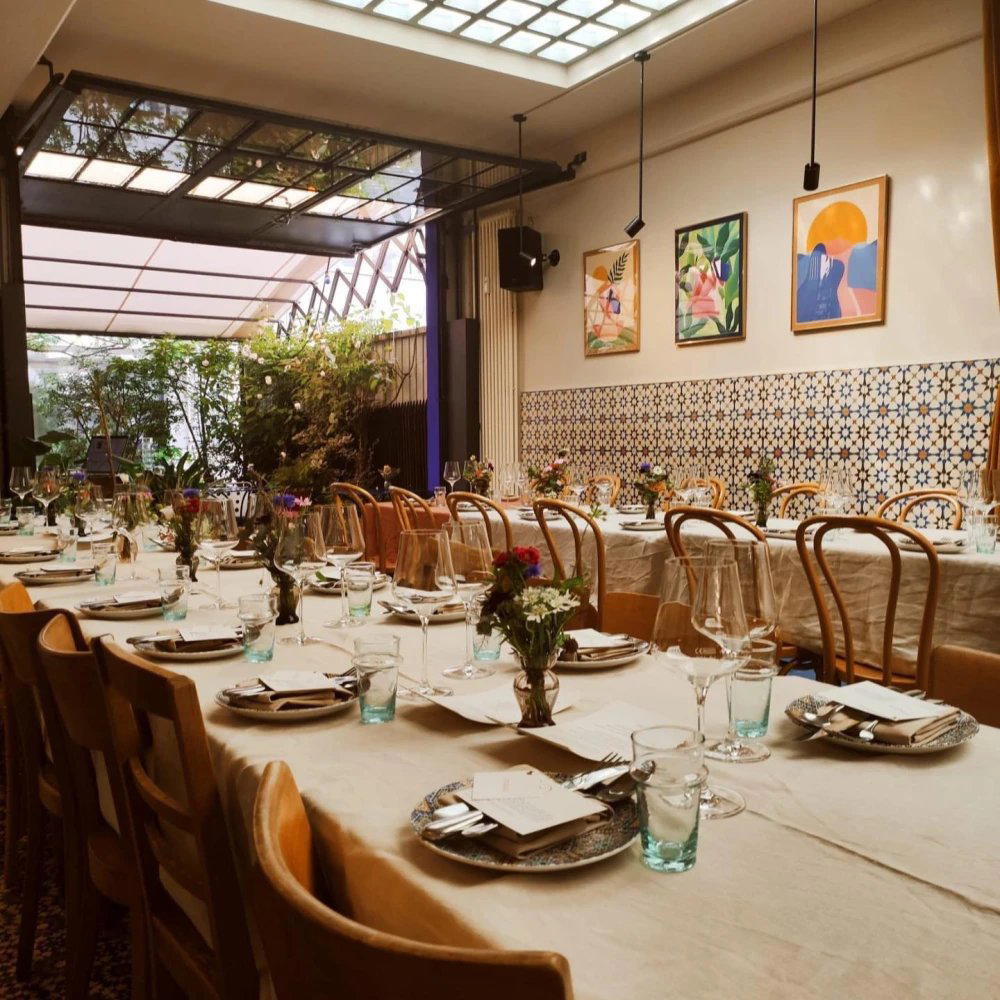
Where Kreis 4 Meets the Vegetable-Forward Kitchen
Weststrasse cuts through one of Zurich's most densely inhabited and culinarily active districts, Kreis 4, where kebab counters, wine bars, and neighbourhood trattorias share the same pavement. It is a restaurant in Zurich, in the Kreis 4 district, known for its modern Moroccan-Spanish vegan fusion cooking. The area's unpretentiousness creates the conditions for a particular kind of hospitality: no-theatre, no white-tablecloth distance, just food that has a clear point of view and a room that lets it speak. DAR lands squarely in that register, operating at a price tier, priced at about €60 per person, which sits below many Michelin-recognised addresses in Zurich.
The format is sharing plates, which in Zurich's current dining scene has become a dividing line between two different experiences. At IGNIV Zürich by Andreas Caminada, sharing sits within a €€€€ bracket and functions as a luxury format. At DAR, the same structure serves a more communal, less ceremonial purpose: the table is the organising principle, the food arrives when it is ready, and the interaction is direct. The contrast matters because it shows how much a single format can diverge depending on its price tier, neighbourhood, and culinary direction.
The Source Question: What Spanish-Moroccan Plant-Based Cooking Actually Means Here
Plant-based menus occupy a contested position in serious dining. In cities where the category has matured, the argument has shifted from what the kitchen excludes to what it builds: the sourcing decisions, the flavour development, and the cultural frameworks that make a vegetable-forward menu feel like a cuisine rather than a constraint. DAR's approach, shaped by Chef Zineb Hattab's Spanish-Moroccan culinary reference points, draws on two traditions that have long treated vegetables as primary rather than supplementary.
Moroccan cooking, in its classical form, relies on spice combinations, slow-cooked pulses, preserved citrus, and fermented dairy in ways that generate deep, layered flavour without protein-as-anchor. Spanish vegetable cookery, particularly from the south, brings direct heat, olive oil discipline, and a long tradition of market-driven menus where the ingredient available on a given Tuesday determines what is cooked. Together, these influences create a sourcing logic that is produce-first by design, not by restriction. The vegetables are not substituting for something else; they are the dish.
This distinction separates DAR from the wider plant-based category in Zurich and positions it differently from KLE, which operates at the €€€ tier and approaches vegan cooking through a more European fine-dining lens. The cultural source material at DAR is specific enough to give the menu an identity that is not simply defined by what it omits. Dairy is incorporated where it belongs within those traditions, and 100% plant options remain available for those who require them, making the menu structurally inclusive without compromising its culinary logic.
Bib Gourmand, Two Years Running: What the Award Actually Says
Michelin's Bib Gourmand designation, awarded to DAR in both 2024 and 2025, recognises restaurants offering cooking of notable quality at a price point below the starred category. The back-to-back recognition matters not just as a signal of consistency but as a statement about where good-value cooking sits in Zurich's dining hierarchy. The city's upper end, represented by addresses like The Restaurant and The Counter at the €€€€ tier, is well-documented. The middle tier, where serious cooking meets accessible pricing, is thinner.
DAR has also been noted by We're Smart for its no-nonsense approach and sharing format. That recognition places DAR among Zurich's more distinctive value-driven, ingredient-led restaurants.
Across Switzerland, plant-forward dining still tends to sit beside more classical or creative European frameworks. DAR's positioning as a Bib Gourmand in a category those kitchens largely do not occupy makes it notable within the Swiss context specifically.
The Bread: Why One Item Signals the Rest
Among the details that emerge consistently from accounts of eating at DAR, the bread draws particular attention. In a sharing format built around Spanish-Moroccan reference points, bread functions as both a structural and cultural anchor: it is the element that ties Moroccan table tradition, where bread is present throughout a meal rather than as an opening gesture, to a menu designed for communal eating. When a restaurant's bread is specifically flagged by the We're Smart guide as a reason to visit, it is usually because the kitchen treats it as part of the cooking rather than as a given. The small menu philosophy at DAR reinforces this: fewer dishes mean each element carries more weight, and nothing arrives by default.
DAR in the Context of Zurich's Vegetable-Forward Moment
Zurich's plant-based restaurant scene has developed steadily over the past decade, moving from health-focused cafes toward more cooking-serious formats. Marktküche represents a parallel strand of market-driven vegetable cooking in the city. Internationally, the category now includes Michelin-starred references: Légume in Seoul and Plates London both demonstrate that plant-based cooking can operate credibly at the upper end of the recognition spectrum. DAR's Bib Gourmand places it within that broader shift without overstating its position: it is a neighbourhood restaurant with a clear culinary identity, consistent recognition, and a price point that makes it one of the more accessible entries in Zurich's Michelin-acknowledged dining.
Spring and early summer are particularly natural months for this kitchen's market-driven cooking. Asparagus, spring onions, broad beans, and early courgettes occupy the same seasonal position across both culinary geographies, and a kitchen structured around produce-first logic will reflect that availability directly in what appears on the small menu. It is the period most likely to show the kitchen's sourcing approach at its most direct.
Planning Your Visit
DAR sits at Weststrasse 20 in Zurich's Kreis 4. A meal here is about $60 per person. The small menu changes with the market, so flexibility helps. For fine-dining context elsewhere in Switzerland, Hotel de Ville Crissier, Cheval Blanc by Peter Knogl in Basel, 7132 Silver in Vals, and Colonnade in Lucerne represent the country's upper tier across different regions.
Comparable Options
Comparable venues nearby, for context on price, style, and recognition.
| Venue | Cuisine | Price | Notes |
|---|---|---|---|
| DARThis venue — the venue you are viewing | Modern Moroccan-Spanish Vegan Fusion | $$$ | Not listed |
| Didi's Frieden | Authentic Swiss Classic | $$$ | Oberstrass |
| Bianchi | Italian Seafood | $$$ | Oberstrass |
| Barranco | Modern Peruvian Fusion | $$$ | Aussersihl |
| blooms | Seasonal Vegan Fine Dining | $$$ | Sonnenberg |
| Lindenhofkeller | Modern Seasonal Swiss-German Fine Dining | $$$$ | Enge |
Recognition history
Dated appearances from independent guides and award organizations, with the underlying list record or original source where available.
Michelin Bib Gourmand
Michelin
We're Smart World 3 Radishes
We're Smart World
Michelin Bib Gourmand
Michelin
Continue exploring
More in Zürich
Restaurants in Zürich
Browse all →
Bars in Zürich
Browse all →
Hotels in Zürich
Browse all →

At a Glance
- Trendy
- Cozy
- Modern
- Lively
- Special Occasion
- Brunch
- Date Night
- Open Kitchen
- Craft Cocktails
- Local Sourcing
Current opening hours
- Monday
- Closed
- Tuesday
- Closed
- Wednesday
- 9 AM–11 PM
- Thursday
- 9 AM–11 PM
- Friday
- 9 AM–11 PM
- Saturday
- 10 AM–11 PM
- Sunday
- 10 AM–9 PM
Hours can change for holidays and private events. Last verified .
Warm, colorful Moroccan-style decor with cheerful, relaxed, and busy atmosphere.