Tabelog 100 #68
Our verdict
Tokyo’s yoshoku tradition often rewards restraint over spectacle: Western-derived comfort dishes filtered through Japanese timing, portions, and sauce work. Shichijo, a Mitaka counter-and-table room selected for Tabelog 100 Yoshoku EAST 2025, sits in the small-format end of that category, with accessible pricing and a suburban address that changes the usual central-Tokyo dining calculation.

Pearl is the En Primeur Club membership app, where members save venues, book tables and use the concierge.
The menu
What to order
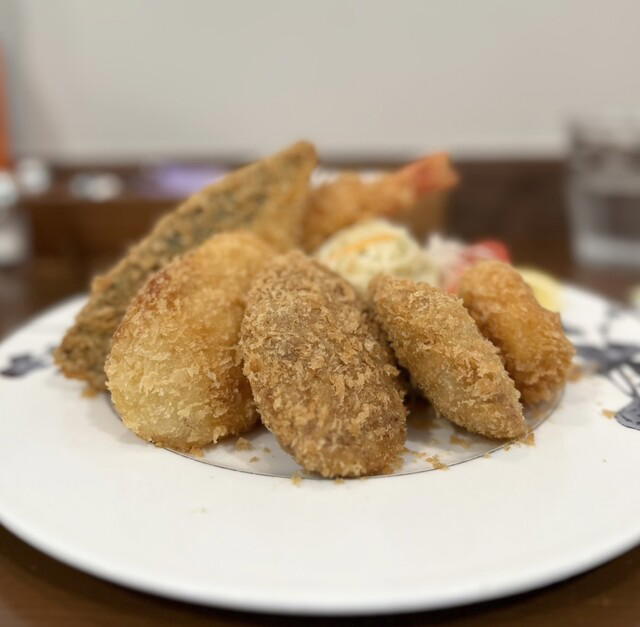
- Fried shrimp
- Fried oysters
- Horse mackerel curry flavor
- Appetizer platter
The approach to Shichijo in Tokyo differs from the entrance ritual at the city’s more formal dining rooms. The tempo is modest, the experience feels focused, and the promise is less ceremony than execution: Japanese-style Western cooking presented without unnecessary theatre. Shichijo belongs to the Tokyo category where food looks approachable on paper but depends on details that separate serious yoshoku from nostalgia dressed up for tourists.
Yoshoku has always been translation. Familiar Western-influenced forms entered Japan through outside contact, then became domestic food with their own rules. The serious version is not fusion for novelty. It is frying temperature, sauce reduction, rice texture, portion discipline, and making a familiar form feel composed without making it precious. That is the context here.
Tokyo yoshoku, judged by execution rather than theatre
Tokyo’s dining map pushes visitors toward omakase counters, kappo rooms, and hotel restaurants, but everyday excellence is not limited to luxury formats. Shichijo rewards diners willing to take yoshoku seriously on its own terms. In that sense, selection for Tabelog Hyakumeiten 2025 is useful evidence. The recognition is category-specific, placing the room against other yoshoku specialists rather than sushi, French, or ramen venues with different expectations.
The price signal matters too. A listed range of JPY 1,000 to JPY 1,999 for both lunch and dinner puts the experience in a radically different bracket from Tokyo’s high-end counters. Among comparison venues, names such as Ramen Sukoyaka show how Tokyo’s credible food map extends well beyond luxury dining, while other Tokyo dining can sit far higher. That spread says something about the city: credibility is not confined to expensive formats. A yoshoku specialist can draw attention through consistency and category fluency rather than luxury cues.
The appeal of the format reinforces that reading. Yoshoku works best when the kitchen’s timing is visible in the food itself: frying, saucing, plating, and handoffs need rhythm even when the dishes appear humble. The point is not grandeur. The point is watching familiar Japanese-Western forms handled with precision, restraint, and enough confidence to avoid overcomplication.
Where wine thinking fits a Japanese-Western kitchen
Assigned lens here is wine, and yoshoku is instructive because the food sits between bistro logic and Japanese restraint. Sauces, fried coatings, egg, rice, and meat-led preparations can take more structure than many washoku dishes, yet portions and seasoning rarely demand a heavy-handed pairing program. In Tokyo, persuasive beverage choices around yoshoku tend to work like the cooking: practical, food-led, and uninterested in grandstanding.
That makes the category more revealing than any unsupported claim about cellar depth. A serious yoshoku kitchen does not need a trophy list to reward a wine-minded diner. The relevant question is balance: acidity for fried dishes, moderate tannin for richer sauces, texture for egg and cream-leaning preparations, and restraint when rice is part of the plate. Japanese-Western cooking differs from old-school European dining here. The plate may borrow Western forms, but the meal structure remains Japanese in pacing and appetite.
For a traveler building a Tokyo food itinerary, this stop works as a counterweight to formal reservations. It shows how the city absorbs foreign technique and domesticates it without pastiche. The same itinerary might include other seafood rooms, grill formats, high-density city dining, skewer counters, visual café culture, and curry specialists elsewhere in Tokyo. The point is contrast: Tokyo’s range is clearer when humble categories are treated as seriously as luxury ones.
The case for a focused stop outside the hotel circuit
Shichijo’s 2025 category recognition places it within a competitive field for Japanese-style Western cuisine. The Tabelog score of 3.66 adds another public signal, though the stronger editorial point is the combination of recognition, category, and price. Many Tokyo restaurants ask visitors to plan around scarcity and status; this one asks whether a diner values category clarity enough to look beyond the usual luxury cues.
The practical profile suits that decision. The public listing gives Shichijo as a yoshoku restaurant in Tokyo, with lunch and dinner both listed at JPY 1,000 to JPY 1,999. Its published phone contact is +81-422-24-8375. Beyond that, operational details should be checked directly with the venue, because restaurants can adjust hours, booking policies, and service conditions without much warning.
For readers mapping a broader trip, Our full Tokyo restaurants guide gives the citywide dining frame, while Our full Tokyo hotels guide, Our full Tokyo bars guide, Our full Tokyo wineries guide, and Our full Tokyo experiences guide help separate a food-led day from a hotel-led one. Regional contrasts sharpen the picture further through unnamed examples of beef cookery, café culture, contemporary regional dining, Vietnamese cooking, curry, Kyoto dining, and Japanese drinking culture abroad.
The editorial verdict is simple: this is not the Tokyo meal for spectacle hunters. It suits diners who want to understand yoshoku as a living urban tradition, not a retro category. The evidence is compact but meaningful: Tabelog Hyakumeiten 2025 selection, a 3.66 score, accessible listed pricing, and a Tokyo setting outside the usual luxury shorthand.
Frequently asked questions
What's the price range at Shichijo?
Pricing at Shichijo is listed as JPY 1,000 - JPY 1,999 JPY 1,000 - JPY 1,999.
Where exactly is Shichijo?
Tokyo.
What's the best way to book Shichijo?
The public record lists a phone number, +81-422-24-8375. Check the venue's official channels for the latest booking details.
What's the defining dish or idea at Shichijo?
The defining idea is yoshoku, or Japanese-style western cuisine, rather than a narrow tasting-menu format. That positioning is reinforced by its 2025 Tabelog Hyakumeiten selection for yoshoku.
Is Shichijo good for vegetarians?
The provided data does not list a vegetarian menu, so Shichijo should be treated as a case-by-case choice rather than an automatic fit. Its yoshoku format makes it worth asking directly about plant-forward options before visiting.
A Minimal
Comparable venues at a glance for context.
| Venue | Cuisine | Price | Awards | Notes |
|---|---|---|---|---|
| ShichijoThis venue (the venue you are viewing) | Japanese-style Western (Yoshoku) | $20–30 | Tabelog 100 #68 | Not listed |
| Ganso Stamina Manten Ramen Suzuki | Stamina-style ramen & soba | $10–20 | Tabelog 100 #5 | JPY 999 |
| Ramen Sukoyaka | Modern Clam-Focused Ramen & Tsukemen | $10–20 | Tabelog 100 #37 | JPY 1,000 - JPY 1,999 JPY 1,000 - JPY 1,999 |
| Yakitori Yamamoto | Modern Yakitori & Warm Sake | $50–100 | Tabelog 100 #96 | JPY 8,000 - JPY 9,999 |
| Gyoza no Harbin | Casual Chinese Dumpling Shop | $1–10 | Tabelog 100 #24 | JPY 2,000 - JPY 2,999 - JPY 999 |
| Udon Stand Gozu | Casual Udon Stand | $10–20 | Tabelog 100 #36 | JPY 2,000 - JPY 2,999 - JPY 999 |
Recognition history
Dated appearances from independent guides and award organizations, with the underlying list record or original source where available.
Tabelog 100 #68 · No. 68
Tabelog · Tabelog 100 - Yoshoku - EAST - 2025