
Tabelog 100 #62
Our verdict
SERENDIB places Sri Lankan curry inside Tokyo’s serious casual-dining tier, where a compact room, counter seating, and Tabelog 100 recognition matter more than formality. In Kuramae, it offers a low-cost, tightly sequenced meal with vegetarian options, take-out, and a format that rewards early planning, especially at lunch.

Pearl is the En Primeur Club membership app, where members save venues, book tables and use the concierge.
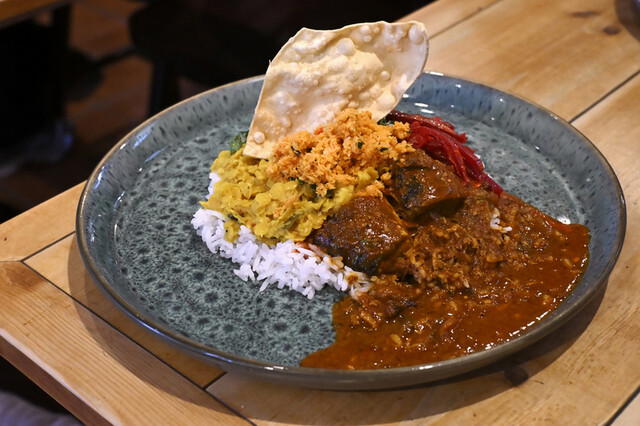
The menu
What to order
- Sri Lankan rice and curry plate
- Fish curry
- Dal (lentil) curry
- Beetroot curry
- Kale sambol
Tokyo’s restaurant rhythm can be quieter than the city’s counter theatre or late-night density. Around SERENDIB, the mood can be read through everyday dining rather than spectacle: small-scale meals, quick decisions, and restaurants where the format shapes the experience before the first plate. SERENDIB fits this side of Tokyo. With a Sri Lankan and curry focus, it sits in a practical, spice-led register rather than a long tasting-menu procession.
Tokyo’s curry culture is broad enough to make “curry” almost meaningless without context. Japanese curry shops, South Asian lunch counters, spice-curry specialists, and regional kitchens all compete for the same midday appetite. Sri Lankan cooking occupies a sharper lane: rice-led, vegetable-aware, and often structured around contrast rather than one uniform sauce. SERENDIB’s listing as Sri Lankan and curry places it where the meal can be understood as a sequence of elements, not just as a single bowl.
Sri Lankan curry in Tokyo, paced as a compact progression
The useful way to read a meal here is through order and accumulation. Sri Lankan curry dining often depends on controlled collision: grains, curries, bright condiments, vegetables, and spice elements working across a plate. That differs from the thick, sweet, roux-based grammar many travellers associate with Japanese curry. In Tokyo, the distinction matters because curry is both everyday food and a specialist category. Other Tokyo curry rooms sit in separate curry conversations, while SERENDIB belongs to the Sri Lankan and curry bracket recognised by Tabelog Hyakumeiten in 2024.
That award context is useful, not decorative. Tabelog’s recognition gathers restaurants across crowded city categories, so inclusion signals performance within a competitive dining field rather than dominance over one narrow style. The 3.65 Tabelog score puts SERENDIB in the serious local-attention zone for casual dining, especially against a price band of JPY 1,000 to JPY 1,999 at lunch and JPY 2,000 to JPY 2,999 at dinner. The economics are part of the appeal: not luxury dining disguised as spice culture, but a focused, affordable table with enough recognition to plan around.
Format affects tempo, particularly when curry is tied to everyday lunch and dinner patterns. The style suits diners who want a direct meal rather than a ceremonial one, and the arc stays close to the restaurant’s listed category: Sri Lankan and curry. In a city where premium dining often signals scarcity through months-long reservation cycles, this is a more practical kind of planning: confirm current service details, then treat the meal as a focused stop rather than an elaborate production.
Tokyo gives the meal a different city frame
Tokyo is useful for travellers who want serious food without spending the day inside department-store restaurant floors or hotel districts. Its dining character mixes coffee, bakeries, old-school local rooms, casual specialists, and small international kitchens. Comparison helps: Tonkatsu Sugita belongs to the city’s deep fried-pork tradition; Pelican and Pelican Cafe point to bread-and-cafe gravity; Ramen Kai reflects ramen’s daily role; McLean -old burger stand- shows how Western casual formats have settled into the city. Against that field, SERENDIB adds regional South Asian cooking to a city many visitors know for craft retail, coffee, and walks between meals.
The location also counters Tokyo itineraries over-concentrated on sushi, yakitori, and wagyu. A day can move through the city into curry without turning dinner into an event. For broader food mapping, nearby and citywide references matter: other casual Japanese dining covers a different register, other yakitori rooms speak to skewered chicken craft, and other nightlife areas return the itinerary to a denser evening mood. SERENDIB works because it does not compete with those formats on spectacle; it competes on specificity.
Tokyo’s international-cuisine scene is strongest when it stops explaining itself to tourists. The better casual specialists are operationally disciplined and priced for repeat local use. SERENDIB’s listed price range keeps the format legible without changing the dining style. This is a low-friction meal, not a careless one.
Know Before You Go
- Format: Sri Lankan and curry restaurant in Tokyo.
- Recognition: Listed with Tabelog Hyakumeiten recognition for 2024; Tabelog score 3.65.
- Budget: Lunch is listed at JPY 1,000 to JPY 1,999; dinner at JPY 2,000 to JPY 2,999.
- Timing: Check current opening details before going, as restaurants can adjust service.
- Access: SERENDIB is in Tokyo.
- Practical fit: Best planned as a focused Sri Lankan and curry stop rather than a long-form destination meal.
- Dietary angle: The Sri Lankan and curry focus makes rice, spice, and vegetable elements central to the way many diners will read the meal.
- Planning links: For a wider city edit, see Our full Tokyo restaurants guide, plus Our full Tokyo hotels guide, Our full Tokyo bars guide, Our full Tokyo wineries guide, and Our full Tokyo experiences guide.
For travellers building a Japan food route beyond Tokyo, the useful comparison is category discipline rather than cuisine match. Other small-format dining rooms in Japan can define a trip more sharply than a grand reservation. Further afield, diaspora cooking can make the same point in another form: specificity beats breadth when the meal has a clear grammar.
Frequently asked questions
Is SERENDIB better for a quiet night or a lively one?
SERENDIB is best framed as a focused Sri Lankan and curry meal in Tokyo, with dinner listed at JPY 2,000–JPY 2,999.
Is SERENDIB more mid-range or high-end?
Pricing at SERENDIB is listed as JPY 2,000 - JPY 2,999 for dinner and JPY 1,000 - JPY 1,999 for lunch.
Where is SERENDIB located?
Tokyo.
Can I walk in to SERENDIB?
Check current booking and service details before going. SERENDIB is in Tokyo, and restaurants can adjust availability depending on the day.
Just the Basics
Comparable options at the same price tier.
| Venue | Cuisine | Price | Awards | Notes |
|---|---|---|---|---|
| SERENDIBThis venue (the venue you are viewing) | Sri Lankan Restaurant & Bar | $10–20 | Tabelog 100 #62 | Not listed |
| Tonkatsu Sugita | Tonkatsu | $20–30 | Tabelog 100 #100 | Not listed |
| Pelican Cafe | Not listed | $10–20 | Tabelog 100 #1 | JPY 1,000 - JPY 1,999 JPY 1,000 - JPY 1,999 |
| Ramen Kai | Clam-focused Japanese ramen | $10–20 | Tabelog 100 #64 | JPY 1,000 - JPY 1,999 JPY 1,000 - JPY 1,999 |
| Pelican | Traditional Tokyo shokupan bakery | $1–10 | Tabelog 100 #60 | JPY 999 - JPY 999 View spending breakdown |
| McLean -old burger stand- | Classic American-style burger stand | $20–30 | Tabelog 100 #82 | JPY 2,000 - JPY 2,999 JPY 1,000 - JPY 1,999 |
Recognition history
Dated appearances from independent guides and award organizations, with the underlying list record or original source where available.
Tabelog 100 #62 · No. 62
Tabelog · Tabelog 100 - Asian cuisine / Ethnic cuisine - TOKYO - 2024
Continue exploring
More in Tokyo
Restaurants in Tokyo
All restaurants in Tokyo →

Bars in Tokyo
All bars in Tokyo →






Details
- Cozy
- Intimate
- Casual Hangout
- Solo
- After Work
- Group Dining
- Standalone
- Local Sourcing
- A La Carte
- Set Menu
- Arrack
- Tea
- Vegetarian Friendly
A small, cozy neighborhood Sri Lankan restaurant and bar with a relaxed, casual feel, where guests enjoy homestyle curry plates in an intimate 17-seat space.