Selvatico

Michelin Plate
Our verdict
Operating since 1912 and now in its fourth generation, Selvatico is one of the most consistent addresses in the Oltrepò Pavese, holding the Michelin Plate in both 2024 and 2025. The kitchen anchors itself in the area's agricultural traditions: charcuterie, braised and boiled meats, and fresh pasta made in-house. Guestrooms with the same lived-in character as the dining room make it a practical base for exploring the wider region.

Pearl is the En Primeur Club membership app, where members save venues, book tables and use the concierge.
The menu
What to order
- Malfatti di erbette
- Taglierini con zafferano e tartufo
- Cod with raisins
Where the Oltrepò Pavese Comes to the Table
Approach Rivanazzano Terme from the vine-covered hills that separate the Po plain from the Ligurian Apennines and the village feels like a deliberate deceleration. The Oltrepò Pavese, the wedge of Lombardy that pushes south of the Po into Piedmont, has never courted the kind of attention that Barolo country attracts, and its restaurant culture reflects that quiet confidence. The cooking here does not explain itself. It assumes you already understand that a slow-braised cut, a board of locally cured salumi, and a bowl of pasta rolled by hand the same morning represent a complete argument for staying at the table longer.
Selvatico sits inside that tradition at Via S. Pellico, 19, a building that has been feeding the area since 1912, now managed by the family's fourth generation. In a country where multi-generational trattorie are common enough to become clichés, 113 years of uninterrupted family operation in a single address is a different kind of credential. The continuity matters because it creates a specific institutional memory: the knowledge of which local producers to use, which preparations to carry forward without alteration, and when to resist the pressure to modernise for modernisation's sake.
Sourcing as the Kitchen's Structural Logic
Country cooking in the Oltrepò Pavese is inseparable from the agricultural geography that surrounds it. The hills produce Bonarda and Barbera, small farms raise pigs and cattle, and the alluvial flatlands closer to the Po support grain cultivation that has historically supported a pasta culture distinct from Emilian neighbours to the east. Selvatico's menu draws from this immediate radius: charcuterie plates built from locally cured product, stews that rely on cuts requiring time rather than technique to resolve, boiled meats in the tradition of gran bollito that defines much of Lombardy's cold-season cooking, and fresh pasta whose quality depends almost entirely on the flour, the eggs, and the hands that make it.
That sourcing logic is why Michelin's inspectors awarded the Plate in both 2024 and 2025, not a star, but a recognition of cooking that meets a consistent quality standard within its chosen register. The Plate is Michelin's way of marking restaurants that cook well without the ambition to climb the tasting-menu hierarchy. For a fourth-generation family kitchen operating in a rural Lombard town, it is the more meaningful signal: it means the cooking has held a line that inspectors consider worth returning to assess again.
The contrast with how northern Italy's destination restaurants operate is instructive. Places like Osteria Francescana in Modena, Dal Pescatore in Runate, or Enoteca Pinchiorri in Florence operate at the €€€€ tier, with tasting menus built around technique and narrative. Similarly positioned addresses such as Enrico Bartolini in Milan or Atelier Moessmer Norbert Niederkofler in Brunico exist in an entirely different competitive conversation. Selvatico's €€ pricing operates on different terms: the ingredient sourcing is local and seasonal, the preparations are classical, and the value proposition rests on execution rather than innovation. That is not a limitation, it is a different set of priorities.
The same approach appears at other country kitchens operating in northern Italy's agricultural hinterlands. 21.9 in Piobesi d'Alba and Andrea Monesi - Locanda di Orta in Orta San Giulio share the same structural logic: local sourcing, classical technique, and a format that resists the tasting-menu drift that has reshaped dining at the higher price tiers. These are the kitchens where the Lombard and Piedmontese agricultural traditions actually live at the table.
The Dining Room and Its Logic
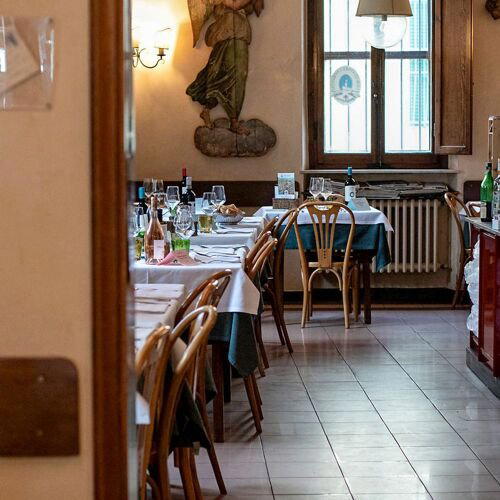
Atmosphere at Selvatico carries the visual register of a place that has not been redesigned to signal its own heritage. The furnishings are described as nostalgic, which in this context means the room looks the way it does because it accumulated that character over generations, not because an interior designer was commissioned to replicate it. That distinction matters to the kind of traveller who can read the difference between genuine patina and staged rusticity.
The consistency of that score across a large number of assessments suggests that expectations are being met reliably across different seasons and table configurations, which is its own form of quality signal for a restaurant operating in a rural setting without the constant attention that urban addresses receive.
Staying On-Site
Selvatico offers guestrooms furnished in the same register as the dining room, which makes it one of the more practical bases for anyone spending time in the Oltrepò Pavese. The wine territory here rewards two or three days of unhurried movement between producers, and having accommodation that shares a kitchen with a Michelin Plate address removes the usual calculation of how far you want to drive after dinner. The rooms carry the same nostalgic atmosphere as the restaurant rather than being a separately managed hospitality operation bolted onto the building.
For readers planning a longer stay in the area, our full Rivanazzano Terme hotels guide maps the wider accommodation picture, and our Rivanazzano Terme wineries guide covers the local producers worth visiting while you're in the zone.
Planning Your Visit
Selvatico is located at Via S. Pellico, 19, in Rivanazzano Terme, in the province of Pavia. The price range sits at the €€ tier, making it one of the more accessible addresses that carries formal recognition from Michelin. Given the combination of accommodation and dining under one roof, it functions well as an overnight stop for travellers moving between Milan and the Ligurian coast, or for those spending time in the Oltrepò Pavese wine zone. For context on what else is worth eating and drinking in the area, our full Rivanazzano Terme restaurants guide provides a wider map, alongside our bars guide and our experiences guide for the area.
Readers whose interest in northern Italian regional cooking extends beyond the Oltrepò Pavese will find relevant reference points at Piazza Duomo in Alba, Le Calandre in Rubano, Reale in Castel di Sangro, Quattro Passi in Marina del Cantone, Uliassi in Senigallia, and Casa Perbellini 12 Apostoli in Verona, all operating at different price points and registers, but sharing the same commitment to regional Italian sourcing as their structural foundation.
Frequently asked questions
Is Selvatico good for families?
For families travelling in the Rivanazzano Terme area, Selvatico's €€ pricing and traditional format make it a practical choice. The menu centres on charcuterie, stews, boiled meats, and fresh pasta, dishes that sit within recognisable territory for most diners regardless of age. The nostalgic atmosphere of the room leans domestic rather than formal, which generally makes for a more relaxed table experience. Guestrooms are also available on-site, which removes logistical pressure for families combining a meal with an overnight stay.
What's the overall feel of Selvatico?
The feel is that of a long-established country restaurant that has not performed a renovation to announce its own longevity. The Oltrepò Pavese context matters here: this is a rural Lombard territory with its own agricultural identity, and the dining room reflects that without theatrical staging. At the €€ tier, the experience sits at the intersection of genuine local tradition and formal recognition, which is a less common combination than it might appear.
What do regulars order at Selvatico?
The menu's strongest signals point toward the kitchen's cured and slow-cooked preparations: charcuterie from local producers, braised and boiled meats in the Lombard tradition, and fresh pasta made in-house. These are the preparations that define the Oltrepò Pavese's culinary identity and the ones that a kitchen with 113 years of continuous operation will have refined to their most consistent form. The Michelin Plate recognition aligns with exactly this kind of cooking, classical, ingredient-led, and anchored in the agricultural sourcing of the surrounding hills.
A Quick Peer Check
| Venue | Cuisine | Price | Awards | Notes |
|---|---|---|---|---|
| SelvaticoThis venue (the venue you are viewing) | Traditional Northern Italian Lombardy Cuisine | $30–50 | Michelin Plate | Not listed |
| Atelier Moessmer Norbert Niederkofler | Modern Alpine Fine Dining | $300–500 | 3 Michelin Stars · World's 50 Best #38 | Italian, Creative |
| Dal Pescatore | Classic Italian Fine Dining | $200–300 | 3 Michelin Stars · World's 50 Best #38 | Italian, Italian Contemporary |
| Enoteca Pinchiorri | Contemporary Italian Fine Dining | $200–300 | 3 Michelin Stars · World's 50 Best #32 | Italian - French, Italian Contemporary |
| Enrico Bartolini | Modern Italian Fine Dining | $300–500 | 3 Michelin Stars · World's 50 Best #85 | Creative |
| Osteria Francescana | Avant-Garde Italian Contemporary | $300–500 | 3 Michelin Stars · World's 50 Best #1 | Progressive Italian, Creative |
Recognition history
Dated appearances from independent guides and award organizations, with the underlying list record or original source where available.
Michelin Plate
Michelin
Full recognition history (3 entries)
Michelin Plate
Michelin
Michelin Plate
Michelin
Continue exploring
More in Rivanazzano Terme
Restaurants in Rivanazzano Terme
All restaurants in Rivanazzano Terme →
Hotels in Rivanazzano Terme
Browse all →

Details
- Rustic
- Cozy
- Classic
- Intimate
- Date Night
- Family
- Group Dining
- Special Occasion
- Garden
- Historic Building
- Extensive Wine List
- Local Sourcing
- Garden
- A La Carte
- Wine
- Vegetarian Friendly
- Vegan Options
- Gluten Free Options
Rustic and nostalgic interior with fireplace, pleasant shaded garden for summer dining, warm family hospitality.