Samoa Cookhouse
Our verdict
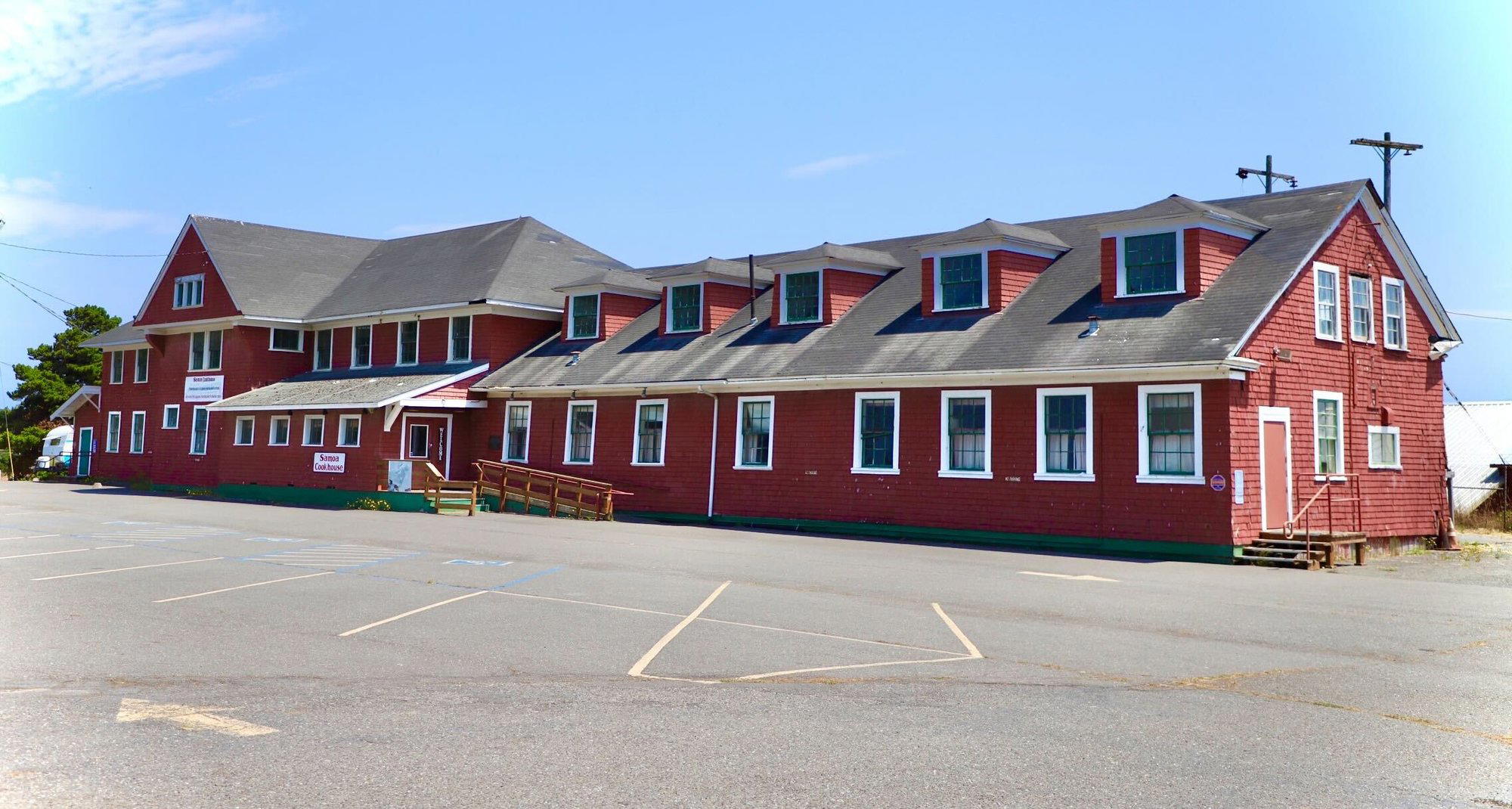
The Samoa Cookhouse on California's North Coast operates as one of the last working lumber camp cookhouses in the American West, serving family-style meals at long communal tables in a cavernous dining hall that has fed mill workers and travelers alike for well over a century. The food is straightforward and plentiful, rooted in the tradition of feeding hungry laborers rather than satisfying gastronomes.

Pearl is the En Primeur Club membership app, where members save venues, book tables and use the concierge.
The menu
What to order
- Roast beef
- Fried chicken
- Pork chops
- Corned beef and cabbage
A Dining Hall Shaped by Industry, Not Ambition
The road into Samoa, California crosses the bay from Eureka on a narrow causeway, depositing you onto a wind-scoured peninsula where the Pacific fog is a near-permanent condition and the smell of salt air mixes with the memory of sawdust. This is timber country, and the Samoa Cookhouse at 908 Vance Ave exists as a direct architectural and culinary artifact of that industry. The building is a large, no-frills structure that made no concessions to atmosphere when it was built to feed mill workers and has made few since. Long communal tables, mismatched chairs, and the ambient noise of a busy hall greet you before any food does. If you arrive expecting the restrained precision of a tasting menu counter, or the ingredient-forward ambition of a place like Single Thread Farm in Healdsburg, you have come to the wrong address. If you arrive expecting a meal that is honest about what it is, you are in the right place.
The Ingredient Logic of the Lumber Camp Kitchen
American lumber camp cookhouses operated on a specific procurement logic: volume, caloric density, and whatever was locally available in quantity. Protein came from nearby sources because refrigerated long-haul transport did not exist when these kitchens were established. Vegetables were seasonal by necessity rather than philosophy. Bread was baked on site because packaged alternatives were not an option. This was ingredient sourcing before the term became a marketing category, and it produced a style of cooking that was deeply regional in the most literal sense.
The North Coast of California sits between two significant food systems. To the south, the agricultural abundance of Sonoma and Marin counties has been refined over decades into the farm-to-table infrastructure that supports places like Lazy Bear in San Francisco and the Michelin-circuit restaurants of the Bay Area. To the north and east, Humboldt County produces dairy, beef, and produce that rarely travels far because the county's geography makes bulk transport difficult. The Samoa Cookhouse sits inside that northern supply logic, relying on the kind of short-chain sourcing that contemporary chefs at Blue Hill at Stone Barns and Smyth in Chicago work hard to recreate as a premium offering. Here, it was never a choice; it was simply the condition of operating in a remote coastal town.
The Pacific Ocean, which sits just beyond the dunes west of the cookhouse, has historically supplied the North Coast with Dungeness crab, rockfish, salmon, and oysters. Humboldt Bay, one of the largest coastal estuaries in California, supports an active oyster farming industry that represents a different mode of sourcing than the high-end seafood programs at Le Bernardin in New York City or Providence in Los Angeles, but draws from the same coastal abundance. The cookhouse's menu has always reflected proximity rather than prestige, which is a distinction worth understanding before you sit down.
Family-Style as a Format, Not a Trend
Communal, family-style format that has become fashionable in contemporary American dining as an expression of conviviality is, at the Samoa Cookhouse, simply the original operational model. Lumber camps fed large numbers of workers quickly and efficiently. Dishes came to the table in quantity because portion control was not the point; feeding people with demanding physical jobs was. This context matters because it frames the experience correctly: you are not at a restaurant that has chosen communal dining as an aesthetic position. You are at a working cookhouse that has operated continuously in the same format because the format worked.
For families traveling the Northern California coast, this makes the Cookhouse a practical stop with genuine historical character. Children fit naturally at long communal tables, and the volume of food arriving at once suits groups of varying appetites. The price point, consistent with the blue-collar heritage of the place, sits in a different register than the $$$$ tasting menus of The French Laundry in Napa or Addison in San Diego. The Cookhouse operates on a different economy entirely, one built around accessibility rather than exclusivity.
The Broader American Tradition of Institutional Cooking
The Samoa Cookhouse belongs to a category of American restaurant that has largely disappeared: the institutional kitchen that fed a specific community and became, by accident of longevity, a historical record. The South has its equivalent in the meat-and-three tradition, restaurants that evolved from feeding workers at specific sites and became cultural institutions. New Orleans has its own version of this in places like Emeril's, which draws on a city-wide tradition of communal abundance. The cookhouse format of the American West, however, is rarer, and the Samoa operation is among the most intact examples remaining.
What connects the cookhouse tradition to the contemporary sourcing conversation is the implicit regionalism of the food. Places like Frasca Food and Wine in Boulder, Bacchanalia in Atlanta, Oyster Oyster in Washington D.C., and ITAMAE in Miami all build their identity around sourcing that is specific to a place and season. The Samoa Cookhouse has always done this by default. The difference is that contemporary fine-dining venues make the sourcing visible as a narrative, while the cookhouse simply cooked what was there. Both approaches produce food that reflects its geography; only one of them requires a tasting menu to explain why.
Planning a Visit
Samoa sits on a peninsula accessible from Eureka via the Samoa Bridge, making it a reasonable detour for anyone traveling Highway 101 along the Northern California coast. The Cookhouse is the town's anchor institution and has been serving meals continuously for well over a century, which makes it among the most historically durable dining venues in the state. Visitors should arrive with expectations calibrated to the format: this is plentiful, communal, and unpretentious food in a setting that has not changed much because it did not need to. Those seeking the precision of Atomix in New York City or the sourcing transparency of The Inn at Little Washington will find a different kind of value proposition here: not refinement, but authenticity of a specific and increasingly rare American type. For a fuller picture of what Samoa's dining options look like beyond the Cookhouse, our full Samoa restaurants guide covers the broader local scene. Reservations and booking policies are best confirmed directly, as operational details for the Cookhouse are subject to change.
Frequently asked questions
Is Samoa Cookhouse a family-friendly restaurant?
The format is inherently suited to families. Meals are served communal and family-style at long tables, which removes the formality of à la carte ordering and makes the setting accessible to children and adults alike. Located at 908 Vance Ave on the Samoa peninsula, it functions less like a conventional restaurant and more like a dining hall, which tends to ease any tension around dress or behavior.
What should I expect atmosphere-wise at Samoa Cookhouse?
The dining room reflects its origins as a working cookhouse built to feed lumber crews, not to impress them. Expect long communal tables, a no-frills interior that has changed little in decades, and a pace set by the kitchen rather than the diner. The fog-scoured Samoa peninsula setting reinforces the utilitarian character of the place.
Is Samoa Cookhouse one of the last surviving lumber camp cookhouses still serving the public in California?
It occupies that category with very few competitors. Institutional cookhouses tied to specific industries, timber, mining, fishing, largely closed as those industries contracted through the late twentieth century. The Samoa Cookhouse at 908 Vance Ave is among the rare examples in California where the physical structure, communal format, and meal logic of the original operation remain in recognizable form for paying guests.
What do people recommend at Samoa Cookhouse?
Because the menu follows the logic of the original lumber camp kitchen, portions are large and dishes rotate based on volume and seasonal availability rather than chef's whim. The family-style format means the full spread arrives at the table, so there is no single dish to single out. Visitors consistently cite the volume and the communal format as the defining experience.
What's Samoa Cookhouse's location?
Samoa Cookhouse is located at 908 Vance Ave, Samoa, CA 95564, Samoa.
How hard is it to get a table at Samoa Cookhouse?
Reservations have historically been straightforward given the large-format dining hall setup, which accommodates groups rather than intimate two-tops. The Samoa peninsula is accessible from Eureka via the Samoa Bridge, and the Cookhouse draws a mix of locals and Highway 101 travelers rather than destination diners booking weeks ahead.
What's Samoa Cookhouse best at?
The Cookhouse does one thing with documented consistency: replicating the format and scale of American institutional cooking as it existed in the Pacific Northwest timber industry. That means volume-driven, family-style meals served without ceremony at communal tables in Samoa, California, a format that has largely vanished from the American restaurant scene.
Quick Comparison
| Venue | Cuisine | Price | Awards | Notes |
|---|---|---|---|---|
| Samoa CookhouseThis venue (the venue you are viewing) | Lumber Camp Comfort Food | $20–30 | Not listed | Not listed |
| Le Bernardin | French Seafood Fine Dining | $300–500 | 3 Michelin Stars · World's 50 Best #13 | French, Seafood |
| Lazy Bear | Modern American Tasting Menu | Not listed | 2 Michelin Stars · World's 50 Best #25 | Progressive American, Contemporary |
| Atomix | Modern Korean Tasting Menu | $300–500 | 2 Michelin Stars · World's 50 Best #7 | Modern Korean, Korean |
| Per Se | French Fine Dining Tasting Menu | $300–500 | 3 Michelin Stars · World's 50 Best #40 | French, Contemporary |
| Masa | Traditional Japanese Omakase | $500+ | 2 Michelin Stars · World's 50 Best #27 | Sushi, Japanese |
Continue exploring
More in Samoa
Restaurants in Samoa
All restaurants in Samoa →
Bars in Samoa
Browse all →
Details
- Rustic
- Well Known
- Classic
- Group Dining
- Family
- Casual Hangout
- Special Occasion
- Historic Building
- Private Dining
- Family Style
- Set Menu
- Coffee
- Orange Juice
Historic and nostalgic with communal long tables, vintage logging artifacts on walls, and warm homestyle dining reminiscent of early 20th-century lumber camp dining halls.