Sagar
Sagar at 157 King Street in Hammersmith sits in a part of west London where South Asian vegetarian cooking has deep residential roots. The restaurant draws on South Indian and Udupi traditions, placing it in a distinct tier from the curry-house mainstream. For the Hammersmith and Shepherd's Bush corridor, it represents the kind of neighbourhood-anchored, cuisine-specific dining that London's inner-west does quietly well.
Pearl is the En Primeur Club membership app — saves, bookings, and concierge access live there. Same editors, same standards.
- Address
- 157 King St, London W6 9JT, UK
- Phone
- +44 20 8741 8563
- Website
- sagarlondon.com
- Directions
- Get directions
 Saves & bookings on Pearl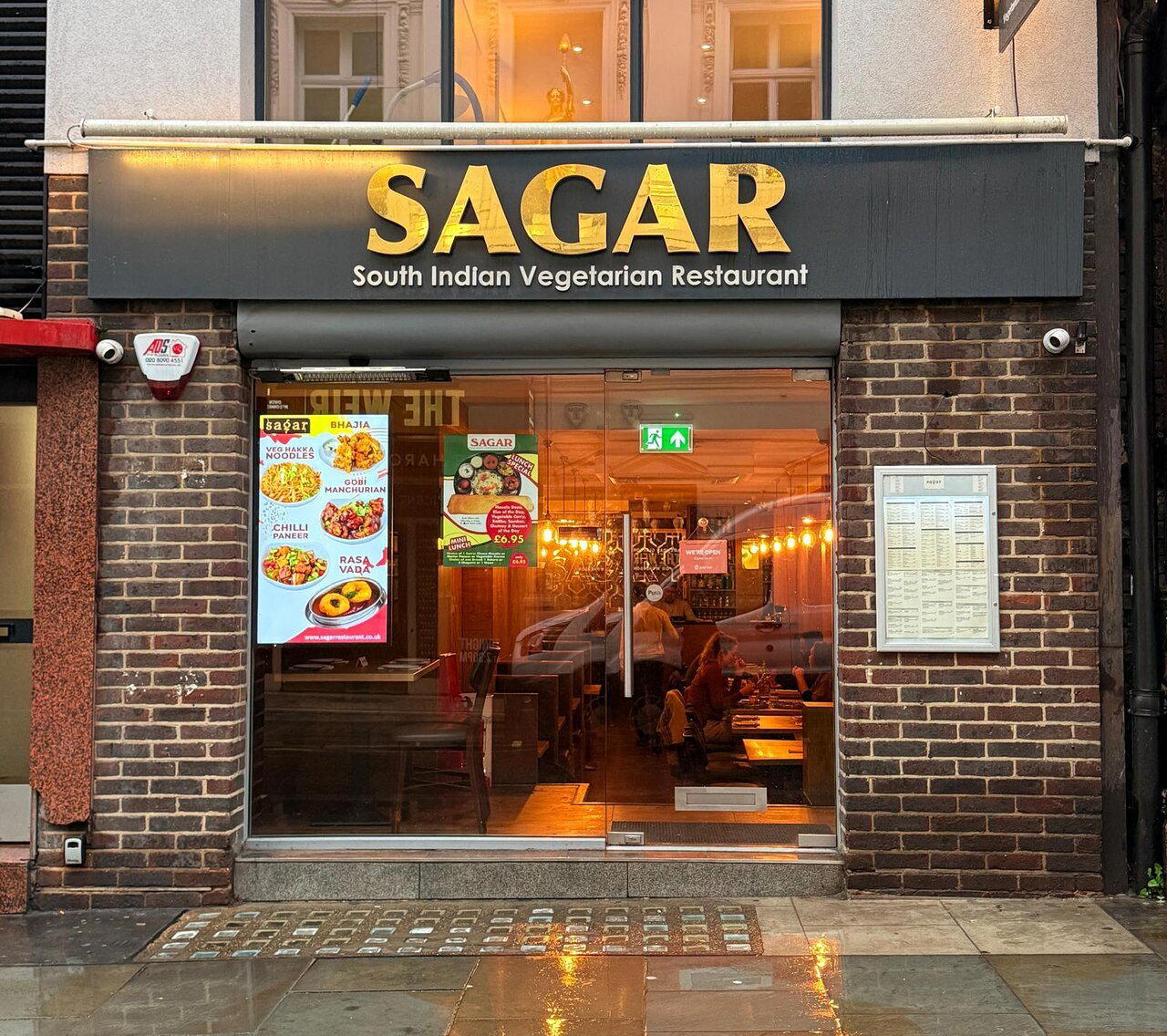
King Street, Hammersmith, and the Case for Neighbourhood-Rooted Dining
West London's King Street corridor is not where food critics tend to plant their flags. The three-Michelin-star conversation in London runs through Chelsea and Mayfair, where venues like CORE by Clare Smyth, Restaurant Gordon Ramsay, and Sketch, The Lecture Room and Library compete in the ££££ tier alongside The Ledbury and Dinner by Heston Blumenthal. Hammersmith operates on a different register entirely: residential, transit-dense, and home to one of the more consequential South Asian communities in the capital. That demographic history is directly relevant to what Sagar does and why it works.
The Udupi and South Indian vegetarian tradition that Sagar draws from is a specific and serious culinary lineage, not a subcategory of generic Indian food. Udupi cooking originates in the temple-town of Udupi in coastal Karnataka, where strict vegetarian principles shaped an entire cuisine around legumes, rice, fermented batters, and coconut. The dishes that emerged from that tradition, dosas, idlis, uttapams, sambars, are technically demanding, particularly the fermentation and griddle work required to produce a dosa with the right crispness and sourness. London has a cluster of restaurants working in this tradition, most of them in neighbourhoods with South Indian residential density, and Sagar at King Street is among the longer-established addresses in that cluster.
What the Address Means for the Experience
Hammersmith's W6 postcode sits between the westward sprawl of Shepherd's Bush and the riverside calm of Chiswick. King Street itself is a working high street rather than a destination dining strip, which shapes the atmosphere at Sagar in ways that matter. The clientele skews local and repeat: families, professionals from the surrounding residential streets, and a South Asian diaspora community for whom this style of cooking represents a reference point rather than an exploration. That mix produces a dining room atmosphere that is grounded and functional rather than performative.
This is worth naming because it marks a real distinction in how London's South Indian vegetarian restaurants split. Some have migrated toward central-London positioning, smoothed their interiors, and adjusted their pricing to reflect Zone 1 rents. Sagar on King Street remains embedded in its neighbourhood context, which affects everything from the pace of service to the price-value relationship. For visitors making a deliberate trip from central London, that neighbourhood character is part of what they are coming for, the cooking exists in a social context that makes it more legible, not less.
Those planning a broader London trip can cross-reference our full London restaurants guide, alongside our guides to London hotels, London bars, London wineries, and London experiences for broader context on the city's offering.
South Indian Vegetarian in the Context of London's Wider Indian Dining
London's Indian restaurant scene has fragmented considerably over the past decade. The Brick Lane and curry-house model has declined in relative prestige as regional-specific formats have taken ground, Keralan seafood, Gujarati thali, Chettinad cooking, and the Udupi-South Indian vegetarian category that Sagar occupies. This fragmentation mirrors what happened in cities like New York, where venues like Le Bernardin and Atomix represent the sharpening of culinary identity into highly specific expressions, and where the mid-tier generalist has lost ground to the credentialed specialist.
Within South Indian vegetarian specifically, the technical benchmark is set by the quality of fermented preparations. A well-made dosa batter requires an overnight ferment at controlled temperature; the resulting crepe, properly executed, is thin enough to be translucent at the edges and carries a faint sourness that balances the richness of the accompanying coconut chutney and sambar. The idli, often treated as a minor item, is actually a reliable quality indicator: a properly steamed rice-and-lentil cake should be light and slightly springy, not dense or gummy. These are the details that separate competent South Indian cooking from the real thing, and they are what a restaurant like Sagar is being implicitly judged against by its core clientele.
For those whose interest in regional British fine dining runs parallel, the comparison set looks entirely different: The Fat Duck in Bray, L'Enclume in Cartmel, Moor Hall in Aughton, Gidleigh Park in Chagford, Hand and Flowers in Marlow, and Le Manoir aux Quat' Saisons in Great Milton represent a different axis of British dining culture entirely, tasting menus, countryside settings, and Michelin recognition. Sagar does not sit on that axis, nor is it trying to.
Planning Your Visit
Sagar is located at 157 King Street, London W6 9JT, within walking distance of Hammersmith tube station (served by the District, Piccadilly, and Hammersmith & City lines). The address is accessible from central London in under twenty minutes on the District or Piccadilly lines, which makes it a realistic weeknight destination for anyone staying or working in the centre. King Street itself has reasonable on-street parking outside peak hours for those arriving by car from the M4 corridor.
The South Indian vegetarian format means the menu is entirely plant-based, which makes Sagar a strong option for mixed groups where dietary requirements vary. The price point, consistent with the neighbourhood context and the category, sits below the ££££ tier occupied by London's fine-dining addresses, this is accessible, high-frequency dining rather than occasion spending.
Quick reference: 157 King St, London W6 9JT. Nearest tube: Hammersmith (District, Piccadilly, Hammersmith & City lines). Fully vegetarian menu in the South Indian and Udupi tradition.
Booking and Cost Snapshot
Comparable venues nearby, for context on price, style, and recognition.
| Venue | Cuisine | Price |
|---|---|---|
| SagarThis venue — the venue you are viewing | Not listed | $$ |
| Namaaste Kitchen | Camden Town, Modern Indian Bar and Grill | $$ |
| Roots in Teddington | Teddington, Modern Regional Indian | $$ |
| Poppadom Indian Kitchen | Bloomsbury, Indian Fusion Kitchen | $$ |
| Salaam Namaste | St Pancras, Modern Indian & Pakistani | $$ |
| Rooburoo | Angel, North Indian | $$ |
Continue exploring
More in London
Restaurants in London
Browse all →
Bars in London
Browse all →
Hotels in London
Browse all →

At a Glance
- Cozy
- Casual
- Casual Hangout
- After Work
- Standalone
Relaxed and cozy with calm atmosphere, clean decor, and a casual vibe suitable for quick pre-theatre meals.