Star Wine List
Our verdict
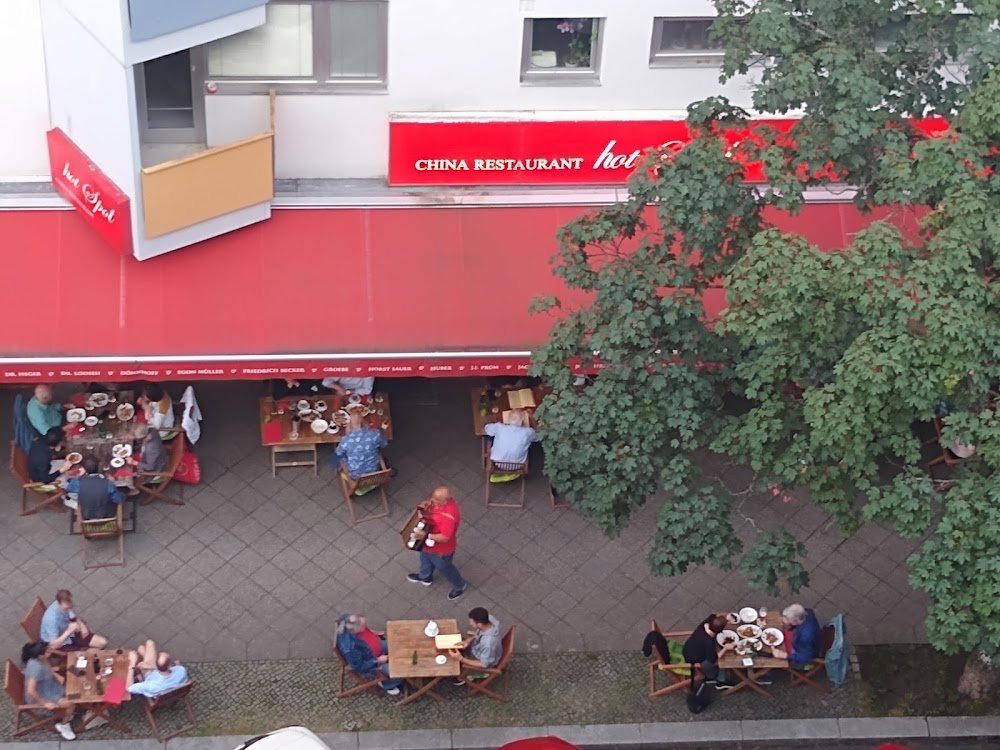
A family-run Chinese restaurant operating since 2007 near the Ku'damm corridor, Restaurant Hotspot occupies a specific niche in Berlin's dining scene: a neighbourhood Chinese table that has built its following through consistency rather than ceremony. The kitchen balances sweet, sour, spicy, and mild registers across its menu, drawing a local crowd that returns for the familiarity of the format as much as the food.

Pearl is the En Primeur Club membership app, where members save venues, book tables and use the concierge.
The menu
What to order
- Tea marinated duck
- Jellyfish salad
- Beef stomach and tongue
The Ku'damm Corridor and Its Chinese Table
Berlin's Kurfürstendamm axis has never been the city's most adventurous dining address. The boulevard and its side streets run toward the reliable and the established, serving a mix of residents, hotel guests, and shoppers who want a known quantity over a discovery. Eisenzahnstraße 66 sits in that orbit, a short distance from the Ku'damm itself, in a residential pocket of Charlottenburg where the pace is quieter than the main drag. For Chinese restaurants in Berlin, this western address is a different proposition from the Mitte dining scene where operators like Restaurant Tim Raue have built a version of Chinese cuisine tuned to fine-dining expectations. Hotspot belongs to a different category altogether: the neighbourhood Chinese table, family-operated, with a cooking register shaped by the Wu family since 2007.
That seventeen-year run matters. In a city that remakes its restaurant map with some regularity, a Chinese restaurant holding the same address for nearly two decades in Charlottenburg signals something about its relationship with the people who live nearby. The comparison set for Hotspot is not the Michelin-tracked creative restaurants of central Berlin, where Rutz, Nobelhart & Schmutzig, and FACIL occupy the premium tier. The comparison is to the broader category of Chinese dining in Berlin, where the range runs from functional takeaway to the technically ambitious, and where a family-run room with a full kitchen and table service occupies the considered middle ground.
How the Meal Is Structured
Chinese table dining in this format does not follow the sequential course structure that European fine dining has normalised. The ritual here is one of shared plates, of dishes arriving in a loose order determined partly by kitchen timing and partly by the logic of balance: something cooling alongside something with heat, something fried alongside something steamed. The menu's stated character, balancing sweet and sour against spicy and mild, reflects a cooking approach that asks diners to read the table as a whole rather than concentrate on a single plate. This is a different discipline from the tasting menus at CODA Dessert Dining where sequence and pacing are entirely controlled, or the chef-led progression at FACIL. The format at Hotspot asks the diner to participate in how the meal unfolds.
That participation extends to ordering. A table of two eating differently than a table of four or six is a structural reality of Chinese restaurant dining that many European diners still underuse. The more dishes ordered and shared, the more the kitchen's range becomes readable. Coming with a group, or ordering beyond the single-dish instinct, returns more of what the menu is designed to deliver.
The Family-Run Format in Berlin's Context
Family-operated Chinese restaurants in German cities have a long history, and Berlin's version of that story runs across multiple generations of operators and multiple waves of Chinese immigration, each bringing different regional cooking traditions. The Wu family opened Hotspot in 2007, placing it in the mid-2000s cohort of Berlin Chinese restaurants that predate the city's sharper rise as a European dining destination. That positioning, opening before Berlin's dining scene attracted the international critical attention it now receives, means the restaurant's identity was formed in a period when the audience it served was primarily local and neighbourhood-based rather than destination-driven.
That neighbourhood character shows in the address. Charlottenburg's dining scene is not where food press attention concentrates in Berlin. The energy that drives coverage at Nobelhart & Schmutzig or the creative tier more broadly is centred east and south of here. What Charlottenburg offers instead is a more settled residential clientele, a quieter room, and a different expectation at the door. For diners who find the self-consciousness of the destination-dining circuit wearing, that can be exactly the point.
Placing Hotspot in Berlin's Wider Dining Map
Berlin's restaurant scene in 2024 covers an unusually wide register, from the destination tasting menus that attract international travellers to the kind of long-running neighbourhood rooms that sustain local life. The critical and award infrastructure naturally clusters around the former: the Michelin-tracked kitchens, the 50 Best adjacent names, the bars and wine-led restaurants that appear in international media. For a complete picture of the city's eating, see our full Berlin restaurants guide. Beyond dining, our Berlin bars guide, Berlin hotels guide, and Berlin experiences guide cover the city's other premium tiers.
For those exploring Germany's wider fine-dining circuit, the comparison set shifts considerably. Operations like Aqua in Wolfsburg, Schwarzwaldstube in Baiersbronn, and Vendôme in Bergisch Gladbach represent the country's highest-awarded kitchens, and JAN in Munich, ES:SENZ in Grassau, and Restaurant Haerlin in Hamburg anchor the premium tier in their respective cities. Hotspot operates at a different altitude from these, but within the logic of Berlin's neighbourhood dining, it fills a role that the destination kitchens cannot: a family table, open since 2007, in a part of the city that runs on repeat visits rather than first-time pilgrimages.
Planning a Visit
Restaurant Hotspot is located at Eisenzahnstraße 66, 10709 Berlin, in the Charlottenburg district, within walkable distance of the Ku'damm and accessible from several S-Bahn and U-Bahn connections serving the western city. The restaurant has operated under family management since 2007, and the format is a seated, full-service Chinese table rather than a takeaway or quick-service operation. Those travelling to Berlin primarily for the premium dining circuit should note that the creative and Michelin-tracked tier is well documented in our full Berlin restaurants guide, and international comparisons for the kind of technically ambitious cooking Berlin now produces can be drawn from addresses like Le Bernardin in New York or Emeril's in New Orleans, both of which represent the sustained institutional weight that long-running restaurants accumulate. Hotspot's equivalent is more local in scale: a Charlottenburg regular's table, shaped by nearly two decades of the same family cooking in the same address.
Frequently asked questions
Is Restaurant Hotspot a family-friendly restaurant?
The restaurant has been family-run by the Wu family since its founding in 2007, which tends to shape both the service style and the welcome extended to guests of all ages. The Charlottenburg location on Eisenzahnstraße 66 is a residential-adjacent address, not a late-night bar strip, which supports a relaxed, all-ages atmosphere.
How would you describe the vibe at Restaurant Hotspot?
Hotspot sits one street removed from the Ku'damm in Charlottenburg, which positions it closer to neighbourhood restaurant than destination showpiece. Opened in 2007 and still operated by the Wu family, the room carries the kind of continuity that comes with nearly two decades of regular clientele. The format is Chinese table dining rather than European sequential courses, so expect shared plates and a more communal pace.
Does Restaurant Hotspot have a Michelin star or similar recognition?
Restaurant Hotspot has received recognition including: Opened in 2007 by the family Wu, this Chinese restaurant is located off the “Champs-Elysées” of Berlin – Ku’damm. The restaurant marries sweet & sour, spicy and mild like no other. Made from the fresh....
What's the must-try dish at Restaurant Hotspot?
The restaurant's founding notes reference a kitchen that balances contrasting flavour profiles across the menu. For the most current picture of what's in season or worth ordering, checking with the restaurant directly before visiting is the practical approach.
How do I find Restaurant Hotspot?
Restaurant Hotspot is located at Eisenzahnstraße 66, 10709 Berlin, Germany, Berlin.
What's the best way to book Restaurant Hotspot?
The restaurant is located at Eisenzahnstraße 66, 10709 Berlin, in Charlottenburg, and is accessible from the Ku'damm. Arriving during off-peak hours or making contact through the venue directly are the most reliable routes for securing a table.
What do critics highlight about Restaurant Hotspot?
What the record does establish is an 18-year run under consistent family ownership in a Berlin neighbourhood not widely associated with destination Chinese dining, a form of durability that speaks for itself in a city with high restaurant turnover.
Cuisine Lens
Comparable venues nearby, for context on price, style, and recognition.
| Venue | Cuisine | Price | Awards | Notes |
|---|---|---|---|---|
| Restaurant HotspotThis venue (the venue you are viewing) | Authentic Sichuan & Jiangsu Chinese | $20–30 | Star Wine List | Not listed |
| Mr. Noodle Chen | Lanzhou Hand-Pulled Noodles | $10–20 | Not listed | Wedding |
| Da Jia Le | Authentic Northeastern Chinese (Dongbei) | Not listed | Not listed | Schoneberg |
| LIU 成都味道面馆 Nudelhaus | Authentic Sichuan Noodle House | $10–20 | Not listed | Mitte |
| UUU | Modern Chinese Fine Dining | Not listed | We're Smart World 3 Radishes | Wedding |
| Peking Ente | Traditional Chinese | $20–30 | Not listed | Mitte |
Recognition history
Dated appearances from independent guides and award organizations, with the underlying list record or original source where available.
Star Wine List
Star Wine List