Our verdict
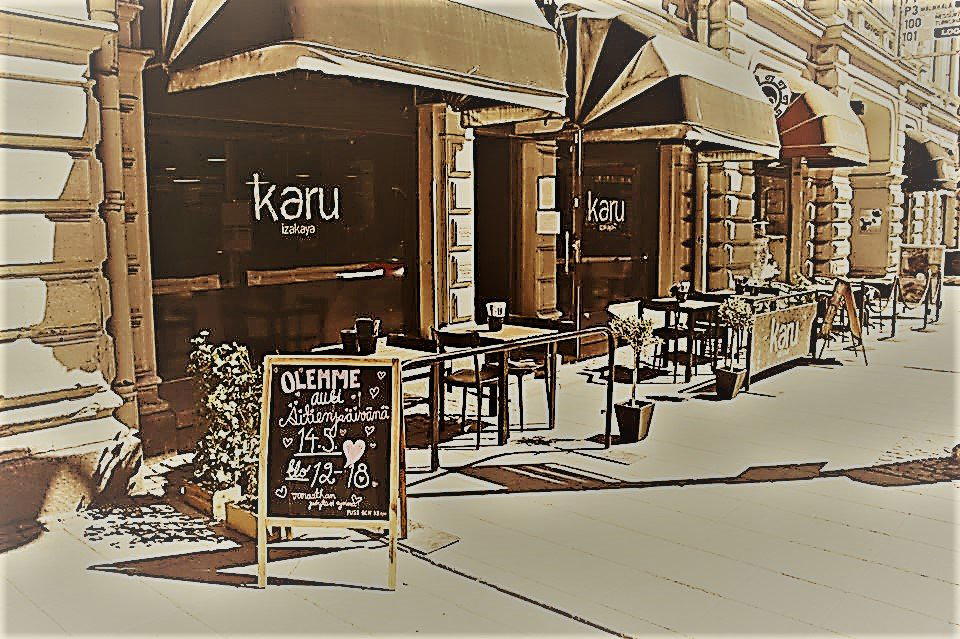
Ravintola Karu Izakaya sits on Aurakatu in central Turku, bringing the izakaya format to Finland's oldest city. The menu architecture follows the Japanese tradition of small, shareable dishes designed for grazing rather than fixed progression, placing it in a different register from Turku's New Nordic-dominant dining scene. It is one of the few dedicated izakaya formats operating outside Helsinki in Finland.

Pearl is the En Primeur Club membership app, where members save venues, book tables and use the concierge.
The Izakaya Format in a Nordic City
Turku's restaurant scene has long been anchored by New Nordic ambition. Kaskis set the benchmark for that tradition, and the city's more serious tables have broadly followed its lead: seasonal Finnish produce, restrained plating, tasting menus or à la carte formats built around progression. What the izakaya tradition represents is a structural departure from all of that. The Japanese izakaya is not a tasting menu and not a single-plate restaurant. It is a format built on lateral abundance: many small dishes, arrived at in no fixed order, designed for sharing, for drinking alongside, for extended time at the table without ceremony. That format sits almost entirely outside the Finnish dining mainstream, which makes Ravintola Karu Izakaya's presence on Aurakatu in central Turku worth examining as a statement about where the city's appetite is moving.
What the Menu Structure Reveals
The izakaya model communicates something specific through its architecture. A menu organised around small, shareable formats is not simply a Japanese version of tapas. The dishes are designed to function in parallel rather than in sequence, meaning the diner constructs the meal rather than receiving it. That places the emphasis on the kitchen's range rather than its ability to build a single narrative arc, and it rewards kitchens that can execute across multiple cooking disciplines simultaneously. Grilled skewers, cold preparations, fried items, and broth-based dishes may all appear on the same table at the same time. The format is demanding in ways that a linear tasting menu is not, and it tends to reveal gaps in consistency faster than a structured progression where each course can be isolated.
In the Finnish context, this structure also signals a different relationship with alcohol. The izakaya tradition is inseparable from drinking culture; the format exists specifically to accompany beer, sake, shochu, and highballs over several hours. The food is calibrated to that rhythm, which is a different design principle from the wine-pairing logic that governs most of Turku's higher-end tables. For a city with a strong café and bar culture along the Aura River, that alignment with extended, drink-anchored sociability is not a misfit. It is a different kind of fluency.
Turku's Position in the Broader Finnish Dining Picture
Finland's most decorated dining is concentrated in Helsinki. Palace in Helsinki operates at the top of the country's formal dining tier, and the capital absorbs most of the international attention directed at Finnish cuisine. Cities like Turku, Tampere, and Porvoo function as secondary markets with their own distinct characters, but they tend to receive less coverage for format experimentation. That makes the appearance of a dedicated izakaya in Turku more legible as a signal: the city is developing appetite for formats outside the Nordic-European axis that has defined Finnish fine dining for the past decade.
The comparison with Asian restaurant development in other Finnish cities is instructive. Hai Long in Rovaniemi represents a different tier of Asian dining in a smaller northern city, while the concentration of format diversity in Helsinki remains higher. Turku's scale and university city demographic create conditions that can support a more specific format like the izakaya, even outside the capital's critical mass.
Aurakatu and the Central Turku Setting
The address at Aurakatu 3 places Karu Izakaya on one of Turku's main central arteries, close to the Aura River corridor that defines the city's social geography. This is not a neighbourhood restaurant in any peripheral sense; it sits in the zone where Turku concentrates its evening activity. Bar4 and Brasserie Amelie operate in the same central area, as does E. Ekblom and Kakolanruusu. The central location matters for the izakaya format specifically, because the format depends on walk-in culture and spontaneous extension of the evening. A riverside address supports that rhythm in a way that a more residential location would not.
Turku is compact enough that central positioning gives a restaurant access to the bulk of the evening population without requiring destination-level intent. For a format that benefits from groups assembling around a table and ordering progressively, that accessibility is part of the proposition.
The Izakaya Tier in European Context
Outside Japan and major immigrant-dense cities, the izakaya format in Europe exists across a wide quality range. At one end are ramen-adjacent operations that approximate the aesthetic without the kitchen discipline. At the other are restaurants with genuine Japanese technique, where the yakitori, karaage, and cold dishes reflect an understanding of the format's internal logic. The distinction matters because the izakaya model, when executed with discipline, positions against a different competitive set than a generalist Asian restaurant. Atomix in New York City represents what Korean fine dining can achieve when format and technique are both taken seriously; the izakaya format has analogous potential when it is treated as a serious cooking tradition rather than a loose thematic frame.
In Finland, the izakaya is rare enough that Karu sits largely without direct local comparators. The nearest peer references would be Helsinki's Japanese dining tier, which includes dedicated sushi and ramen operations but relatively few venues committed to the broader izakaya structure of small plates, grill, and extended-session format.
Planning a Visit
Ravintola Karu Izakaya is located at Aurakatu 3, 20100 Turku, in central Finland's oldest city. The venue is reachable on foot from Turku's main transport connections, and its Aurakatu address puts it within walking distance of the Aura River. Booking details, current hours, and pricing are best confirmed directly with the venue, as this information was not available at the time of publication. The izakaya format generally suits groups of two to six who intend to share across multiple dishes and spend time at the table; solo diners at the counter are also consistent with the tradition. For broader context on where Karu fits in Turku's dining picture, see our full Turku restaurants guide. Readers planning a wider Finnish itinerary can also cross-reference Figaro in Jyväskylä, Filipof in Joensuu, Gösta in Mänttä, JJ's BBQ in Salo, Vintti in Hameenlinna, and Hejm in Vaasa for comparable mid-size Finnish city dining.
Frequently asked questions
What's Ravintola Karu Izakaya's location?
Ravintola Karu Izakaya is located at Aurakatu 3, 20100 Turku, Finland, Turku.
Is Ravintola Karu Izakaya the only izakaya-format restaurant in Turku?
Finland's Japanese dining scene is concentrated primarily in Helsinki, making a committed izakaya operation in Turku's city centre a structural outlier in the regional dining picture.
What dish is Ravintola Karu Izakaya famous for?
The defining feature is the izakaya format itself: a menu structured around shareable small plates rather than a single centrepiece dish. That architecture, applied in Turku where New Nordic tasting menus have set the prevailing tone, is itself the point of difference.
Do I need a reservation for Ravintola Karu Izakaya?
The venue sits on Aurakatu 3, one of Turku's central dining arteries, where foot traffic on weekend evenings and post-event periods tends to fill smaller restaurants quickly. Contacting the venue directly before arrival is advisable, particularly for groups.
A Credentials Check
Comparable venues nearby, for context on price, style, and recognition.
| Venue | Cuisine | Price | Awards | Notes |
|---|---|---|---|---|
| Ravintola Karu IzakayaThis venue (the venue you are viewing) | Modern Japanese Izakaya | $50–100 | Not listed | Not listed |
| Kakolanruusu | Open-fire Nordic Fine Dining | $50–100 | White Guide Nordic Restaurants - Fine Level | Kakolanmäki |
| Brasserie Amelie | Modern French Brasserie | $50–100 | Not listed | riverside |
| Mami | Nordic Bistro with French Influences | $50–100 | Not listed | Old Town |
| Nooa | Modern Scandinavian | Not listed | Not listed | Turku Harbour |
| Smör | Modern Scandinavian Fine Dining | $50–100 | Michelin Plate · Falstaff Restaurant - 93 Falstaff Points | central Turku |
Continue exploring
More in Turku
Restaurants in Turku
All restaurants in Turku →
Bars in Turku
All bars in Turku →
Details
- Cozy
- Modern
- Trendy
- Date Night
- Group Dining
- Casual Hangout
- Open Kitchen
- Sake Program
- Craft Cocktails
- Small Plates
- Tasting Menu
- A La Carte
- Sake
- Cocktails
- Vegetarian Friendly
- Vegan Options
- Gluten Free Options
Current opening hours
- Monday
- Closed
- Tuesday
- 5–10 PM
- Wednesday
- 5–10 PM
- Thursday
- 5–10 PM
- Friday
- 5 PM–12 AM
- Saturday
- 4 PM–12 AM
- Sunday
- Closed
Hours can change for holidays and private events. Hours as of .
Cozy and laid-back with authentic Japanese-inspired atmosphere.