Tabelog 100 #65
Our verdict
Rasa Bojun sits in Osaka’s serious Asian and ethnic dining conversation through Sri Lankan cooking rather than luxury theatre. Its repeated Tabelog 100 recognition across Asian, ethnic and curry categories gives it a reputation that reaches beyond the usual curry circuit, while the room remains casual enough for everyday dining in Kitahama.

Pearl is the En Primeur Club membership app, where members save venues, book tables and use the concierge.
The menu
What to order
- Bojun Plate
- Jaya Plate
- Chicken Keema Curry
- Couple Set
- Nasi Goreng Set
- Special Vegetable Plate with Healthy Curry
Restaurants in Osaka can carry a particular charge: the shift from street noise to a quieter dining room, the pause at the door, the sense that dinner is happening within the city’s everyday rhythm. In Osaka, that setting suits Sri Lankan cooking better than ceremony. The appeal is not performance; it is the confidence of a kitchen working in a category that Osaka diners now take seriously.
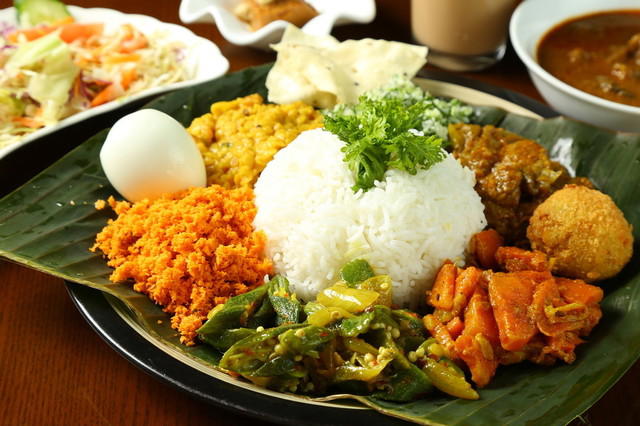
Sri Lankan food in Japan often enters the conversation through curry, but that shorthand can flatten what makes the cuisine distinct. Rice-and-curry culture is built on contrast: heat, coconut, acidity, bitterness, fried texture, pickles, lentils, greens and meat or fish all negotiating space on the plate. In a city famous for okonomiyaki, kushikatsu and counter sushi, this kind of meal offers a different Osaka pleasure: abundance without luxury signalling.
Why Sri Lankan curry has earned a serious Osaka audience
Rasa Bojun’s reputation rests on recognition from Tabelog’s Hyakumeiten program, a useful signal in Japan because it tracks restaurants by category rather than forcing every dining room into the same prestige hierarchy. The restaurant has 2024 recognition in the Tabelog Hyakumeiten context, with categories listed as Sri Lankan, Curry, Asian and Ethnic. That matters because it places the restaurant inside a regional conversation around curry and Asian cooking in western Japan.
Osaka’s curry culture is not a monolith. There are quick, low-cost counters such as Taniguchi Curry, other specialist rooms such as yacipoci and Ebishi, and formal Japanese dining at the other end of the city’s price and ritual spectrum, including Koryu. Sri Lankan cooking cuts across those lines. It can satisfy the same weekday appetite as curry rice, but its structure is closer to a composed spread than a single sauce over rice. That is why recognition in this category is telling: the restaurant is not being read only as a curry stop, but as part of a broader dining category with its own standards.
The strongest way to understand the room is through that category shift. Osaka diners have become comfortable treating Sri Lankan and other Asian cooking as destination dining without demanding white tablecloth manners. The value lies in spice discipline, variety and repeatability. A place can be casual and still operate under critical scrutiny. Rasa Bojun’s Tabelog score of 3.52 and its listed lunch and dinner budget of JPY 1,000 - JPY 1,999 put it in that middle zone where everyday pricing and specialist reputation overlap.
A casual room with category weight, not a luxury performance
The format reinforces the point. This is not presented as a luxury performance; it reads as a practical Osaka restaurant for diners who may be eating alone, with friends or with family, rather than staging a formal night out. The appeal is direct rather than theatrical, with pricing that keeps the experience accessible while still allowing the kitchen’s specialist category to carry the meal.
That informality should not be mistaken for low ambition. In Japan, a Tabelog Hyakumeiten selection can lift a narrow category restaurant into wider circulation, especially when the food sits outside the Michelin-coded grammar of tasting menus and chef counters. For travellers, that makes the restaurant useful: it shows how Osaka eats beyond the clichés without requiring a special-occasion budget. The experience belongs to the city’s everyday dining intelligence, where strong specialist cooking can live within a casual urban rhythm rather than in a hotel lobby.
Osaka also matters. The city’s business-day tempo keeps meals direct, but its dining routes still reward a detour from more familiar restaurant clusters. That makes the restaurant a sharp counterpoint to the city’s other registers: bakery and café circuits, snack-and-souvenir stops, imported comfort formats and other casual dining rooms. Together, they show a city where casual does not mean careless.
How it fits into a sharper Osaka itinerary
For a visitor building meals around reputation rather than spectacle, Rasa Bojun works as a corrective to the idea that Osaka’s memorable dining must be either street-food shorthand or high-form Japanese cuisine. The smarter read is to split the city by function: one meal for regional comfort, one for specialist non-Japanese cooking, one for a formal counter or kaiseki room, then bars and hotels around the logistics of the trip. That rhythm gives Osaka more depth than a checklist of famous foods.
Use Our full Osaka restaurants guide for the broader dining map, then pair it with Our full Osaka hotels guide if Osaka will shape the evening. Drinking plans sit separately in Our full Osaka bars guide, while Our full Osaka wineries guide and Our full Osaka experiences guide help frame the city beyond dinner. For national context, compare Osaka’s casual-specialist mode with other dining rooms in Japan and abroad that show how focused, everyday restaurants can earn attention without relying on spectacle.
The editorial case is simple: this is not Osaka at its loudest or grandest. It is Osaka taking an overseas food tradition seriously enough to reward consistency, category fluency and value. That is the more interesting city to eat through.
Frequently asked questions
Is Rasa Bojun a family-friendly restaurant?
Rasa Bojun is a casual Osaka restaurant with listed lunch and dinner pricing of JPY 1,000 - JPY 1,999. For family visits or mixed-age groups, check the venue's official channels for the latest details.
Is Rasa Bojun formal or casual?
Casual is the better read here. The pricing sits at JPY 1,000 - JPY 1,999 for lunch and dinner, which keeps it well away from a formal dining profile. The Tabelog Hyakumeiten recognition gives it category weight without changing the mood of the room.
What's the price range at Rasa Bojun?
Pricing at Rasa Bojun is listed as Dinner: JPY 1,000 - JPY 1,999; Lunch: JPY 1,000 - JPY 1,999.
What is Rasa Bojun known for?
Rasa Bojun is known in Osaka for Sri Lankan, Curry, Asian and Ethnic cooking, with 2024 Tabelog Hyakumeiten recognition and a Tabelog score of 3.52.
What It’s Closest To
Comparable venues at the same tier.
| Venue | Cuisine | Price | Awards | Notes |
|---|---|---|---|---|
| Rasa BojunThis venue (the venue you are viewing) | Sri Lankan Curry & Asian Ethnic | $10–20 | Tabelog 100 #65 | Not listed |
| Mole & hosoi coffees | Japanese kissaten-style coffee shop | $1–10 | Tabelog 100 | Chūō |
| Cafe Fate | Cafe | $10–20 | Tabelog 100 #29 | Kita |
| Resolve Coffee Ten | Japanese kissaten-style coffee shop | $1–10 | Tabelog 100 | Takatsuki |
| Fournier | Whole-grain Japanese bakery | $1–10 | Tabelog 100 #68 | Izumi Chuo |
| Gelateria Circo D'oro | Italian-style gelato & ice cream | $1–10 | Tabelog 100 #100 | Chūō |
Recognition history
Dated appearances from independent guides and award organizations, with the underlying list record or original source where available.
Tabelog 100 #65 · No. 65
Tabelog · Tabelog 100 - Asian cuisine / Ethnic cuisine - WEST - 2024