Tabelog 100 #20
Our verdict
Ramenya Akagi sits in Osaka’s serious ramen conversation through format rather than spectacle: a compact counter, no reservation system, and repeated selection for Tabelog’s Ramen OSAKA 100 from 2023 to 2025. For travelers mapping Osaka beyond Dotonbori and Umeda, it shows how neighbourhood ramen culture rewards precision, speed, and a room built around the bowl.

Pearl is the En Primeur Club membership app, where members save venues, book tables and use the concierge.
The menu
What to order
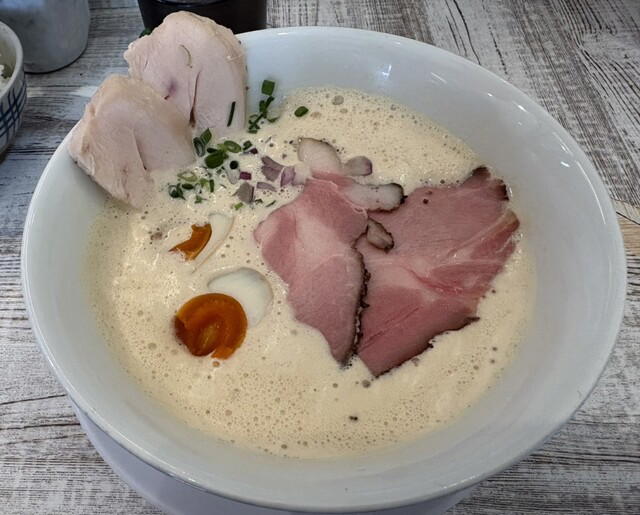
- Tokusei Tori Paitan Shio (special chicken paitan salt ramen)
A serious Osaka ramen stop rarely needs theatrical framing. It works through restraint: a focused menu category, quick decision-making, rising steam, and the clipped momentum of bowls moving through a busy room. Ramenya Akagi belongs to that compact, sensory world of ramen dining, where the meal is read in minutes, not courses, and the atmosphere is shaped by broth, timing, and proximity.
Osaka’s ramen scene is discussed less loudly than its takoyaki, okonomiyaki, or kushikatsu cultures, which makes its ramen rooms more interesting, not less. The strongest casual specialists often operate with fewer moving parts than larger destination restaurants and less tourist choreography than heavily trafficked central dining. In Osaka, the draw is not necessarily a room built for lingering, but the compressed focus of a ramen meal, where pace, heat, and solo dining all feel native to the format.
A compact counter in Osaka's neighbourhood ramen register
The small-venue grammar is the key cultural signal for this kind of meal. A ramen room puts Ramenya Akagi in the bracket where turnover, portion rhythm, and kitchen discipline matter more than interior drama. That scale changes the diner’s relationship with the bowl: little distance between preparation and service, little ceremony, and little reason to treat ramen as a long-form restaurant evening. The pleasure is concentration: a direct exchange, a clear category, and the sense that the meal belongs to the operating system of everyday Osaka dining.
That matters in Osaka because the city’s casual dining culture is dense, fast, and intensely local. A ramen venue in this tier competes not only with other ramen shops but with every efficient local meal that can feed a worker, student, or solo diner without friction. Compared with KUCHE, Jikaseimen Tsukiyomi, Hakata Tonkotsu Tenjinki, isato, and Gokumen Aonisai, Ramenya Akagi sits in an affordable specialist lane rather than a celebratory restaurant lane. The comparison frames the decision correctly: judge it not by luxury cues, but by whether the bowl delivers enough clarity to justify a dedicated trip.
Selection for Tabelog’s Ramen OSAKA 100 in 2025 gives that local reputation a public marker, with a listed Tabelog score of 3.71. Tabelog’s ramen lists are not Michelin-style fine-dining awards; they are closer to maps of serious public consensus within a crowded category. For travelers, the distinction is useful: the shop resonates with Japanese diners in a city where ramen is judged against many low-cost alternatives, not tasting-menu standards.
Why the sensory experience is built into the format
Ramen is one of the few restaurant forms where sound and pace are part of the critical vocabulary. Slurping is not a breach of decorum; it brings noodles, broth, aroma, and heat together before the bowl cools. In a compact ramen setting, that sound becomes communal without becoming overly social. Diners may share the same quick rhythm, but attention stays on the bowl and the moment of eating.
The lack of private ceremony reinforces the point. This is public, functional eating, closer to Osaka’s everyday mechanics than to a staged night out. The room’s practical pace also matters more than it may seem, because ramen depends on aroma, heat, and timing. In small spaces, the format is part of the experience: the bowl arrives with immediacy, and the diner meets it without another layer of performance.
The broader Osaka pattern is worth reading through this lens. The city’s dining identity is often reduced to street-food shorthand, yet its stronger casual restaurants reward repeatable craft: bakeries, counters, curry shops, pizza rooms, and specialist noodle houses that build loyalty through narrow execution. Readers can place Akagi alongside the wider Osaka restaurant map, from unnamed cafes and bakeries to other casual dining rooms across the city. The useful thread is specialization, not cuisine type.
For a traveler, the question is whether to make time for a bowl. The answer depends on appetite for local dining. A visitor building a day around major Osaka itineraries may keep meals close to the day’s route. A traveler treating ramen as a serious regional subject gains more by seeing how a small Osaka ramen venue works beyond the most tourist-facing version of the city. That is the shop’s value: Osaka as lived city rather than postcard.
How to place it in a wider Osaka itinerary
Ramenya Akagi works as a focused meal, not an anchor for a long evening. The service model for this kind of ramen visit favours decisiveness, and the room rewards simple etiquette: arrive ready to choose, eat while the noodles hold texture, and keep the flow moving when finished. That rhythm is not brusque; it is the social contract of small ramen shops across Japan.
Because small ramen venues often run on immediate demand, timing becomes strategy. Lunch and dinner can carry different Osaka crowd patterns: lunch may compress local traffic, while evening can bring diners willing to wait after work. Treat the visit as flexible within the day, not the sole fixed point of an itinerary.
It also suits solo diners. Many premium restaurant formats in Japan are harder to access alone or require advance planning; ramen often inverts that logic. A single diner can be easier to absorb into the flow, and the experience loses nothing without a companion. For independent visitors in Osaka, the shop corrects the assumption that notable dining requires a full table, long reservation window, or formal budget.
For broader planning, place the meal within our full Osaka restaurants guide, then build the trip through our full Osaka hotels guide, our full Osaka bars guide, our full Osaka wineries guide, and our full Osaka experiences guide. The wider Japan and overseas casual-dining trail can be read through the same lens: modest specialist rooms, local habits, and focused meals that reveal more than their price point suggests.
The case for Ramenya Akagi is not grandeur. It is a clear example of Osaka ramen stripped to essentials: 2025 Tabelog recognition, Osaka setting, affordable listed pricing, and a meal governed by heat, speed, and attention. For travelers who care about the mechanics of everyday Japanese dining, that is reason enough.
Frequently asked questions
How do I find Ramenya Akagi?
Osaka.
Is Ramenya Akagi more mid-range or high-end?
Pricing at Ramenya Akagi is listed as - JPY 999 - JPY 999.
What are the opening hours for Ramenya Akagi?
Check current opening hours before visiting Ramenya Akagi.
What is Ramenya Akagi known for?
Ramenya Akagi is known as a ramen venue in Osaka and is listed in Tabelog’s 2025 Ramen OSAKA 100, with a Tabelog score of 3.71.
Cost and Credentials
Comparable venues in the metro at similar price points.
| Venue | Cuisine | Price | Awards | Notes |
|---|---|---|---|---|
| Ramenya AkagiThis venue (the venue you are viewing) | Chicken paitan ramen shop | $10–20 | Tabelog 100 #20 | Not listed |
| Shouchiku Dou Suita yamada honten | Traditional Japanese Wagashi & Fruit Mochi | $1–10 | Tabelog 100 #65 | : Suita (Yamada area), Traditional Japanese Wagashi & Fruit Mochi |
| Raku Nijin | Niboshi-focused ramen & tsukemen shop | $10–20 | Tabelog 100 #16 | Kita, Niboshi-focused ramen & tsukemen shop |
| GARuRu KO-RI | Kakigori (Japanese shaved ice) specialty shop | $10–20 | Tabelog 100 #42 | Kita, Kakigori (Japanese shaved ice) specialty shop |
| Columbia8 Sakaisuji honmachi ten | Japanese Curry | $10–20 | Tabelog 100 #65 | Chūō, Japanese Curry |
| Kotikaze | Japanese cafe with traditional sweets | $10–20 | Tabelog 100 #96 | Tennōji, Japanese cafe with traditional sweets |
Recognition history
Dated appearances from independent guides and award organizations, with the underlying list record or original source where available.
Tabelog 100 #20 · No. 20
Tabelog · Tabelog 100 - Ramen - OSAKA - 2025