
Raa Men Men Soushin puts Shimada ramen in a serious East Japan conversation: counter-only, low-priced, and repeatedly selected for Tabelog’s Ramen EAST 100 from 2017 through 2025. The draw is not luxury theatre but ingredient discipline, with homemade noodles and a no-chemical-seasoning approach that places the bowl, rather than the room, at the centre of the visit.
Pearl is the En Primeur Club membership app — saves, bookings, and concierge access live there. Same editors, same standards.
- Address
- 3538 Kanayasakaecho, Shimada, Shizuoka 428-0017, Japan
- Phone
- +81 547-46-0160
- Website
- blog.goo.ne.jp
 Saves & bookings on Pearl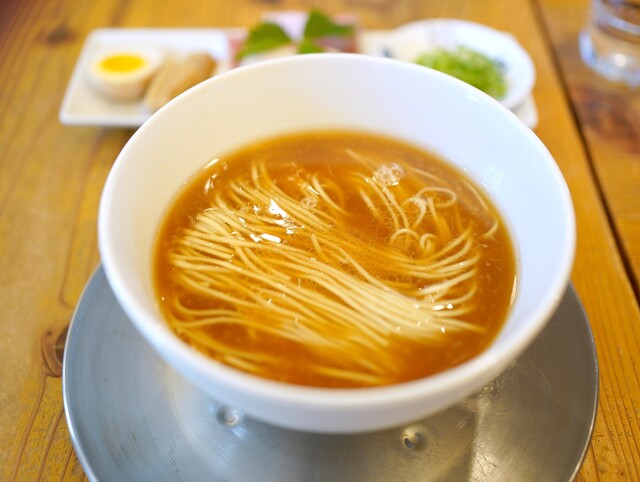
The approach is suburban Shizuoka, not metropolitan ramen theatre: a small counter room, a residential-side entrance, and the rhythm of a shop built around daytime bowls rather than late-night spectacle. In Shimada, ramen sits closer to local routine than destination dining, yet Raa Men Men Soushin has entered the East Japan ramen conversation by stripping away excess and letting sourcing, noodle-making, and broth discipline make the case.
Japan’s ramen culture often rewards maximalism: dense pork broths, heavy aroma oils, limited-run toppings, and scarcity-driven queues. The quieter counter-current is more interesting. Shops working without chemical seasonings must build depth through stock work, tare balance, and noodle texture, not shortcut intensity. Raa Men Men Soushin belongs to that camp, with homemade noodles and a stated no-chemical-seasoning approach. That is not cosmetic; it puts more weight on wheat choice, hydration, cut, broth extraction, and seasoning.
Ingredient discipline in a counter-only ramen format
The 16 counter seats place the operation in the compact ramen-shop category, where turnover, timing, and consistency matter more than ceremony. This is not a long-menu izakaya or chef’s-counter tasting format. It is the Japanese ramen counter at its most direct: order, watch the bowl come together, eat while the noodles hold their intended texture, then move on. That brevity may look casual, but repeated recognition in Tabelog’s Ramen EAST 100 from 2017 through 2025 signals sustained credibility rather than a local spike.
The ingredient angle is why the shop deserves attention beyond Shimada. Homemade noodles are not automatically superior, but they give a ramen kitchen control over bite and how the noodle carries soup. In a bowl without chemical seasonings, that control matters more. The noodle must add structure without reducing the soup to support; the broth must read clearly without additive-driven umami. It is a narrower lane than many travellers expect from ramen, and a useful corrective to the idea that the category is defined only by richness.
Shimada is not Tokyo, Kyoto, or Osaka, and that distance shapes the experience. Regional ramen shops outside major tourist circuits often have fewer English-language cues and more functional service grammar. The reward is a clearer view of ramen as everyday Japanese dining: affordable, fast, technically demanding, and judged by repeat local use as much as outside acclaim. For travellers comparing the city’s ramen options, Ramen Le Dessin offers another Shimada reference point at a similar spending level, while our full Shimada restaurants guide maps the broader local dining field.
Why Shimada's ramen scene rewards precision over polish
Shizuoka Prefecture is often read through tea, seafood, and Fuji views, but inland and rail-linked towns such as Shimada reveal a humbler food logic: specialist shops with narrow formats, modest prices, and a clientele that knows exactly what it wants. Ramen fits well. The category is democratic by price but unforgiving in execution; a small mistake in noodle timing or seasoning balance is obvious because there are few distractions.
Raa Men Men Soushin’s Tabelog recognition matters because Hyakumeiten-style lists reward category specialists across regions, not only heavily publicised urban addresses. Its Tabelog score of 3.75 places it in a competitive bracket for a local ramen shop, and repeated Ramen EAST 100 selections give a stronger signal than a single-year mention. Rankings do not settle taste, but they identify where a modest-format counter has attracted sustained attention among serious ramen followers.
The comparison with higher-priced Japanese dining is instructive. A soba specialist such as Yabusoba Miyamoto, or a formal Japanese restaurant such as Shin Japanese cuisine Obune, occupies a different meal structure, budget, and expectation set. Ramen’s strength is compression: technique, sourcing choices, and service rhythm condensed into one bowl. That is why a shop at this price level can still be worth planning around for travellers who care about Japanese food culture, not only prestige dining.
For a broader Shimada day, treat the restaurant as a focused meal stop, not an all-afternoon destination. The city’s other editorial rails can build the rest of the itinerary: our full Shimada hotels guide, our full Shimada bars guide, our full Shimada wineries guide, and our full Shimada experiences guide. The meal belongs to the precise, low-friction side of Japanese travel: arrive with cash, expect counter seating, and let the bowl define the stop.
Where it fits in a Japan-focused dining itinerary
Travellers building a wider Japan itinerary often place ramen beside sushi, wagyu, soba, curry, and regional cafés rather than treating it as a lesser category. That is right. The difference is format. A ramen counter asks for less time and ceremony, yet can show as much regional specificity as a longer meal when the kitchen makes its own noodles and avoids chemical seasonings.
Use the restaurant as a Shizuoka counterpoint to more formal or city-centred meals. The national range is broad: beef sukiyaki at -Grilled beef Sukiyaki- KAMAKURA TANUKIAN 鎌倉 たぬき庵 in Kamakura, tuna and charcoal grilling at . 鮪と炭火焼き うお炭 秋葉原店 in Tokyo, café culture at .cafe in Osaka, and contemporary dining at.know in Kumamoto all sit in different lanes. Smaller-format specialists such as (Shoku) Vietnam in Kawasaki, [Curry Senmon Ten] Maruyama Kyoju. in Sapporo, [ki:] in Kyoto, #肉といえば松田 奈良本店 in Kashihara, 1/3 HAMBURGER FACTORY in Kanazawa, and 1000 in Yokohama show how Japan’s casual dining categories can carry serious intent without luxury coding.
The same logic extends overseas, where Japanese drinking and quick-service formats have become more specialised: Jōdo Saké Bar in Los Angeles and Onigiri Time in Pasadena translate different parts of the Japanese everyday-food grammar. The restaurant is the domestic reference point: compact, counter-led, ingredient-conscious, and rooted in a city where the meal needs no spectacle to make its case.
Snapshot
Comparable venues by cuisine and price in the same metro.
| Venue | Cuisine | Price | Notes |
|---|---|---|---|
| Raa Men Men SoushinThis venue — the venue you are viewing | Japanese Ramen | $$ | Not listed |
| Ramen Le Dessin | French-influenced artisan ramen | $$ | Rokugo |
| Kin no Kotteushi (金乃こって牛) | Hida Beef Nigiri Sushi | $$ | 上二之町 |
| Mendo Hanamokoshi (麺道はなもこし) | Shoyu Ramen | $$ | Yakuin |
| 松栄寿司東口店 | 本格握り寿司 | $$ | 栗田 |
| Sobanomi | Togakushi Soba | $$ | Togakushi |
Recognition history
Dated appearances from independent guides and award organizations, with the underlying list record or original source where available.
Tabelog 100 #90 · No. 90
Tabelog · Tabelog 100 - Ramen - EAST - 2025
Continue exploring
More in Shimada
Restaurants in Shimada
Browse all →
Hotels in Shimada
Browse all →
Wineries in Shimada
Browse all →
At a Glance
- Classic
- Cozy
- Solo
- Casual Hangout
- Standalone
Current opening hours
- Monday
- 9 AM–2 PM
- Tuesday
- 9 AM–2 PM
- Wednesday
- Closed
- Thursday
- 9 AM–2 PM
- Friday
- 9 AM–2 PM
- Saturday
- 9 AM–2 PM
- Sunday
- Closed
Hours can change for holidays and private events. Last verified .
Simple, no-frills ramen-shop atmosphere in a residential-side location near Daikancho Station, with a quiet daytime-only service profile.