



La Liste Top Restaurants · Tabelog Gold #21
Our verdict
Chakaiseki Onjaku holds Tabelog Gold consecutively from 2023 through 2026 and a score of 4.58, placing it among Japan's top-ranked Japanese cuisine restaurants despite operating from a quiet residential address in Yaizu, Shizuoka. The format is tea kaiseki only, served across 12 seats, with a menu built around the port city's exceptional fish supply. Reservations are required and made in advance through the venue website.

Pearl is the En Primeur Club membership app, where members save venues, book tables and use the concierge.
The menu
What to order
- Kinmedai uroko-yaki
- Japanese jack mackerel roll
- Grilled squid
Tea Kaiseki Outside the Major Centres
Japan's kaiseki tradition is most densely mapped across Kyoto, Tokyo, and Osaka, where centuries of formal dining culture, proximity to premium ingredients, and dense critical attention have concentrated the form's highest expressions. Venues like Ifuki in Kyoto and Kikunoi in Tokyo operate within that established geography. What makes Shizuoka's Yaizu worth the detour is precisely that it sits outside that circuit. The coastal city is better known as one of Japan's leading fishing ports than as a fine dining destination, and that asymmetry turns out to be an asset. Chakaiseki Onjaku has accumulated Tabelog Gold in four consecutive years, 2023, 2024, 2025, and 2026, with a Tabelog score of 4.58, and has been selected for the Tabelog Japanese Cuisine EAST Top 100 in 2021, 2023, and 2025. Opinionated About Dining placed it 24th among all Japanese restaurants in 2024 and 42nd in 2025. La Liste awarded it 93 points in its 2026 rankings. These are not regional consolation prizes. They place Onjaku in direct comparison with kaiseki counters operating from addresses that command international pilgrim traffic.
The Physical Encounter
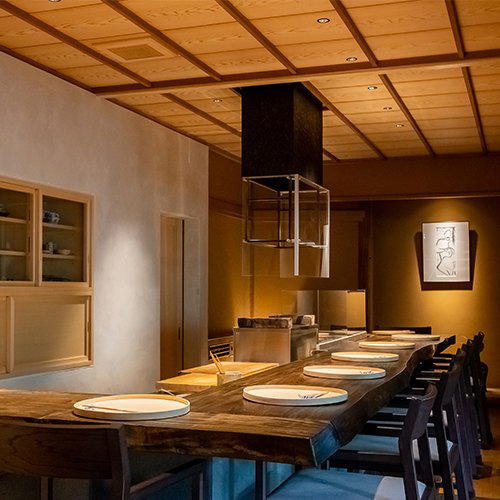
The address, a residential block in Honmachi, about 20 minutes on foot from Yaizu Station, offers none of the visual cues that precede a meal at a celebrated urban kaiseki counter. There is no grand frontage, no positioning on a well-trafficked dining street. The format is described as a house restaurant, a category that recurs across Japan's most deliberate dining experiences, where the absence of institutional signalling is itself a signal. Inside, the 12-seat space divides between eight counter seats installed in 2019 and private rooms that accommodate parties from two up to ten. The tatami room coexists with counter seating, giving the space a range that allows both the formal intimacy of traditional Japanese dining and the observational engagement of watching a meal take shape in front of you. The setting is non-smoking throughout, with parking available on-site for up to four cars, a practical detail that matters, since reaching Yaizu by car from the interchange takes roughly 15 minutes.
Chakaiseki as a Discipline
The kaiseki tradition that developed alongside the Japanese tea ceremony, cha-kaiseki, is formally distinct from the kaiseki ryori that evolved into secular haute cuisine. Where the latter can accommodate virtuosic elaboration and increasing spectacle, cha-kaiseki is constrained by its origins in hospitality before tea: the food must not overwhelm, must not distract, must support and set the conditions for what follows. Restraint here is not minimalism for its own sake but a structural principle. The cook works against the temptation to impress, and the measure of skill shifts from complexity to calibration. Chef Daigo Sugiyama operates within that framework at Onjaku. You take the course or you don't come, which is itself a curatorial position.
The city's fishing industry operates at scale, the port handles tuna, bonito (katsuo), and a range of deep-sea species, and access to product at this quality and proximity is not something a kaiseki kitchen in Kyoto or Tokyo can replicate without significant logistics. This is one of the cases where geography and cuisine are genuinely aligned rather than coincidentally adjacent. For comparison, the seasonal fish-forward positioning at Onjaku connects to broader patterns in Japanese fine dining, where the leading work being done outside the major cities often reflects exactly this kind of local supply advantage. Aji Arai in Oita operates within a similar logic, as does Goh in Fukuoka.
Award Trajectory and What It Signals
Onjaku's Tabelog trajectory, Bronze in 2020, Silver in 2021 and 2022, Gold from 2023 onward, describes a restaurant that opened in March 2019 and built its reputation through the review culture rather than through prior institutional positioning. The jump from Silver to Gold represents entry into Tabelog's top tier, where fewer than 100 restaurants across Japan are recognised in any given year in the Gold and above categories. Holding that position for four consecutive years, while maintaining a 4.58 score at a price point of JPY 20,000 to JPY 29,999 for both lunch and dinner, suggests a consistency that award snapshots alone don't convey. The price bracket, while substantial in absolute terms, sits below the ceiling of Tokyo's leading kaiseki counters, several of which exceed JPY 50,000 per head. The La Liste score of 93 places it within the band occupied by restaurants like akordu in Nara and 1000 in Yokohama, geographically dispersed kitchens that have built credibility outside the obvious centres.
Seasonal Rhythm and the Logic of the Course
The kaiseki form is, structurally, a record of a season's produce at the moment of a meal. The dishes arrive in a prescribed sequence, warming soup, raw preparations, grilled courses, simmered preparations, rice, each calibrated to demonstrate the central ingredient at its correct point of maturity. In the cha-kaiseki variant, that sequence has additional constraints: portions are modest, richness is modulated, and the meal ends where the ceremony begins. At Onjaku, the kitchen's explicit focus on fish inflects every seasonal pivot. Shizuoka's waters and the Yaizu port supply mean that the seasonal ingredient calendar is, in practice, a coastal one. Katsuo peaks in spring and again in autumn as the fish make their north and south migrations through Suruga Bay. Summer brings aji and other species from the warmer near-shore waters. The menu responds to that calendar rather than imposing one from outside. This is not unusual in ambitious Japanese cuisine, but the directness of the connection, between port, kitchen, and course, is more legible here than in city restaurants working through intermediaries.
Planning the Visit
Onjaku operates Tuesday through Saturday with lunch service starting at 12:30 and dinner at 18:30, closing at 15:30 and 21:30 respectively. The venue is closed on Sundays and every other Monday. All visits require a reservation, made through the venue website; the phone line is not reliably answered during service hours, so the website remains the functional booking channel. The 12-seat capacity means that availability is limited, and the four-year Gold run has extended that constraint further. Credit cards are accepted, Visa, Mastercard, JCB, and Amex, alongside QR code payments via PayPay and Rakuten Pay; electronic money is not accepted. Private rooms are available for parties of two to ten, and the venue can be booked for exclusive private use. Reaching Yaizu from Tokyo requires the Tokaido Shinkansen to Shizuoka or Kakegawa, then a local train or taxi to Yaizu, the restaurant sits about 1,356 metres from Yaizu Station and 15 minutes by car from the Yaizu Interchange.
For broader planning in the area, Chiso Nishikenichi represents a French-influenced alternative within Yaizu's limited but quality-conscious dining scene. Our full Yaizu restaurants guide covers the complete picture. For accommodation and further orientation, see our Yaizu hotels guide, and for after-dinner options, the Yaizu bars guide is the relevant starting point. Those building a wider Shizuoka or central Japan itinerary around serious dining might also consider Harutaka in Tokyo or HAJIME in Osaka for bookending the trip. Our Yaizu wineries guide and Yaizu experiences guide offer additional context for extending time in the region. Elsewhere in Japan, Gion Sasaki in Kyoto, 6 in Okinawa, Abon in Ashiya, and affetto akita in Akita each represent the same pattern of serious kitchens operating at distance from the capital's gravitational pull.
Frequently asked questions
Is Chakaiseki Onjaku 茶懐石 温石 good for families?
Onjaku is structured around a formal cha-kaiseki course served in a 12-seat space with counter and private rooms. The format, reservation-only, tea ceremony-derived courses, no à la carte, is better suited to adult dining occasions than family meals with children. Tabelog reviewers most commonly cite it for business and friends gatherings.
What kind of setting is Chakaiseki Onjaku 茶懐石 温石?
The venue occupies a residential address in Honmachi, Yaizu, described on Tabelog as a house restaurant with a discreet presence. Inside, there are eight counter seats installed in 2019 and private rooms accommodating up to 10 guests. The space combines counter seating with a tatami room, and the entire venue can be reserved for private use.
What awards or recognition does Chakaiseki Onjaku 茶懐石 温石 have?
Chakaiseki Onjaku 茶懐石 温石 has received recognition including:
What do regulars order at Chakaiseki Onjaku 茶懐石 温石?
There is no à la carte at Onjaku. The kitchen operates on a tea ceremony course only, a single cha-kaiseki progression with no substitutions. The venue's Tabelog profile notes a particular focus on fish, which aligns with Yaizu's status as one of Shizuoka's principal fishing ports. Budget runs JPY 20,000–29,999 per person at both lunch and dinner.
What are the operating hours at Chakaiseki Onjaku 茶懐石 温石?
Hours at Chakaiseki Onjaku 茶懐石 温石: Hours: Monday 11:30 am–1:30 pm, 5:30–8:30 pm Tuesday 11:30 am–1:30 pm, 5:30–8:30 pm Wednesday 11:30 am–1:30 pm, 5:30–8:30 pm Thursday 11:30 am–1:30 pm, 5:30–8:30 pm Friday 11:30 am–1:30 pm, 5:30–8:30 pm Saturday 11:30 am–1:30 pm, 5:30–8:30 pm Sunday 11:30 am–1:30 pm, 5:30–8:30 pm.
What part of town is Chakaiseki Onjaku 茶懐石 温石 in?
Chakaiseki Onjaku 茶懐石 温石 is located at 6 Chome-14-12 Honmachi, Yaizu, Shizuoka 425-0022, Japan, Yaizu.
At-a-Glance Comparison
Comparable venues nearby, for context on price, style, and recognition.
| Venue | Cuisine | Price | Awards | Notes |
|---|---|---|---|---|
| Chakaiseki Onjaku 茶懐石 温石This venue (the venue you are viewing) | Chakaiseki Kaiseki with Local Seafood | $150–200 | La Liste Top Restaurants · Tabelog Gold #21 | Not listed |
| Nakamura | Shizuoka Tempura Omakase | $300–500 | Not listed | near Yaizu Station |
| Chiso Nishikenichi | French Omakase with Suruga Bay Seafood | $100–150 | Tabelog Gold #6 | Nishiogawa |
| 温石 | Chakaiseki Kaiseki with Local Seafood | $150–200 | La Liste Top Restaurants · Tabelog Gold #21 | Bayan Lepas |
| 馳走 西健一 | French Omakase with Suruga Bay Seafood | $100–150 | Tabelog Gold #6 | Not listed |
| Kyubey | Traditional Japanese Omakase Sushi | $150–200 | La Liste Top Restaurants | Chūō |
Recognition history
Dated appearances from independent guides and award organizations, with the underlying list record or original source where available.
La Liste Top Restaurants
La Liste
Opinionated About Dining Top Restaurants in Japan Ranked #20
Opinionated About Dining
Tabelog Gold #21
Tabelog
The Japan Times Destination Restaurants Destination Restaurants Selection #7
The Japan Times Destination Restaurants
Full recognition history (8 entries)
Opinionated About Dining Top Restaurants in Japan Ranked #42
Opinionated About Dining
Tabelog 100 #1 · No. 1
Tabelog · Tabelog 100 - Japanese cuisine - EAST - 2025
Tabelog Gold
Tabelog
Opinionated About Dining Top Restaurants in Japan Ranked #24
Opinionated About Dining
Continue exploring
More in Yaizu
Restaurants in Yaizu
All restaurants in Yaizu →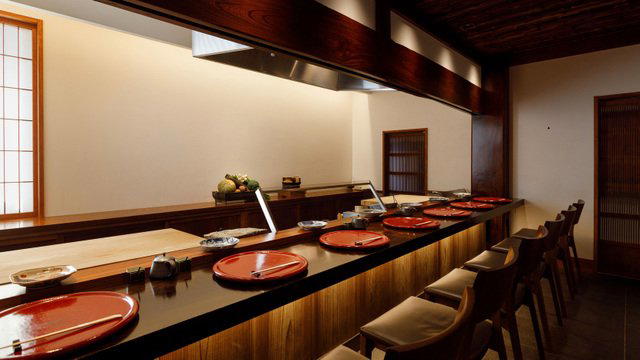

Wineries in Yaizu
Browse all →
Details
- Elegant
- Cozy
- Intimate
- Sophisticated
- Classic
- Special Occasion
- Business Dinner
- Chefs Counter
- Garden
- Open Kitchen
- Sake Program
- Local Sourcing
- Sustainable Seafood
- Garden
- Omakase
- Tasting Menu
- Counter Dining
- Sake
Current opening hours
- Monday
- 11:30 AM–1:30 PM, 5:30–8:30 PM
- Tuesday
- 11:30 AM–1:30 PM, 5:30–8:30 PM
- Wednesday
- 11:30 AM–1:30 PM, 5:30–8:30 PM
- Thursday
- 11:30 AM–1:30 PM, 5:30–8:30 PM
- Friday
- 11:30 AM–1:30 PM, 5:30–8:30 PM
- Saturday
- 11:30 AM–1:30 PM, 5:30–8:30 PM
- Sunday
- 11:30 AM–1:30 PM, 5:30–8:30 PM
Hours can change for holidays and private events. Hours as of .
Inviting traditional Japanese home with open counter, intricate wooden details, and serene Japanese garden view, creating a warm, relaxing atmosphere.