
1 Michelin Star
Our verdict
Quintessenza holds a Michelin star in Trani's historic waterfront district, operating from two dining levels within period walls and a terrace with views of the Norman-Swabian castle and the cathedral's bell tower. Run by four brothers, the kitchen reinterprets classical Italian cooking through Apulian produce, offering serious regional cuisine at a price point that holds its own against the best-value starred dining in southern Italy.

Pearl is the En Primeur Club membership app — saves, bookings, and concierge access live there. Same editors, same standards.
- Address
- Via Lionelli, 62, 76125 Trani BT, Italy
- Phone
- +39 0883 880948
- Hours
- Mon–Tue ClosedWed–Sat 12:45–2:15 PM, 7:45–10 PMSun 12:45–2:15 PM
- Website
- quintessenzaristorante.it
- Directions
- Get directions
- Booking
- Book on the venue's website
The menu
What to order
- Risotto alla pescatora
- Tortelli
- Spaghettone al limone
Where the Setting Is Part of the Argument
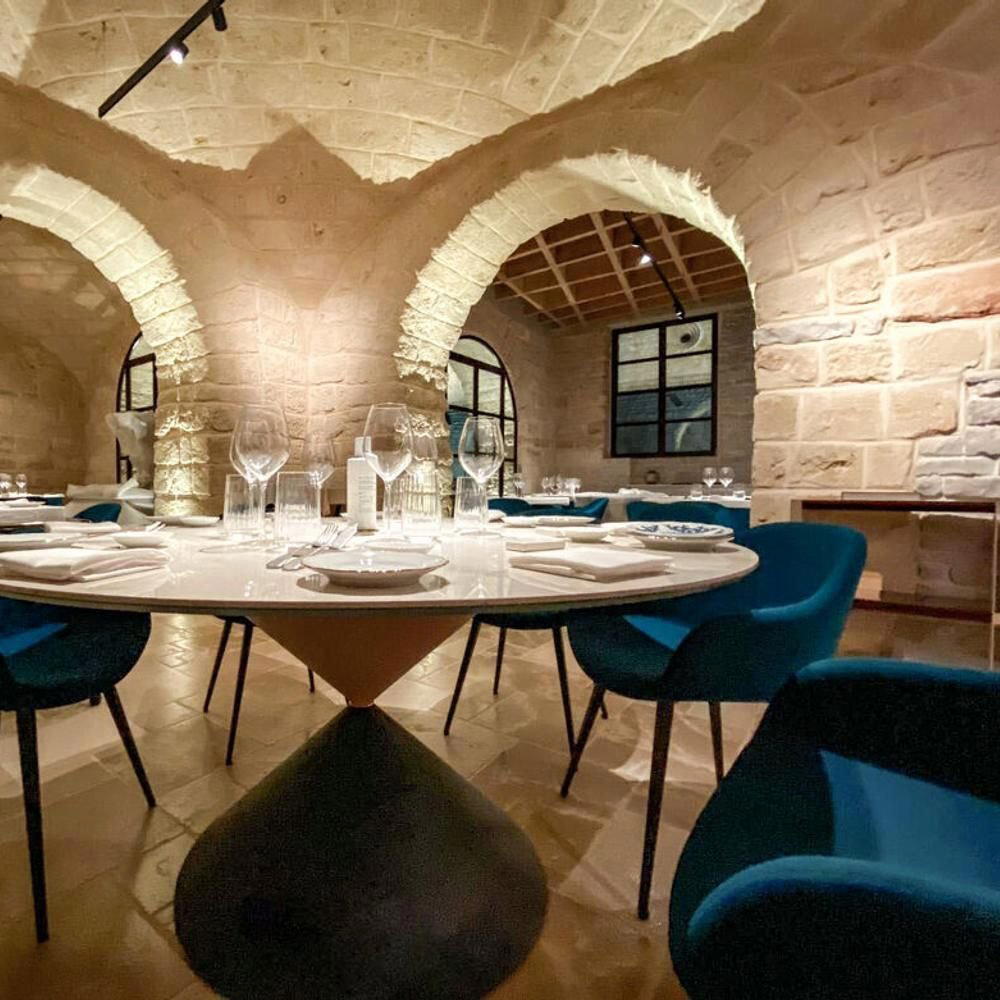
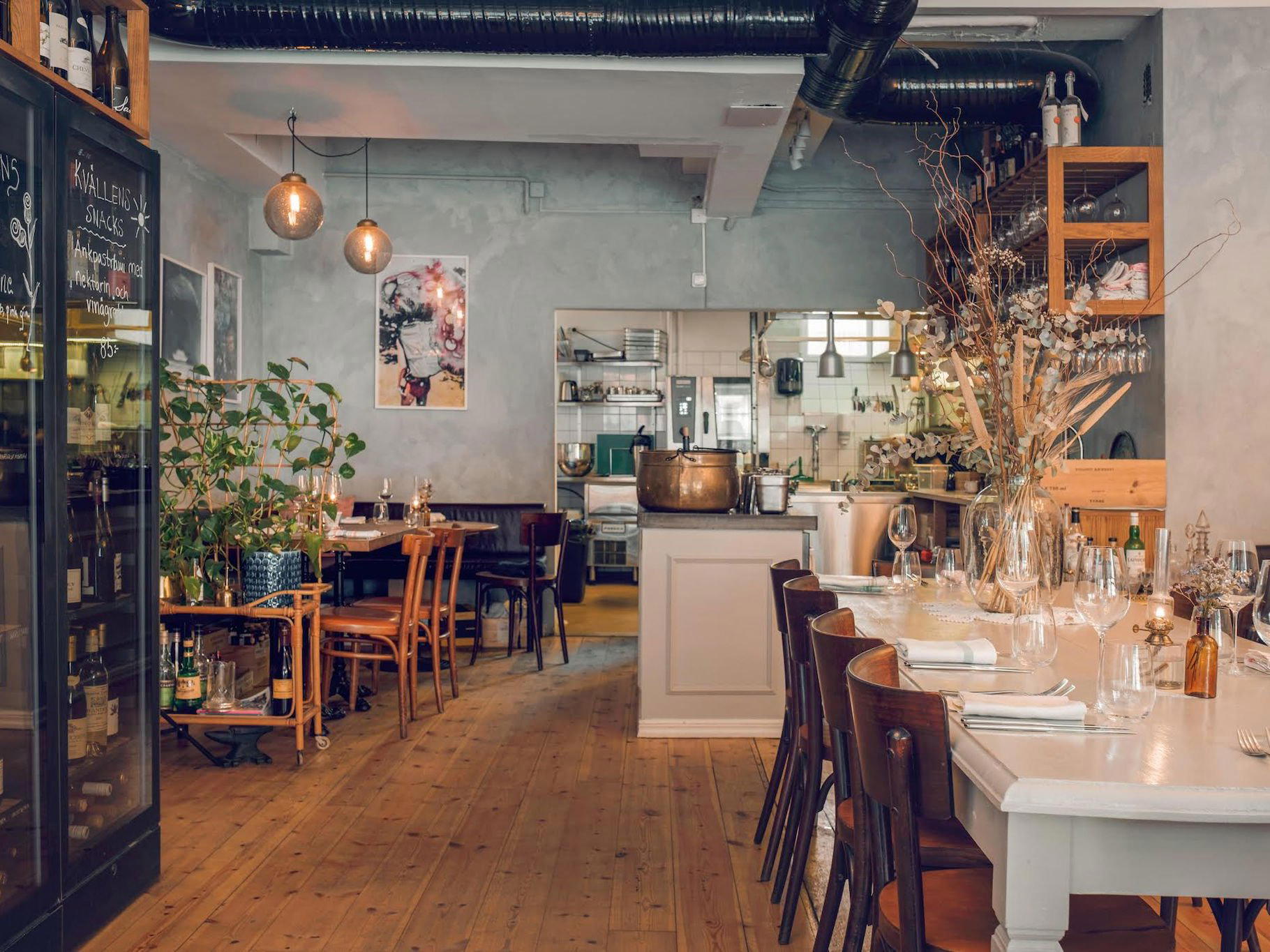
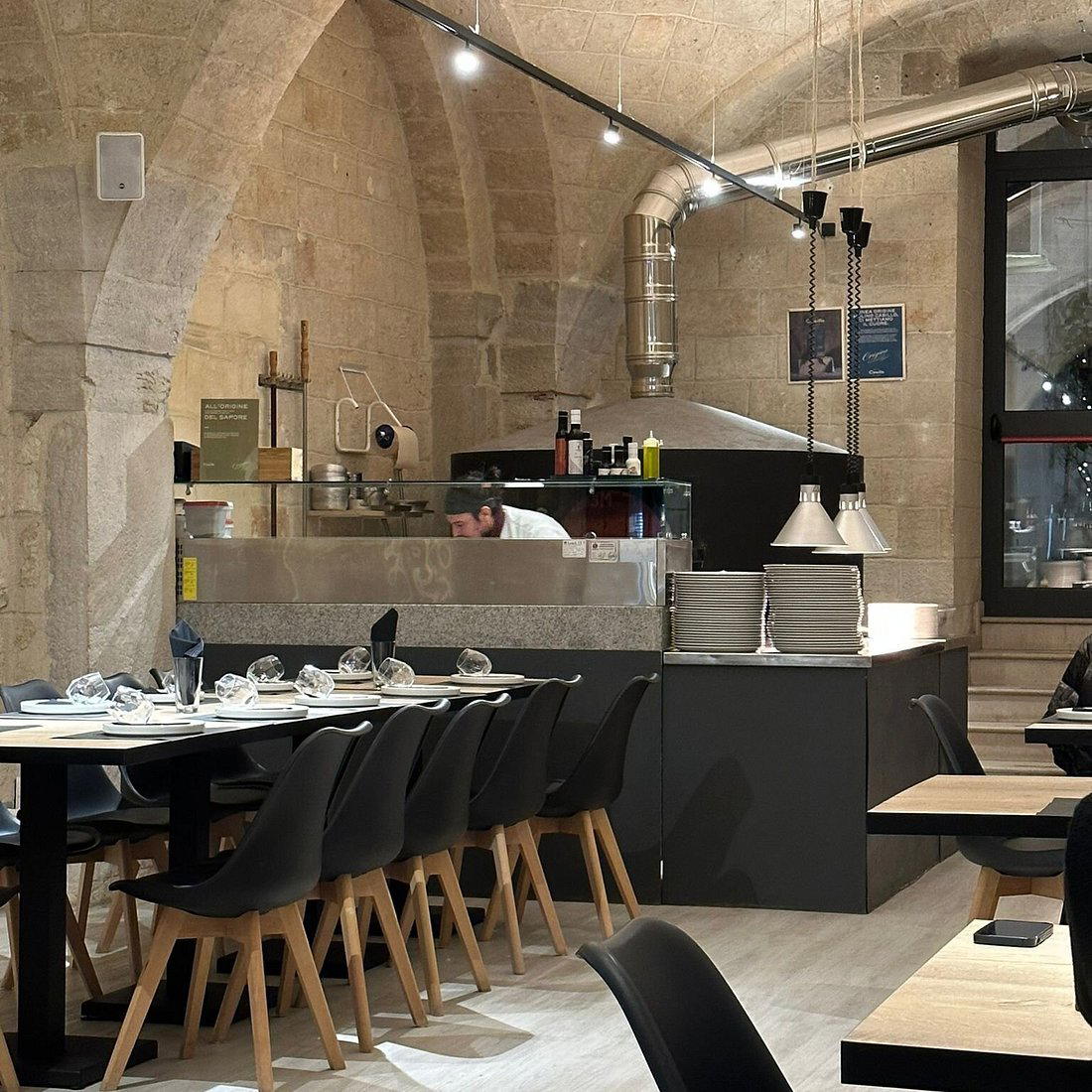
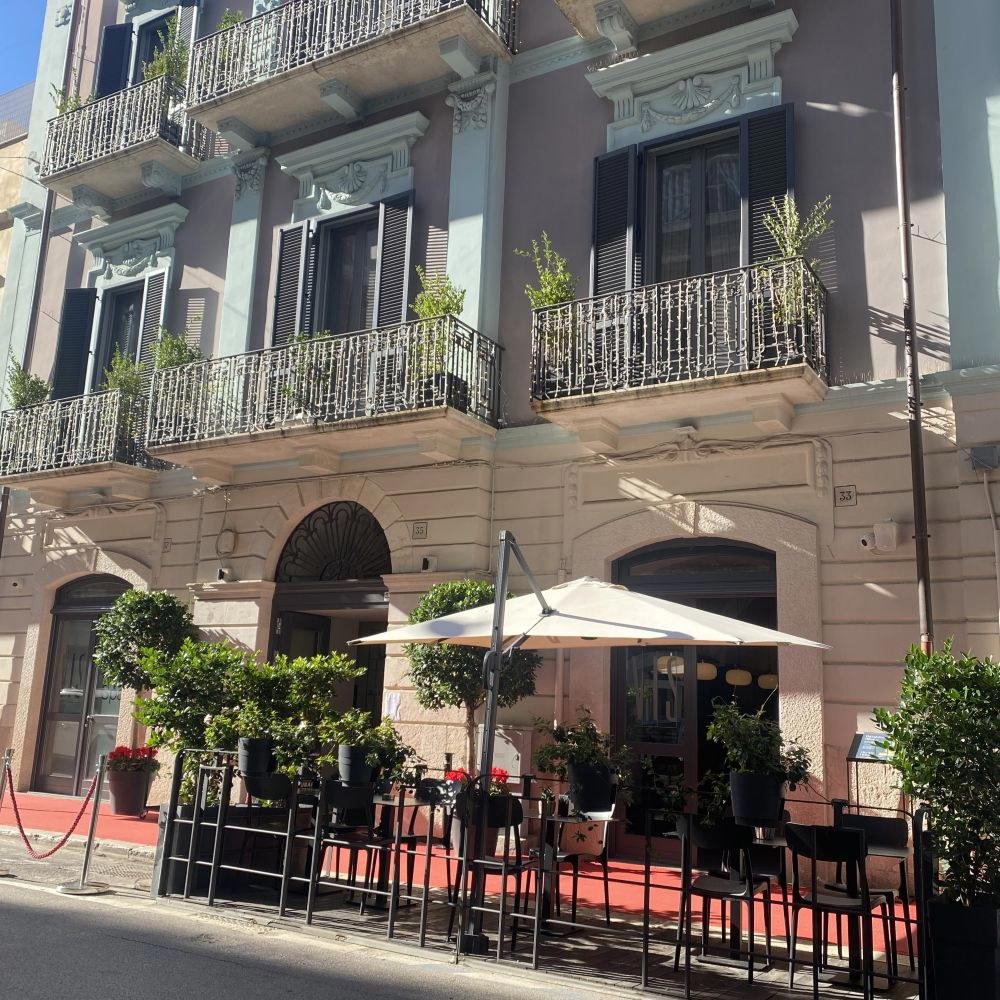
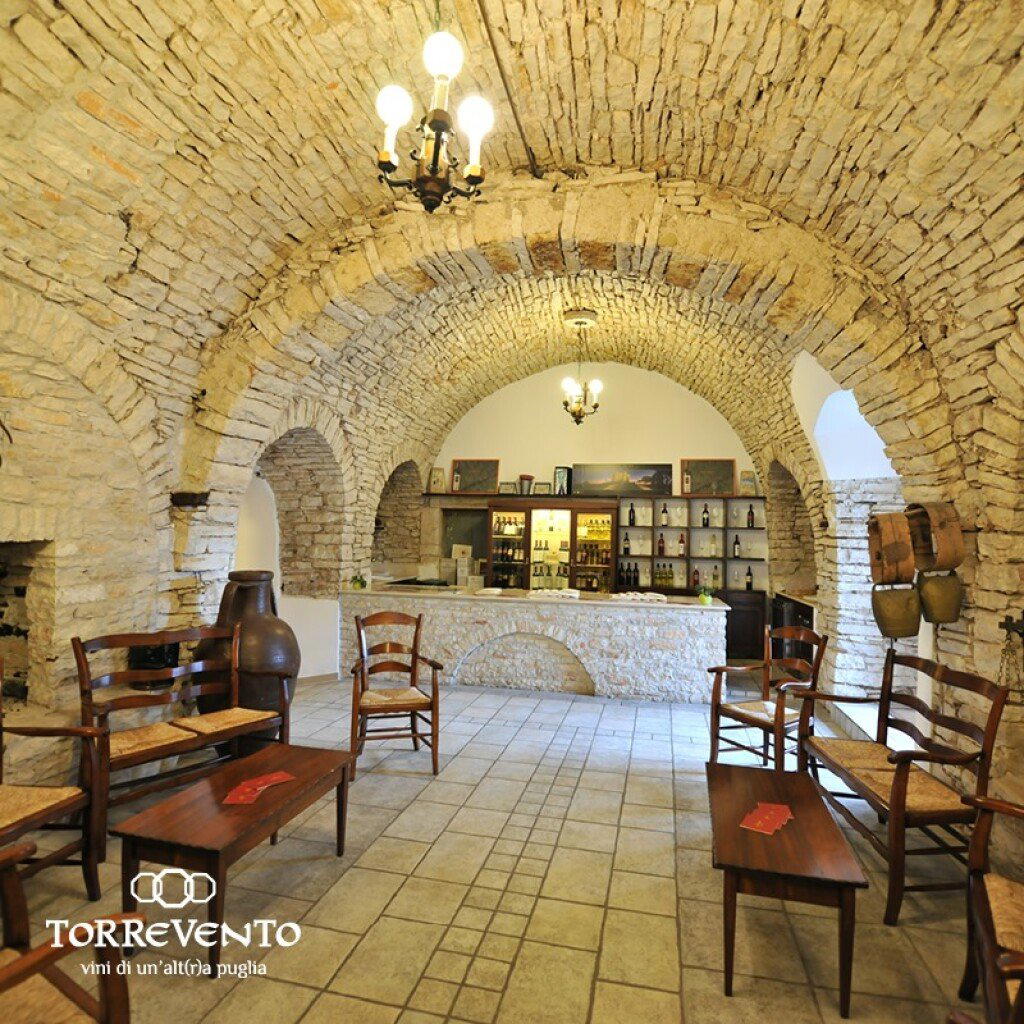
Trani's old town positions its monuments with unusual concentration: the Norman-Swabian castle sits directly at the waterfront, the cathedral rises on a promontory over the Adriatic, and the streets between them are tight enough that a restaurant on Via Lionelli can offer sightlines to both from a single terrace. Quintessenza occupies that position. Its two internal dining levels sit within period walls that carry the visual weight of the neighbourhood; the terrace, when the season allows, faces the castle directly with the cathedral's bell tower visible in the middle distance. There is also a table set within a small wine-cellar room, framed by bottles on all sides, for those who prefer enclosure over panorama. In a region where historic atmosphere is common, the layering here — multiple rooms, each with a different character — gives the space more range than most of its neighbours.
The Value Case for a Starred Dinner in Southern Italy
Michelin's 2024 star for Quintessenza places it in a small tier of recognised kitchens in Puglia, a region that has historically underperformed its culinary quality in terms of formal recognition. Across northern Italy, a Michelin-starred dinner at an equivalent address, say, Enoteca Pinchiorri in Florence or Enrico Bartolini in Milan, carries a price structure that reflects northern real-estate costs and a different clientele profile. In Trani, €€€ pricing at a starred table represents materially better value-per-course than comparable formats in the north. The same is true when the comparison runs east along the Apulian coast: Pashà in Conversano and Al Dragone in Vieste occupy the same regional tier, but Trani's density of high-quality competition at €€ and €€€ makes the step up to Quintessenza feel proportionate rather than extravagant.
Across Trani's restaurant scene, the mid-range tier is occupied by strong seafood addresses: Il Melograno and Osteria Frangipane both operate at €€ with credible quality. A step up to €€€ gets you either Le Lampare al Fortino's Mediterranean-leaning format, Terradimare's contemporary approach, Casa Sgarra's Apulian positioning, or Quintessenza's starred kitchen. Within that €€€ bracket, the Michelin credential is the clearest differentiator, and for a traveller making one considered dinner reservation in Trani, it is the most externally validated option in the set.
A Kitchen That Prioritises the Plate Over the Concept
Southern Italian fine dining has moved in competing directions over the past decade. One strand runs toward high-concept abstraction: hyper-seasonal tasting menus, elaborate technique, and a format that privileges narrative over flavour. The other strand stays closer to the classical Italian table, working Apulian ingredients through accumulated craft rather than creative provocation. Quintessenza belongs to the second tradition. The kitchen, led by Stefano Di Gennaro, works with substance and flavour as the organising principles, avoiding unnecessary complication and reinterpreting the classic Italian canon through specifically Apulian produce.
That approach has a different risk profile than the concept-driven format. A kitchen that chases novelty can hide technical weakness behind invention. A kitchen that commits to satisfying the palate through familiar reference points has nowhere to hide. The family structure, with four brothers sharing responsibility across front of house and kitchen, typically produces the kind of institutional consistency that hired-team restaurants struggle to replicate over time. It also aligns the space's character with the cooking: there is no sense of performance for its own sake.
The broader Italian fine-dining comparison set, including Osteria Francescana in Modena, Dal Pescatore in Runate, and Quattro Passi in Marina del Cantone, demonstrates the range of what a single Michelin star can represent in Italy. At the lower end of that star tier, a kitchen earns recognition primarily for technical competence in a defined regional register. Quintessenza appears to operate within that definition: a kitchen that has earned formal recognition for doing its particular thing well, rather than for rewriting the terms of what it does.
Apulian Ingredients at the Centre
Puglia's pantry is specific: Primitivo and Negroamaro grapes, burrata from Andria, orecchiette, lamb from the Murge plateau, locally caught seafood from the Adriatic coast. The region's cuisine has historically been shaped by a cucina povera tradition that turns limited ingredients into deeply flavoured dishes, and the leading Apulian kitchens carry that instinct into their higher-end registers. A dish that reinterprets classical Italian cooking through Apulian produce is doing something distinct from, say, a Piedmontese kitchen applying the same logic through truffles and Barolo. The ingredient base is different in character: the flavours tend toward intensity and earthiness, and the techniques that serve them tend toward slow cooking, preservation, and restraint in fat and acidity.
For a traveller arriving in Trani from the north or from abroad, Quintessenza functions as an access point to that tradition at a level of technical refinement that makes the ingredient qualities easier to read. That is part of the value proposition that a starred kitchen in a regional setting offers: it is not simply a better meal, it is a more articulate version of what the region's food is capable of, and by extension a better orientation for the rest of the trip's eating.
Trani sits on the northern Apulian coast, between Bari and Barletta, and is accessible by regional rail from Bari Centrale in approximately 40 minutes. The restaurant operates Tuesday through Saturday for both lunch (12:45 to 2:15 PM) and dinner (7:45 to 10:00 PM), and Sunday for lunch only. Monday is closed. Given the limited service windows and the starred reputation, advance booking is advisable, particularly for terrace tables in warmer months and for the wine-cellar room, which is a single table rather than an open seating area. For a fuller picture of where Quintessenza sits in Trani's wider dining and hospitality scene, see our full Trani restaurants guide, our Trani hotels guide, our Trani bars guide, our Trani wineries guide, and our Trani experiences guide.
How Quintessenza Sits in the Wider Italian Starred Tier
Italy's Michelin map is dense enough that a single star, depending on location, can mean very different things. In cities like Milan and Florence, a star occupies a competitive tier with strong peer pressure on price and format. In smaller regional cities, the star often carries more gravitational pull because the alternative fine-dining options are fewer. Trani, despite its quality restaurant scene, has limited starred competition, which means Quintessenza functions as a reference point for the entire city's upper dining bracket rather than one option among several. That scarcity has a practical effect: it is the address that a well-informed visitor to Trani is most likely to prioritise, and it is the address most likely to be mentioned in the same breath as the city itself when the conversation turns to food. For a broader sense of what starred dining looks like across the Italian spectrum, Atelier Moessmer Norbert Niederkofler in Brunico represents the northern Alpine end of that range, a useful comparison for understanding how regionally specific a star can be.
Frequently asked questions
Is Quintessenza expensive?
Pricing at Quintessenza is listed as €€€.
Is Quintessenza award-winning?
Quintessenza has received recognition including: What a fascinating historical context: the Swabian castle is right in front of the restaurant, the dining rooms, on two levels, are also within period walls, and finally there is the possibility, when the weather permits, to eat on a panora….
What should I order at Quintessenza?
The kitchen's approach is built around classical Italian dishes reinterpreted through Apulian produce, with chef Stefano Di Gennaro favouring substance and flavour over technical showmanship. That means local ingredients — the seafood, lamb, and regional staples of Puglia's larder — placed at the centre of the plate rather than subordinated to concept. Ask the dining room team, staffed by the Di Gennaro brothers, for the dishes that change with what is available that service.
When is Quintessenza open?
Hours at Quintessenza: Monday closed Tuesday 12:45 PM-2:15 PM 7:45 PM-10 PM Wednesday 12:45 PM-2:15 PM 7:45 PM-10 PM Thursday 12:45 PM-2:15 PM 7:45 PM-10 PM Friday 12:45 PM-2:15 PM 7:45 PM-10 PM Saturday 12:45 PM-2:15 PM 7:45 PM-10 PM Sunday 12:45 PM-2:15 PM.
Where exactly is Quintessenza?
Quintessenza is located at Via Lionelli, 62, 76125 Trani BT, Italy, Trani.
What makes Quintessenza worth seeking out?
Three things converge at this address that are difficult to replicate elsewhere in Trani: a 2024 Michelin star that places it among a small tier of recognised kitchens in Puglia; a setting within period walls opposite the Norman-Swabian castle, with a panoramic terrace in view of Trani cathedral's bell tower; and a kitchen run by four brothers that has resisted the drift toward high-concept abstraction in favour of direct, produce-led cooking. At a €€€ price point in southern Italy, the value position is considerably stronger than an equivalent star in Milan or Florence.
Awards and Standing
| Venue | Cuisine | Price | Awards | Notes |
|---|---|---|---|---|
| QuintessenzaThis venue — the venue you are viewing | Modern Italian Fine Dining | Not listed | 1 Michelin Star | Not listed |
| Casa Sgarra | Modern Apulian Fine Dining | $100–150 | 1 Michelin Star | Apulian |
| Il Melograno | Modern Seafood | $50–100 | Michelin Plate | Not listed |
| Le Lampare al Fortino | Puglian Seafood Fine Dining | $50–100 | Michelin Plate | Not listed |
| Terradimare | Modern Apulian Seafood | Not listed | Michelin Plate | Not listed |
| Osteria Frangipane | Modern Italian Seafood Osteria | Not listed | Michelin Plate | Not listed |
Recognition history
Dated appearances from independent guides and award organizations, with the underlying list record or original source where available.
Michelin 1 Star
Michelin
Full recognition history (3 entries)
Michelin 1 Star
Michelin
Michelin 1 Star
Michelin
Continue exploring
More in Trani
Restaurants in Trani
Browse all →

Quintessenza
The wine
- Wine program
- Curated wine list
- Extensive wine list
Details
- Elegant
- Romantic
- Sophisticated
- Intimate
- Date Night
- Special Occasion
- Celebration
- Terrace
- Historic Building
- Open Kitchen
- Extensive Wine List
- Local Sourcing
- Street Scene
- Tasting Menu
- A La Carte
- Gluten Free Options
Current opening hours
- Monday
- Closed
- Tuesday
- Closed
- Wednesday
- 12:45–2:15 PM, 7:45–10 PM
- Thursday
- 12:45–2:15 PM, 7:45–10 PM
- Friday
- 12:45–2:15 PM, 7:45–10 PM
- Saturday
- 12:45–2:15 PM, 7:45–10 PM
- Sunday
- 12:45–2:15 PM
Hours can change for holidays and private events. Last verified .
Refined and elegant atmosphere in a meticulously renovated historic multi-storey building with stone arches, warm lighting, and a relaxed yet sophisticated feel enhanced by far-reaching seafront views.