
Michelin Plate
Our verdict
Chef Domenico Cilenti runs a no-à-la-carte format built around Gargano's seafood and land produce, offered across two tasting menus, one of which is vegetarian. For the Gargano coast, this is the reference point for serious, product-led seafood cooking.

Pearl is the En Primeur Club membership app, where members save venues, book tables and use the concierge.
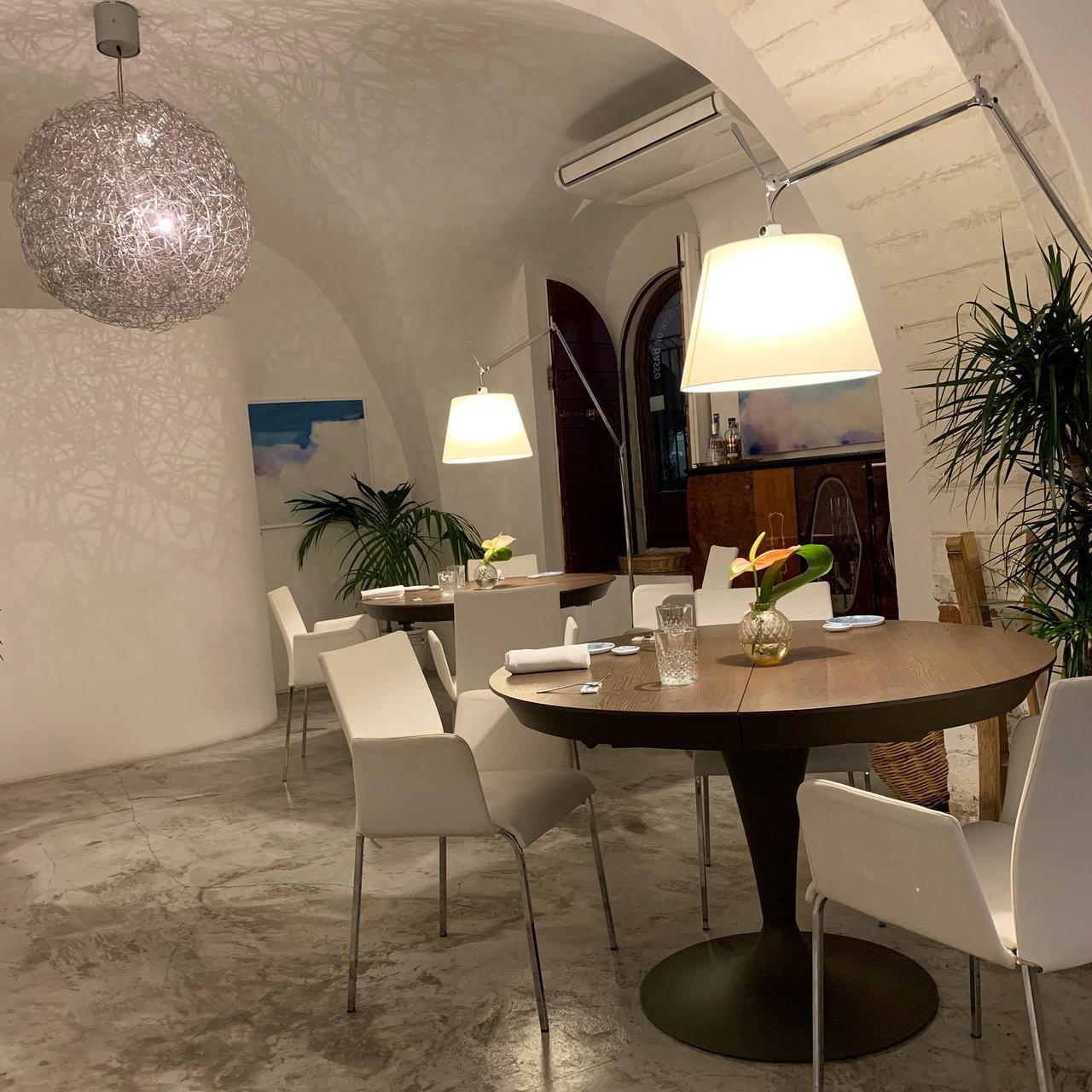
A Cliff Above the Adriatic
In Peschici's tightly wound historic centre, the approach to Porta di Basso gives almost nothing away. The entrance sits inside one of the town's narrow limestone alleys, where the buildings press close and the sea is audible before it is visible. Then the dining room opens, and the entire seaward wall is gone, replaced by a view across the Adriatic from a table perched directly above the cliff face. The terrace seats carry the longest waiting lists, and the window positions aren't far behind. This is the physical condition that shapes every meal here: the sea is not backdrop decoration, it is the operative context of the food.
That positioning also explains something about how Porta di Basso functions within the wider scene of Southern Italian fine dining. The Gargano peninsula, the spur of the Italian boot, jutting into the Adriatic from Puglia, has historically been known more for summer tourism than for serious gastronomic infrastructure. Michelin's 2024 star for Porta di Basso changed that calculus, placing Peschici on a map that previously connected the dots between the Adriatic's recognised seafood reference points further north and south. For context on that broader Italian coastal fine-dining tier, you can compare the approach here against Uliassi in Senigallia on the Adriatic's northern stretch, or Quattro Passi in Marina del Cantone on the Tyrrhenian side, both operating within the same logic of territory-specific seafood rendered through technical precision.
The Kitchen's Sourcing Framework
The editorial angle at Porta di Basso is not the tasting menu format itself, tasting menus are common across the €€€€ tier of Italian fine dining, it is what the menu is built from. Chef Domenico Cilenti's kitchen operates within a defined sourcing perimeter. Gargano produces from both sea and land form the foundation of the menu: this is a region where small fishing boats work the Adriatic daily, where the fishing grounds remain less industrialised than those serving major urban restaurant markets, and where the distance between catch and kitchen is measurable in kilometres rather than supply-chain days.
That short supply chain is the structural difference between coastal fine dining in a place like Peschici and the same price tier operating in a capital city. A €€€€ seafood restaurant in Rome or Milan sources from the same Adriatic or Mediterranean, but adds logistics, time, and intermediaries. Here, the catch arrives with minimal interruption. The quality floor for the raw ingredient is higher before the kitchen applies any technique at all. This is the argument that rigorous coastal restaurants in small towns have always made, that proximity to source is a competitive advantage no amount of kitchen investment can fully replicate from a distance.
The menu also includes a vegetarian option, which is structurally significant in a kitchen this focused on fish. It suggests that the land-side of Gargano, its produce, its herbs, its agricultural particularity, is treated as equally worthy of the same tasting-menu discipline rather than as an afterthought for non-fish-eating guests. Gargano is already known for its protected designation of origin products: the Caciocavallo Podolico cheese, the Gargano citrus varieties, and the local legumes that have made their way into serious Italian restaurant kitchens over the past decade.
Format and Commitment Level
There is no à la carte at Porta di Basso. Two tasting menus are the entire proposition. For some guests, this is a commitment question, tasting-menu-only restaurants ask for a different kind of engagement than à la carte, demanding time (the lunch service runs 12:30 to 2:30 PM; dinner runs 7:00 to 10:30 PM), appetite, and trust in the kitchen's sequencing. This format sits within a well-established tradition of Southern Italian fine dining, where the chef's menu has become the dominant mode of expression at the top of the market. You see it at Reale in Castel di Sangro in Abruzzo, and it characterises much of the creative Italian dining scene from Osteria Francescana in Modena down through the peninsula's starred restaurants.
The tasting-menu format also concentrates the kitchen's sourcing discipline. When a restaurant commits to a fixed sequence of courses, it can build around what arrived that morning rather than maintaining a standing supply of fifteen à la carte proteins. For a seafood kitchen in a small fishing town, this is operational logic as much as culinary philosophy. The menu can move with the catch without disappointing guests who came expecting a specific dish.
Among the comparable seafood addresses further along Italy's coasts, this model is increasingly the norm at the Michelin level. Alici Restaurant on the Amalfi Coast and Gambero Rosso in Marina di Gioiosa Ionica both operate in the same territory of southern Italian coastal seafood at the serious end of the market, and the tasting menu has become the lingua franca of that tier.
Peschici in Context
Peschici sits within the Gargano National Park on a promontory above the Adriatic, and its historic centre, a dense cluster of whitewashed buildings along a clifftop, is one of the more architecturally coherent old towns in Puglia. It draws strong summer tourism, but the shoulder seasons (May through June, and September through October) offer the combination of good weather and manageable crowds that serious restaurant visitors tend to prefer. This is particularly relevant for Porta di Basso, where the outdoor terrace tables become the most sought-after seats and reservations are harder to secure during the peak weeks of July and August.
Tuesday closures are fixed in the current schedule, so any planning should account for that. The restaurant operates lunch and dinner most days, with Wednesday running dinner-only. Given the Gargano's relative distance from Italy's main transport arteries, Foggia is the closest rail hub, roughly 90 kilometres to the south, most visitors arrive by car, and the area rewards a multi-day stay rather than a single-purpose trip. For guidance on where to stay and what else the town offers, see our full Peschici hotels guide and our full Peschici experiences guide.
For drinking before or after dinner, our full Peschici bars guide covers the options within the historic centre. And for a fuller view of dining across the town, our complete Peschici restaurants guide maps the range from casual to formal.
Where It Sits in the Italian Fine Dining Map
Compared to the longer-tenured multi-star addresses in the Italian canon, Enoteca Pinchiorri in Florence, Le Calandre in Rubano, Piazza Duomo in Alba, Dal Pescatore in Runate, Enrico Bartolini in Milan, or Atelier Moessmer Norbert Niederkofler in Brunico and Casa Perbellini 12 Apostoli in Verona, it is a newer entry in the starred tier and one defined specifically by its geographic particularity rather than by urban prestige or decades of accumulated reputation.
That is both a limitation and a specific kind of credibility. The case for Porta di Basso is the Gargano itself: the fishing grounds, the produce, the cliff-edge setting, and the tasting menu built directly from the territory.
Planning Your Visit
The no-à-la-carte format means all guests commit to a tasting menu on arrival, so visiting with significant dietary restrictions requires advance communication with the restaurant. The terrace tables are the most in-demand seats, and booking well ahead during summer is advisable, this is a small restaurant in a town that fills with visitors from June through August. The shoulder months deliver a more relaxed experience at the same quality level. Tuesday remains the weekly closing day, and Wednesday is dinner-only; all other days offer both lunch (12:30–2:30 PM) and dinner (7:00–10:30 PM).
Frequently asked questions
Is Porta di Basso child-friendly?
There is no à la carte option, which means no flexibility for shorter or simpler meals. Families with young children would find the format and duration difficult to accommodate.
What's the vibe at Porta di Basso?
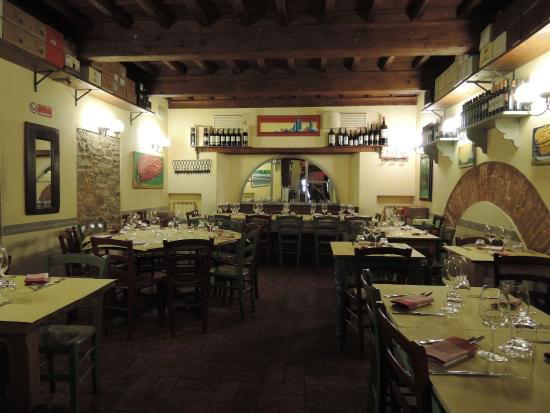
The entrance is through a narrow alley in Peschici's historic centre, which gives no indication of what follows: a dining room built into a cliff above the Adriatic, with terraces and sea-facing windows as the primary draw.
What kind of recognition has Porta di Basso received?
Porta di Basso has received recognition including: Although the entrance is in one of the alleys of the historic center, the dining room opens entirely towards the sea, as it is perched on a cliff overlooking the water. Naturally, the most sought-after tables are on the terraces or near the….
What dish is Porta di Basso famous for?
The kitchen's Michelin recognition in 2024 is tied to its tasting menu framework, which draws on Gargano products from both sea and land. A vegetarian tasting menu runs alongside the main menu, which is less common in a coastal seafood-focused restaurant at this level in southern Italy.
In Context: Similar Options
| Venue | Cuisine | Price | Awards |
|---|---|---|---|
| Porta di BassoThis venue (the venue you are viewing) | Contemporary Italian Fine Dining | $100–150 | Michelin Plate |
| Atelier Moessmer Norbert Niederkofler | Modern Alpine Fine Dining | $300–500 | 3 Michelin Stars · World's 50 Best #20 |
| Dal Pescatore | Classic Italian Fine Dining | $200–300 | 3 Michelin Stars · World's 50 Best #38 |
| Enoteca Pinchiorri | Contemporary Italian Fine Dining | $200–300 | 3 Michelin Stars · World's 50 Best #32 |
| Enrico Bartolini | Modern Italian Fine Dining | $300–500 | 3 Michelin Stars · World's 50 Best #85 |
| Osteria Francescana | Avant-Garde Italian Contemporary | $300–500 | 3 Michelin Stars · World's 50 Best #1 |
Recognition history
Dated appearances from independent guides and award organizations, with the underlying list record or original source where available.
Michelin Plate
Michelin
Continue exploring
More in Peschici
Restaurants in Peschici
All restaurants in Peschici →
Wineries in Peschici
Browse all →
Details
- Elegant
- Scenic
- Intimate
- Sophisticated
- Date Night
- Special Occasion
- Terrace
- Waterfront
- Extensive Wine List
- Local Sourcing
- Waterfront
- Tasting Menu
- Vegetarian Friendly
- Vegan Options
- Gluten Free Options
Current opening hours
- Monday
- 12:30–2:30 PM, 7–10:30 PM
- Tuesday
- Closed
- Wednesday
- 7–10:30 PM
- Thursday
- 12:30–2:30 PM, 7–10:30 PM
- Friday
- 12:30–2:30 PM, 7–10:30 PM
- Saturday
- 12:30–2:30 PM, 7–10:30 PM
- Sunday
- 12:30–2:30 PM, 7–10:30 PM
Hours can change for holidays and private events. Hours as of .
Refined all-white interior with terraces and windows offering dramatic sea views, creating a magical and sensory atmosphere especially at sunset.