Pocha 32
Pocha 32 sits on West 32nd Street in Manhattan's Koreatown strip, serving the kind of late-night Korean street food that has anchored the block for decades. The format draws on the pojangmacha tradition, informal tent-stall eating, transposed into a full-service dining room. It occupies a different price tier and register from the progressive Korean restaurants that have earned Michelin attention nearby.
 Discover on Pearl
Pearl is the En Primeur Club membership app — saves, bookings, and concierge access live there. Same editors, same standards.
- Address
- 15 W 32nd St (btwn Broadway & 5th Ave), New York, NY 10001
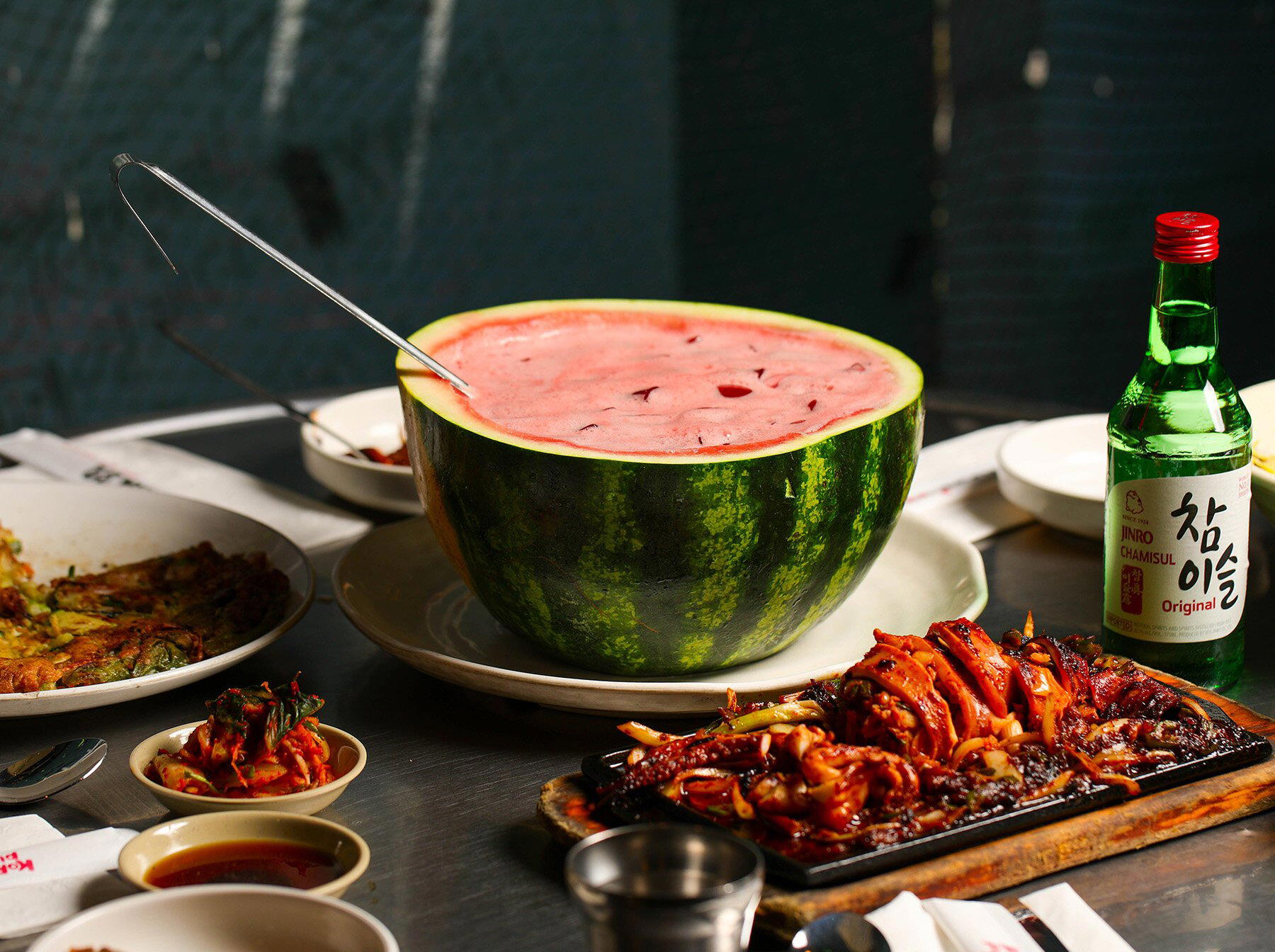
Koreatown Before the Tasting Menus Arrived
Manhattan's West 32nd Street has operated as a Korean dining corridor since the 1980s, long before Atomix or Jungsik New York redefined what progressive Korean cooking could look like in a fine-dining frame. The block between Broadway and Fifth Avenue has always run on a different logic: high-volume, late-night, built around the communal rhythm of shared plates rather than the choreography of a tasting counter. Pocha 32 belongs to that older, noisier tradition, drawing on the pojangmacha format, the street-stall tent culture that has fed Seoul after midnight for generations, and delivering it inside a casual Korean pub on West 32nd Street in New York.
That lineage matters because it explains why Pocha 32 sits so far outside the competitive set of, say, Masa or Per Se. Those rooms are about precision, restraint, and the kind of service architecture that involves separate teams for bread, wine, and tableside preparation. The pojangmacha model is the opposite: abundance, noise, and a table that fills up with small plates faster than you can clear the previous round. Koreatown's durability as a dining destination rests precisely on maintaining that distinction, even as high-end Korean cooking has moved into a different register entirely.
The Pojangmacha Tradition in a Fixed Address
The pojangmacha is not just an aesthetic, it is a specific social format with deep roots in Korean working-class food culture. The original stalls were collapsible tent structures, typically run by a single operator, offering grilled skewers, spicy rice cakes, fish cakes in broth, and anju (drinking food) to office workers, students, and anyone who needed a cheap meal after dark. What distinguished the format from ordinary street food was the drinking culture built around it: anju is food designed to accompany soju or makgeolli, and the pacing of the meal is calibrated to the rhythm of pouring and refilling rather than to a kitchen's tasting sequence.
Translating that format into a Manhattan dining room requires certain compromises, health codes, fixed seating, a printed menu, but the social logic survives. The table is the unit of activity, not the individual diner, and the food arrives in waves rather than courses. This is a model that restaurants across the city have moved toward in the past decade, as New York diners have become more comfortable with shared-plate formats. But on West 32nd Street, it was never a trend. It was always just how dinner worked.
The Floor as a Collaborative System
The editorial angle most relevant to Pocha 32 is not the kitchen in isolation but the way the room functions as a system. In pojangmacha-derived dining, the server is doing substantially more interpretive work than in a Western tasting-menu context. There is no sommelier walking a guest through pairing logic, no chef's card explaining provenance. Instead, the front-of-house team reads table pace, manages the flow of anju items against drink orders, and helps first-time diners sequence dishes that are built to overlap rather than follow in linear succession. That skill set is particular, and it is different from the highly scripted service choreography you find at restaurants like Le Bernardin.
The drinking component is inseparable from how the food is ordered and paced. Soju arrives in small glasses, shared around the table, and the expectation is that dishes keep coming as long as glasses are being refilled. This is not a room where the meal has a defined endpoint, it ends when the table is ready. Understanding that rhythm is what separates a competent server from a genuinely useful one in this format. A good floor team in a pocha-style room is effectively managing a collective social experience, not just taking and delivering orders.
This collaborative dynamic between kitchen output and floor management is part of what distinguishes the pojangmacha format from both casual fast-food Korean (of which there is plenty in the surrounding blocks) and the more formally structured Korean restaurants that have attracted Michelin attention in New York. The middle ground, informal but attentive, high-volume but not impersonal, is harder to maintain than either extreme.
Where Pocha 32 Sits in the New York Korean Scene
New York's Korean dining range now spans a wider spectrum than any other U.S. city outside of Los Angeles. At the leading end, Atomix operates as a counter-format tasting menu with wine pairings and a research-led kitchen that positions it against European fine dining rather than against its Koreatown neighbors. Jungsik similarly operates at a price point and service level that has more in common with Per Se than with anything on West 32nd Street.
Pocha 32 operates at the opposite end of that spectrum without apology. It is priced accessibly, is walk-in friendly, and is built around a social format that does not require reservation planning. That accessibility has its own value in a city where the premium Korean tier has become genuinely difficult to book and expensive to sustain across multiple visits. For readers who have already experienced what Atomix or Jungsik are doing, Pocha 32 represents the cultural root from which those kitchens ultimately grew, not a lesser version of the same thing, but a different thing entirely.
That distinction is worth understanding for anyone working through our full New York City restaurants guide. The Korean dining scene in Manhattan rewards readers who engage with its full range rather than anchoring only at the Michelin end. The pojangmacha tradition predates the tasting-menu moment and will outlast it.
Planning Your Visit
| Venue | Format | Price Tier | Booking Lead Time | Late-Night |
|---|---|---|---|---|
| Pocha 32 | Pojangmacha / shared plates | $–$$ | Walk-in friendly | Yes |
| Atomix | Counter tasting menu | $$$$ | Weeks to months | No |
| Jungsik New York | Progressive Korean, à la carte / tasting | $$$$ | Several days to weeks | No |
West 32nd Street is accessible from multiple subway lines and operates as a dining destination that peaks after 9pm on weekends. Pocha 32 is located at 15 W 32nd St (btwn Broadway & 5th Ave), New York, NY 10001. The format is well-suited to groups, since the anju model assumes shared plates across a table rather than individual ordering.
What It’s Closest To
Comparable venues nearby, for context on price, style, and recognition.
| Venue | Cuisine | Price | Awards | Notes |
|---|---|---|---|---|
| Pocha 32This venue — the venue you are viewing | Korean Pub | $$ | , | |
| Soju Haus | Korean Pub | $$ | , | Midtown South-Flatiron-Union Square |
| Kimganae | Korean Bunsik Comfort Food | $$ | , | Flushing-Willets Point |
| The Dynamo Room | Classic New York Steakhouse | $$ | , | Midtown-Times Square |
| MAMATACO | Mexican Fusion | $$ | , | East Williamsburg |
| Suzume | Japanese Fusion Izakaya | $$ | , | Williamsburg |
Continue exploring
More in New York City
Restaurants in New York City
Browse all →
Bars in New York City
Browse all →
Hotels in New York City
Browse all →
Wineries in New York City
Browse all →
At a Glance
- Lively
- Energetic
- Trendy
- Hidden Gem
- Late Night
- Casual Hangout
- Group Dining
- Sake Program
Energetic and packed with cool lighting and urban decor evoking a Korean street food night market.