Pizzeria Salvy
Our verdict
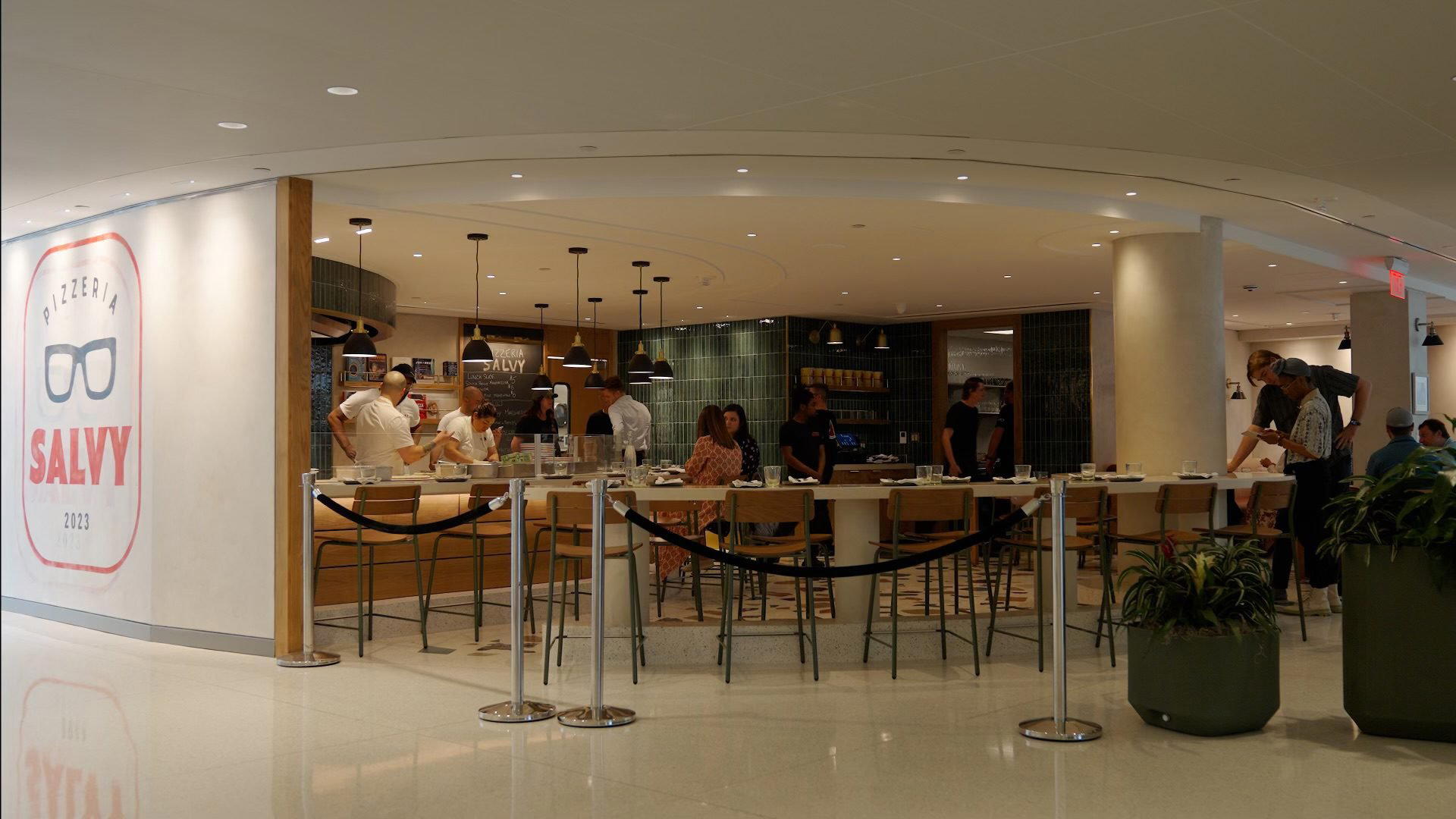
Pizzeria Salvy occupies a prominent address on Arch Street in Philadelphia's Center City, placing it in a neighborhood where the city's appetite for serious, technique-driven pizza has grown steadily over the past decade. The kitchen draws on classical Italian methods applied to locally sourced ingredients, putting it in conversation with a broader movement reshaping how American cities think about pizza as a craft category.

Pearl is the En Primeur Club membership app, where members save venues, book tables and use the concierge.
The menu
What to order
- Sal's Meatballs
- Clam Pie
- South Philly Cheese
Where Arch Street Meets the Neapolitan Tradition
Philadelphia's Center City has become a reliable testing ground for what happens when American ambition meets European method. The stretch of Arch Street near 1800 puts Pizzeria Salvy in a dense pocket of the city where office workers, hotel guests, and destination diners all converge, creating a room that operates at different registers depending on the hour. The physical address alone signals something: this is not a neighborhood-only operation tucked into a residential block, but a spot positioned to perform for a cross-section of the city's daily population.
Pizza, across American cities, has undergone a significant reappraisal over the past fifteen years. What was once filed under casual and low-stakes has fractured into a tiered category, with serious practitioners importing wood-fired techniques, flour sourcing philosophies, and fermentation protocols from Naples and Rome, then applying them to local supply chains. Philadelphia has not been immune to this shift. The city's Italian-American heritage runs deep in South Philly, but the more recent wave of technique-led pizzerias has spread into Center City and beyond, pushing the category upmarket without fully abandoning its democratic roots.
Local Product, Imported Method
The editorial angle that most usefully frames Pizzeria Salvy is the intersection of imported technique and regional sourcing, a pattern that defines the more serious end of American pizza right now. Neapolitan and Roman traditions carry codified rules around dough hydration, fermentation length, oven temperature, and topping restraint. When those rules meet Mid-Atlantic dairy, Pennsylvania-grown produce, and the particular character of local cured meats, the result is something neither purely Italian nor generically American.
This tension, between fidelity to a method and responsiveness to local product, is where the most interesting pizza kitchens currently operate. It requires the kitchen to hold two things simultaneously: discipline around process and flexibility around sourcing. The leading iterations of this approach produce a crust that behaves according to classical expectations while carrying flavor inflected by its specific geography. Whether Pizzeria Salvy executes this at the level of Philadelphia's stronger Italian-leaning kitchens is a question that rewards a visit rather than a verdict from the outside.
For comparison, Philadelphia's Italian dining scene has reference points across price tiers. Barbuzzo, positioned as a Mediterranean small-plates operation, occupies the casual-to-mid end of the market. Serious pizza has historically required a trip to South Philly's residential streets. A Center City address for a pizzeria with craft ambitions represents a different kind of wager on who the customer is and how they think about the category.
Philadelphia's Wider Dining Moment
Pizzeria Salvy sits inside a Philadelphia restaurant scene that has attracted sustained national attention over the past several years. Kalaya repositioned Thai cooking as a serious fine-dining proposition. Mawn brought Cambodian and Pan-Asian cooking into the conversation about what contemporary Philadelphia dining looks like. Fork and Friday Saturday Sunday have anchored the New American end of the market, while My Loup has pushed French-inspired technique into a more intimate register. Against this backdrop, a pizza-focused kitchen on Arch Street is entering a scene that has developed real critical infrastructure and an audience willing to pay attention to craft distinctions.
The city competes differently from New York or Chicago in the pizza category. New York's slice culture and Chicago's deep-dish identity both function as powerful gravitational fields that newcomers must consciously position around. Philadelphia has no single pizza tradition that exerts that kind of force, which creates genuine room for a kitchen to define its own terms. That openness is both an opportunity and a challenge: there is less inherited authority to borrow from, so the cooking has to make its own case.
For readers who want to map Philadelphia's position in the national dining conversation, the city's ambition tracks alongside what kitchens like Lazy Bear in San Francisco or Blue Hill at Stone Barns in Tarrytown have demonstrated in their own categories: that American dining, when it takes a specific tradition seriously and applies rigorous sourcing logic, can produce results that hold up against the European originals. Pizza is simply the current front on which that argument is being made most accessibly.
What the Address Tells You
1800 Arch Street places Pizzeria Salvy near the eastern edge of the Benjamin Franklin Parkway corridor, a part of Center City that runs between the business district and the cultural institutions anchored along the Parkway itself. It is a high-traffic zone with a mixed daytime and evening population, which tends to shape how a kitchen calibrates its offer. The lunch trade is real here, and the proximity to hotels and convention-adjacent foot traffic means the room cannot lean too far into the direction of destination-only dining without losing volume it needs.
That constraint is worth naming because it shapes what a craft-focused pizza kitchen can and cannot do at this address. The more austere, reservation-heavy end of the category, the kind of operation where you book six weeks out for a specific dough made from a single heritage grain, is harder to sustain in a location where walk-in traffic forms a meaningful part of the business model. The version of craft pizza that works here likely sits in a more accessible register: technically serious but operationally hospitable.
Know Before You Go
Frequently asked questions
What's the address for Pizzeria Salvy?
Pizzeria Salvy is located at 1800 Arch St, Philadelphia, PA 19103, Philadelphia.
How does Pizzeria Salvy fit into Philadelphia's broader Neapolitan pizza scene?
Philadelphia has developed a measurable concentration of Italian-method pizza operations over the past decade, with Center City acting as the primary proving ground for imported technique applied to regional sourcing. Pizzeria Salvy's Arch Street address places it within that competitive corridor, where the distinguishing factor between operators tends to be dough fermentation time and flour sourcing rather than format alone. For visitors specifically tracing Philadelphia's Italian-influenced dining options, the 19103 zip code covers several points of comparison within walking distance.
What's the signature dish at Pizzeria Salvy?
For the current menu, checking directly with the Arch Street location is the reliable route.
Should I book Pizzeria Salvy in advance?
Philadelphia's Center City dining corridor has seen sustained demand over recent years, so contacting the restaurant directly before visiting is advisable, particularly on weekend evenings.
What makes Pizzeria Salvy worth seeking out?
Pizzeria Salvy sits at the intersection of imported Neapolitan technique and Philadelphia's current dining moment, a scene that has drawn sustained national attention, with venues like Kalaya repositioning the city's culinary standing. The Arch Street address places it near the Benjamin Franklin Parkway, a part of Center City that bridges the cultural district and downtown core. That combination of method and location gives it a different footing from the city's more nightlife-driven restaurant strips.
Can Pizzeria Salvy accommodate dietary restrictions?
Neapolitan pizzerias as a category often offer vegetarian options by default, but for specific requirements, gluten-free bases, vegan preparation, reaching out to the 1800 Arch St location directly will give you a confirmed answer.
A Pricing-First Comparison
Comparable venues nearby, for context on price, style, and recognition.
| Venue | Cuisine | Price | Notes |
|---|---|---|---|
| Pizzeria SalvyThis venue (the venue you are viewing) | Modern Italian Pizzeria | $20–30 | Not listed |
| Santucci's North Broad | Original Square Pizza | $20–30 | Avenue of the Arts, Original Square Pizza |
| Cry Baby Pasta | Modern Italian Pasta & Wine | $30–50 | South Street, Modern Italian Pasta & Wine |
| Popi's Restaurant | Authentic Italian | $30–50 | Packer Park, Authentic Italian |
| Trattoria Carina | Authentic Italian Trattoria | $30–50 | Rittenhouse Square, Authentic Italian Trattoria |
| Luna BYOB | Authentic Italian BYOB | $50–100 | Rittenhouse Square, Authentic Italian BYOB |