Pillar
Our verdict
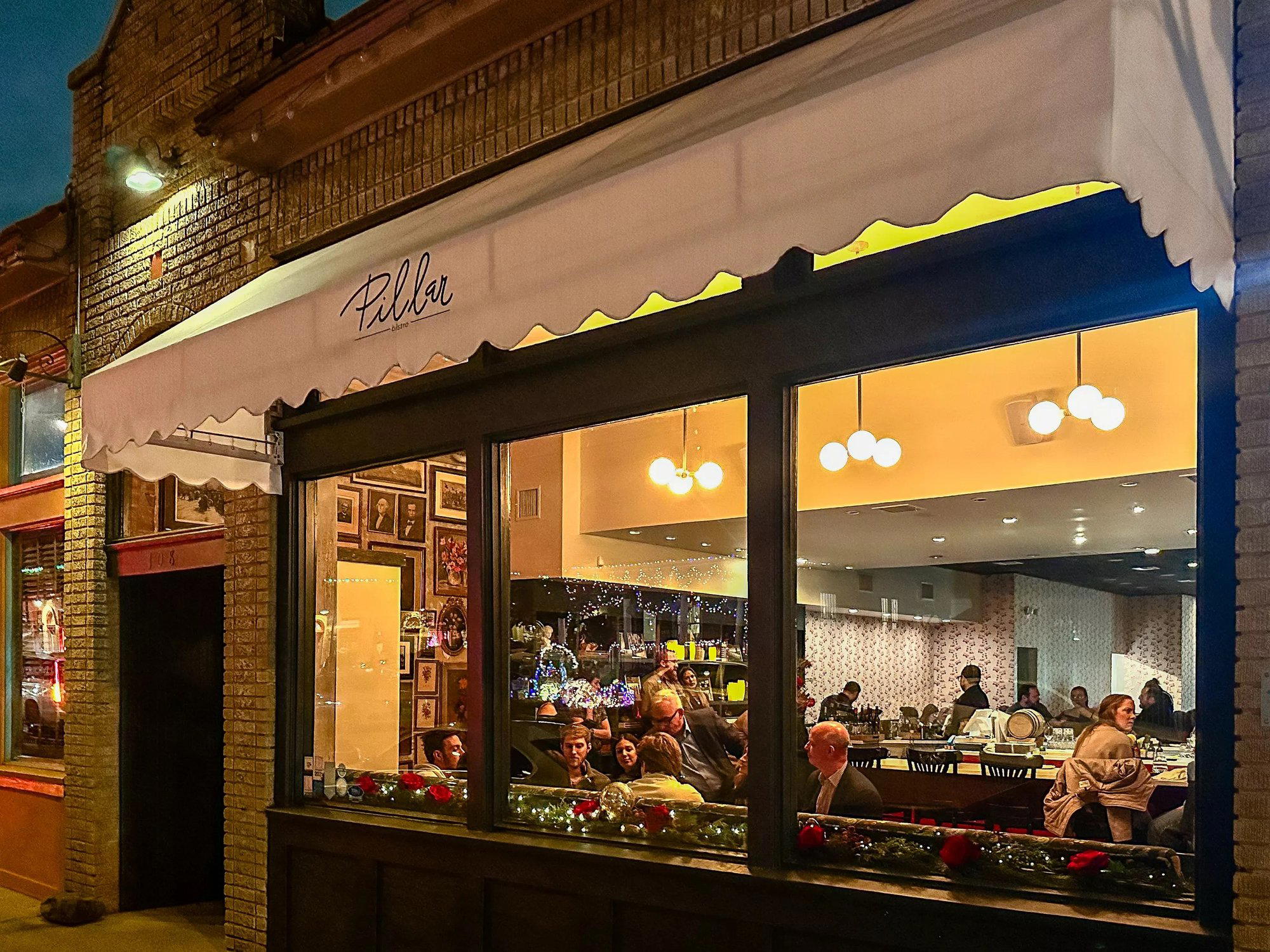
On North Bishop Avenue in the Oak Cliff neighbourhood, Pillar occupies a quietly serious position in Dallas's maturing fine-dining scene. The address places it among a cluster of chef-driven rooms that have shifted Oak Cliff from a bargain alternative into a destination in its own right. Sourcing discipline and a restrained kitchen approach define what arrives on the plate.

Pearl is the En Primeur Club membership app, where members save venues, book tables and use the concierge.
The menu
What to order
- Grilled leeks with crab and hazelnuts
- Fried chicken
- Duck cassoulet
- Nashville hot oysters
- Duck, leek, bacon pot pie
Oak Cliff's Quiet Shift, and Where Pillar Sits Inside It
For most of the last decade, Dallas's serious dining energy concentrated north of the Trinity River, in Uptown and the Design District. Oak Cliff was framed as the scrappier counterpoint: cheaper rents, more risk-tolerant operators, a neighbourhood still finding its register. That framing has become increasingly difficult to sustain. The stretch of North Bishop Avenue around the 400 block now holds a collection of rooms where the cooking asks to be taken seriously, and Pillar, at 408 N Bishop Ave, is part of that consolidation. It is not a destination that announces itself loudly. The address, a suite in a low-profile commercial building, is the kind of placement that rewards people who are paying attention to a neighbourhood rather than following a star on a map.
The broader Dallas fine-dining market gives useful context. At the top of the price tier, rooms like Fearing's and Tatsu Dallas operate at the $$$$ level with polished service infrastructure and substantial room presence. A middle tier of focused, ingredient-led restaurants has grown around them, places closer in spirit to what Mamani does on the cocktail and small-plate side, or what Lucia has built for Italian cooking in the neighbourhood. Pillar reads as part of that second cohort: tighter in format, harder to categorise by a single cuisine line, and built around sourcing choices rather than a flagship dish or a celebrity name.
The Sourcing Argument That Defines This Kind of Kitchen
Ingredient-sourcing as an editorial frame is not a new concept in American fine dining, but the credibility of the claim varies sharply by city and by room. In established farm-to-table markets, the relationship between a kitchen and its producers is often documented, named, and verifiable. Dallas has historically lagged behind cities like San Francisco, where Lazy Bear and Single Thread Farm in Healdsburg have built their entire identities around traceable supply chains, or Tarrytown, where Blue Hill at Stone Barns operates its own farm as the kitchen's primary supplier. Texas, however, has a legitimate sourcing infrastructure of its own: cattle ranches with direct-to-kitchen relationships, Gulf Coast seafood, Hill Country produce, and a growing cohort of small farms supplying urban restaurants. The question for any Dallas room making sourcing claims is whether the supply chain is genuinely specific or simply gestural.
Pillar's placement in Oak Cliff, a neighbourhood with a higher concentration of independent operators and lower tolerance for the kind of generic sourcing language that fills hotel restaurant menus, suggests a kitchen operating with some discipline on this point. The rooms that have built lasting reputations in this part of Dallas tend to hold their suppliers to account rather than using provenance as decoration. Compare that to the institutional approach: at the highest tier of American sourcing-driven kitchens, places like Providence in Los Angeles or Addison in San Diego have made supplier specificity a verifiable part of their identity, documented in menus and press coverage. Pillar operates at a different scale, but the neighbourhood it occupies has its own version of that accountability built into the culture of the block.
Format, Scale, and What the Room Signals
Suite 108 of a mixed-use building on North Bishop is not the kind of address that signals volume dining. Small-format rooms in these positions typically run limited covers, which has downstream effects on everything from sourcing flexibility (smaller quantities, more specific producers) to the pacing of service. The intimacy of that format is what separates this category from the larger, more theatrical rooms in the Dallas dining scene, such as 12 Cuts Brazilian Steakhouse, which operates on a fundamentally different scale and service logic. Pillar is closer in disposition to the kind of room where the cooking is the spectacle, and the physical environment is kept deliberately spare to direct attention toward what is on the plate.
For comparison, some of the American rooms that have made this format work at the highest level, among them Alinea in Chicago, Atomix in New York City, and The French Laundry in Napa, have used format discipline and sourcing specificity as the twin foundations of their critical standing. Pillar does not operate in that tier, and it would be misleading to frame it as a peer of those rooms. But it belongs to a lineage of thinking about what a small, serious, ingredient-led room can achieve in a neighbourhood context. Le Bernardin in New York City, Emeril's in New Orleans, and The Inn at Little Washington each occupy a different tier of American dining, but all share an insistence on knowing where the food comes from before deciding what to do with it. That intellectual priority is legible in the rooms that take it seriously, and it shapes everything from menu length to the vocabulary used to describe dishes.
The Neighbourhood as Context
Oak Cliff's dining scene in 2024 is worth understanding on its own terms rather than purely as a counterpoint to North Dallas. The neighbourhood has developed a consistent identity around independent operators, shorter menus, and a preference for craft over spectacle. 360 Brunch House and 3Eleven Kitchen and Cocktails both operate nearby and represent different registers of the same neighbourhood commitment to focused, non-corporate hospitality. Pillar sits inside that ecosystem, which means it benefits from an audience that is already comfortable with independent rooms and already disposed to engage with cooking that prioritises ingredient over presentation volume.
The competition set for Pillar is not the hotel restaurant or the celebrity steakhouse. It is the cluster of chef-driven independent rooms where reputation is built through consistency over time rather than through a single high-profile launch. That is a harder track, and a slower one, but it is the track that produces the rooms Dallas diners return to across years rather than just seasons. For a broader map of where Pillar sits in relation to the city's full dining range, the full Dallas restaurants guide offers the most complete picture of how the market is currently structured.
Know Before You Go
Address: 408 N Bishop Ave, Suite 108, Dallas, TX 75208
Neighbourhood: Oak Cliff, Bishop Arts District
Booking: Contact details not publicly listed at time of publication; check current reservation platforms for availability
Price tier: Not confirmed at time of publication; the format and neighbourhood position it in the mid-to-upper independent range
Format: Small-format independent room; intimate covers expected
Getting there: Oak Cliff is accessible by car from central Dallas; street parking on North Bishop and surrounding blocks
Frequently asked questions
Where exactly is Pillar?
Pillar is located at 408 N Bishop Ave #108, Dallas, TX 75208, Dallas.
How does Pillar fit into Dallas's Oak Cliff dining scene in 2024?
Pillar occupies a specific position in Oak Cliff's shift from Dallas's northern dining axis, it operates as a small-format, ingredient-driven room on North Bishop Ave at a moment when the neighbourhood has developed a dining identity independent of Uptown and the Design District. Suite 108 in a mixed-use building signals a deliberately intimate scale, consistent with the sourcing-focused cooking the kitchen is known for in Dallas. That combination of address, format, and culinary approach reflects how Oak Cliff's serious dining tier has taken shape through the mid-2020s.
What do people recommend at Pillar?
Pillar's kitchen at 408 N Bishop Ave, Suite 108 is organized around ingredient sourcing, so the menu shifts with what's available from regional producers. Dishes tied to that sourcing argument tend to draw the most consistent praise from regulars.
Do they take walk-ins at Pillar?
Pillar sits inside a mixed-use building in Oak Cliff's Bishop Avenue corridor, a suite-scale format that typically runs at capacity most evenings. Walk-in availability at this kind of small-format room is generally limited, particularly on weekends. Contacting the venue directly before arriving is the practical approach, as reservation policy is not publicly listed.
What's the signature at Pillar?
The defining argument at Pillar is its sourcing framework: the kitchen at Suite 108 on North Bishop builds its identity around regionally sourced ingredients rather than a single headline dish. That positioning places it alongside a tier of Dallas restaurants where the supply chain is the editorial point, not just a talking note.
Cuisine and Recognition
| Venue | Cuisine | Price | Awards | Notes |
|---|---|---|---|---|
| PillarThis venue (the venue you are viewing) | American Bistro with Global Influences | $50–100 | Not listed | Not listed |
| Fearing's | Southwestern American Steakhouse | $100–150 | Michelin Plate · Wine Spectator Award of Excellence | Not listed |
| Lucia | Contemporary Italian | $50–100 | Michelin Bib Gourmand · James Beard Award Semi Finalist | Not listed |
| Tei-An | Japanese Soba House | $100–150 | Michelin Plate | Not listed |
| Tatsu Dallas | Traditional Edomae Omakase | $150–200 | 1 Michelin Star | Japanese |
| Cattleack Barbeque | Texas Barbecue | $20–30 | Michelin Bib Gourmand | Not listed |