Penang Air Itam Laksa
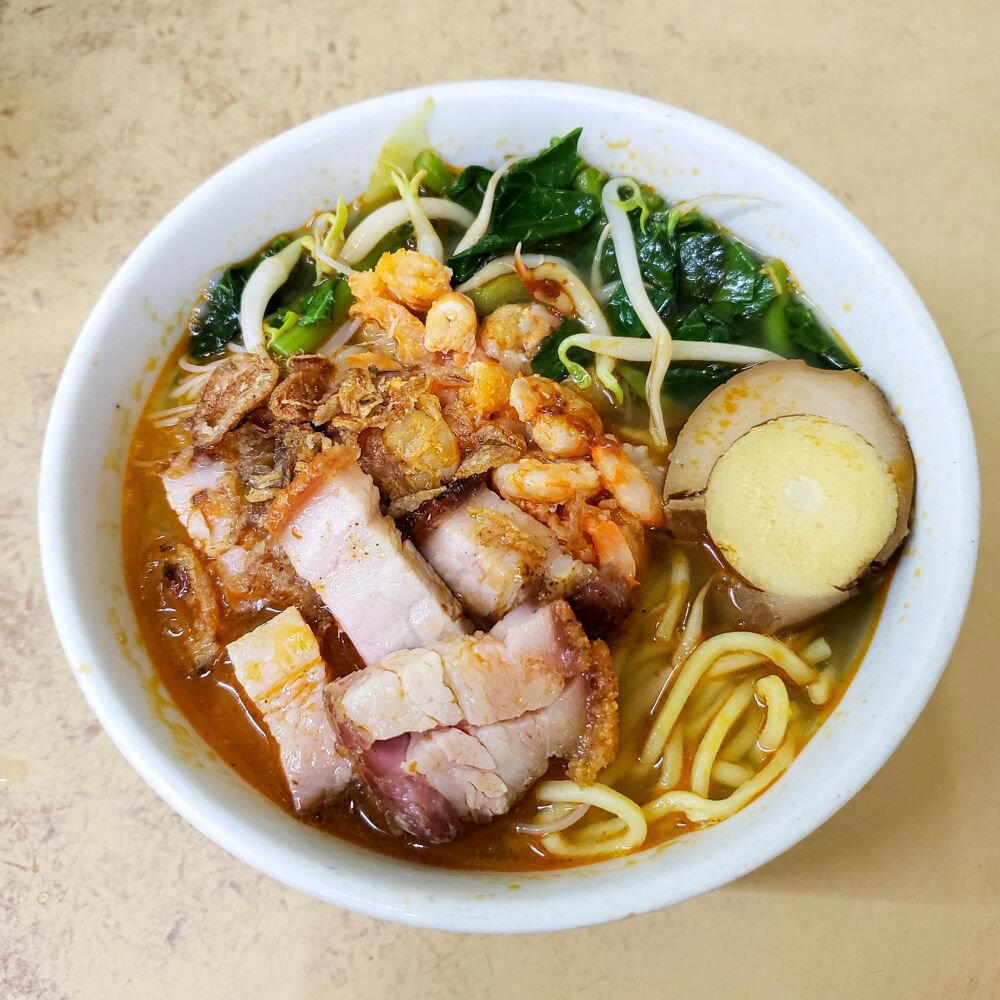
Air Itam laksa is among Penang's most referenced hawker dishes, and the stalls clustered near the Jalan Pasar market in the Air Itam neighbourhood represent the tradition at its most distilled. The bowl arrives thick with mackerel-based broth, tamarind sourness, and a dark prawn paste finish that defines the Penang style. No reservations, no menu choices, you queue, you eat, you leave.
Pearl is the En Primeur Club membership app — saves, bookings, and concierge access live there. Same editors, same standards.
- Address
- Jalan Pasar, Paya Terubong, 11500 George Town, Pulau Pinang, Malaysia
- Phone
- +60 12 500 7063
- Website
- facebook.com
- Directions
- Get directions
 Saves & bookings on Pearl
Where the Queue Is the Ritual
In Penang's hawker culture, the mechanics of eating are inseparable from the food itself. You do not browse a menu, weigh options, or negotiate a table. At the Air Itam laksa stalls on Jalan Pasar in Paya Terubong, the protocol is simple: join the queue, state your order, find a plastic stool, and wait for a bowl that arrives without ceremony and demands your full attention. The ritual is not incidental to the experience, it is the experience. This is how Penang's street-food tradition asserts its authority over the fine-dining playbook: not through scarcity marketing or tasting menus, but through the accumulated weight of repetition and public trust.
Air Itam sits inland from George Town's heritage core, past the commercial sprawl of Jalan Burma and up toward the hills that give the neighbourhood its slightly cooler register. The market area on Jalan Pasar anchors a cluster of hawker activity. If you are planning a visit from central George Town, a taxi or Grab ride is the practical choice.
The Penang Laksa Tradition in Context
Penang laksa, specifically the asam variant, occupies a distinct position within Malaysia's broader noodle culture. Where the curry laksas of Kuala Lumpur and Sarawak lean on coconut milk to round and enrich the broth, Penang's version runs on tamarind sourness, flaked mackerel, and a finish of hae ko (thick prawn paste) that delivers a fermented, almost marine depth. The result is sharper, more assertive, and considerably more polarising than its coconut-based cousins. Penang asam laksa has long been a reference point for the dish's international standing.
The noodle itself is a thick, opaque rice noodle, soft but with enough body to hold up against the aggressive broth. Garnishes typically include cucumber julienne, pineapple, mint, red chilli, and a slick of the prawn paste stirred in at the table. The broth cools quickly, the noodles soften further as they sit, and the balance between sour, sweet, and saline shifts with every minute. This is food that rewards speed and full attention, not the leisurely grazing tempo of a Western tasting format.
For broader context on George Town's street-food register, the city's hawker culture spans everything from the char kway teow counters along Lorong Baru to the Hokkien mee operations that have run for decades in the commercial streets below. 888 Hokkien Mee on Lebuh Presgrave and Ah Boy Koay Teow Th'ng sit in the same single-dish, queue-dependent format, stalls where the discipline is in the doing, not the deciding. Air Itam laksa fits inside this pattern but occupies a higher profile position within the city's food identity, partly because the dish itself has accrued international attention and partly because the neighbourhood stalls have maintained consistency across multiple decades.
The Bowl as Cultural Document
Understanding what makes Penang asam laksa worth the trip to Air Itam requires understanding what the dish encodes. The tamarind base reflects the influence of Malay and Siamese cooking traditions on a predominantly Chinese-origin hawker format. The hae ko paste, thick, black, intensely saline, is a Hokkien contribution. The pineapple garnish introduces a sweetness that softens the acid without neutralising it. The mackerel, poached and flaked rather than left in whole pieces, distributes through the broth in a way that gives every spoonful a different texture. This is not fusion in the contemporary sense; it is the ordinary result of a port city's ingredient and technique overlaps, codified over time into something that reads as entirely coherent.
George Town's Peranakan dining tradition, represented by venues like Auntie Gaik Lean's Old School Eatery and Richard Rivalee, draws from similar ethnic layering but operates at a different price point and formality register. The contrast is instructive: both traditions are products of the same historical mixing, but hawker laksa and Peranakan set meals represent opposite poles of how that history gets served. At the contemporary end of George Town's restaurant spectrum, places like Au Jardin apply European technique to local produce in a formal dining context. The Air Itam stalls operate on an entirely different axis, no technique concealment, no plating as communication, no hospitality layer between cook and bowl.
Across Malaysia more broadly, the conversation about preserving hawker knowledge has intensified as older operators age out and younger generations move toward other careers. The hawker stalls that have held their ground in Air Itam represent the kind of institutional knowledge that formal restaurants elsewhere in the region spend considerable effort trying to reference or reconstruct. For context on how Malaysian fine dining engages with this heritage, Dewakan in Kuala Lumpur has built a tasting menu format around indigenous Malaysian ingredients, a different project, but one that implicitly acknowledges the depth that street-food traditions like Air Itam laksa contain.
Planning the Visit
The Air Itam market area operates on hawker time. Pricing sits at the lowest tier of George Town's eating options, consistent with the single-dish hawker format across the city. Visitors staying in George Town's heritage zone should budget roughly twenty minutes by Grab to reach Jalan Pasar; the ride is inexpensive and eliminates the parking problem entirely.
Those extending their Malaysia trip beyond Penang may find relevant context in Christoph's in Penang or, further afield, The Dining Room at The Datai Langkawi for a sharp contrast in register and formality. For those tracing Malaysia's hawker tradition beyond Penang, Bismillah Cendol in Taiping offers a comparable single-dish street-food experience in a different state.
Cuisine and Credentials
Comparable venues nearby, for context on price, style, and recognition.
| Venue | Cuisine | Price | Awards | Notes |
|---|---|---|---|---|
| Penang Air Itam LaksaThis venue — the venue you are viewing | Penang Asam Laksa | $ | Not listed | Not listed |
| Loh Kei Duck Meat Koay Teow Th'ng (羅記鴨肉粿條湯) | Duck Meat Koay Teow Th'ng | $ | Not listed | Georgetown |
| Nasi Kandar Deen Mutiara (Hutton Lane) | Penang Nasi Kandar | $ | Not listed | George Town |
| Penang Road Famous Laksa | Penang Asam Laksa | $ | Bib Gourmand | George Town |
| Red Garden Food Paradise | Penang Hawker Food Court | $ | Not listed | George Town |
| Tok Tok Mee Bamboo Noodle | Cantonese Bamboo Noodles & Pastries | $ | Michelin Plate | George Town |
Continue exploring
More in George Town
Restaurants in George Town
Browse all →
Bars in George Town
Browse all →

At a Glance
- Well Known
- Rustic
- Casual Hangout
- Historic Building
- Street Scene
Current opening hours
- Monday
- Closed
- Tuesday
- Closed
- Wednesday
- Closed
- Thursday
- Closed
- Friday
- Closed
- Saturday
- 11 AM–6 PM
- Sunday
- 11 AM–6 PM
Hours can change for holidays and private events. Last verified .
Casual roadside market stall with lively local atmosphere amid wet market hustle.