Nasi Kandar Deen Mutiara (Hutton Lane)
On Jalan Hutton in Georgetown's historic core, Nasi Kandar Deen Mutiara represents one of the oldest and most culturally rooted dining traditions in Penang: the Tamil Muslim nasi kandar counter, where rice meets a rotating cast of gravies, curries, and proteins assembled at speed. The format predates the modern restaurant entirely, and this address has long been part of how locals measure the genre.
Pearl is the En Primeur Club membership app — saves, bookings, and concierge access live there. Same editors, same standards.
- Address
- 74, Jalan Hutton, George Town, 10050 George Town, Pulau Pinang, Malaysia
- Phone
- +60 11-1683 9597
- Website
- facebook.com
- Directions
- Get directions
 Saves & bookings on Pearl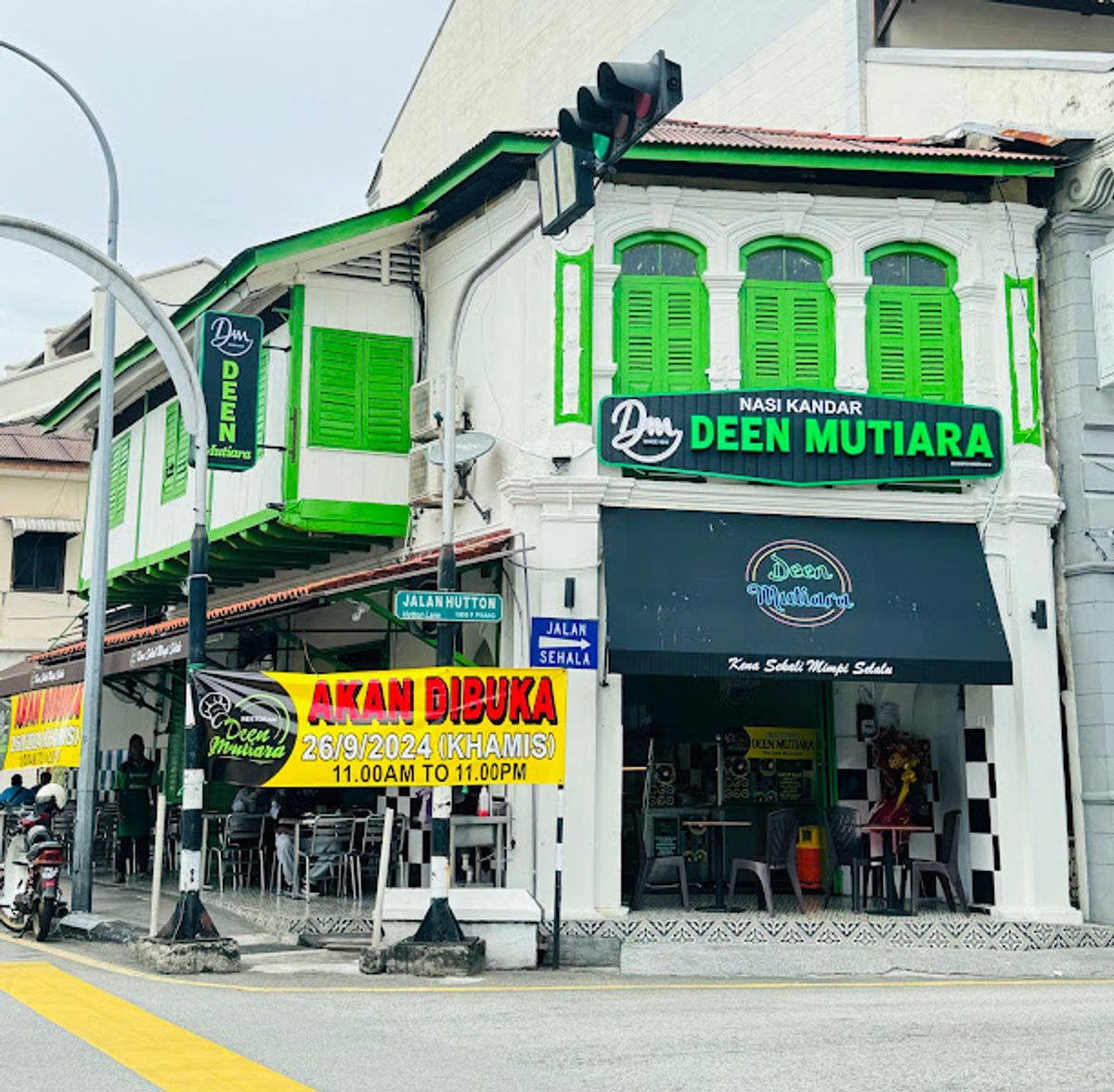
The Street, the Counter, the Gravy
Jalan Hutton sits in the older residential and commercial fabric of Georgetown, a few blocks from the waterfront heritage zone that draws most of the tourist foot traffic. The street is quieter than Armenian or Penang Road, and that relative obscurity is part of what defines the nasi kandar houses along it. These are places that exist for the neighbourhood and the city. Arriving at Nasi Kandar Deen Mutiara, at number 74, the scene is immediately legible: steel trays of curried protein and vegetable side dishes set behind glass or along a counter, a pile of rice at the centre of the operation, and a queue of people who know exactly what they want.
That physical grammar is not incidental. It is the entire point of the nasi kandar format, and understanding it is the precondition for understanding why places like this matter in the context of Malaysian food culture.
What Nasi Kandar Actually Is
Nasi kandar is a Tamil Muslim tradition that developed in Penang over more than a century, carried to the island by Indian Muslim traders and labourers from the Madras region. The name references the kandar, the shoulder pole that early hawkers used to carry pots of rice and curry through the streets, selling to labourers and dockworkers. By the mid-twentieth century, the mobile format had consolidated into fixed stalls and shophouses, but the operational logic remained: rice served with a selection of gravies and proteins, poured and assembled to the customer's instruction.
The critical element is the banjir, or flood, where multiple gravies are poured over the rice simultaneously rather than served separately. Each gravy carries the accumulation of the day's cooking, thickened and intensified as proteins cook down into the base. The result is not a single curry but a layered combination that changes depending on what you select and in what order the ladle hits the plate. No two plates are quite the same, which is one reason the format rewards regularity: knowing which combinations work, and which vendor's gravy base suits your palate, takes time.
Georgetown has become one of the reference points for this tradition across Southeast Asia, partly because of the city's UNESCO World Heritage designation and the visibility that brought to its food culture, and partly because a handful of addresses have maintained consistency over decades. The nasi kandar counter sits alongside char kway teow and assam laksa as one of the dishes most closely associated with Penang identity.
Deen Mutiara in the Competitive Set
Georgetown's nasi kandar scene has stratified over time. A small number of names, including Line Clear on Penang Road and Hameediyah on Campbell Street, have built reputations that extend well beyond the city. These counters draw queues that include visitors who have specifically sought them out based on editorial coverage and food tourism content. Deen Mutiara on Hutton Lane operates in a slightly different register: more embedded in the immediate neighbourhood, less publicised in the tourism circuit, and oriented toward the regular customer rather than the first-timer.
That positioning is not a mark against it. In Penang's hawker and nasi kandar ecosystem, the distinction between a place that serves tourists and a place that serves locals is meaningful. The latter tends to maintain its calibration more reliably, because the customer base notices drift. The Hutton Lane location places Deen Mutiara close to a residential and working population that has been eating here across generations, which is a form of quality signal that awards infrastructure does not always capture.
The breadth of that range, from a shophouse nasi kandar counter to a Michelin-recognised French kitchen, is part of what makes Georgetown an unusually dense food city for its size.
How the Format Works in Practice
Nasi kandar counters do not take reservations and do not operate on tasting menu logic. The format is self-directing: you approach the counter, indicate your rice quantity, and choose from whatever proteins and vegetables are available that day. Chicken curry, fish, prawns, squid, fried egg, and a rotating set of vegetable preparations are typical components, though availability shifts through the day as dishes sell out. Arriving earlier in a service period gives access to the widest selection and gravies that have not yet reduced to the point of saltiness. The meal is assembled in under a minute and often eaten standing or at basic tables.
For visitors accustomed to booking windows and prix-fixe formats, the comparison point is useful: what the nasi kandar counter lacks in ceremony, it replaces with immediacy and directness. There is no mediation between the food and the customer. This is among the more democratic formats in Malaysian dining, and also among the more technically demanding to execute at volume, because the gravy base is the foundation of everything and it cannot be corrected once it tips too far in any direction.
Penang's food culture extends well beyond nasi kandar, and Hutton Lane is a reasonable starting point for a broader circuit. Auntie Gaik Lean's Old School Eatery addresses the Nyonya side of Georgetown's culinary history, while Air Itam Asam Laksa, Chong Char Koay Teow, and 888 Hokkien Mee cover the Hokkien-influenced hawker traditions that form the other major strand of the city's food identity. For Malaysian cooking at the fine dining register, Dewakan in Kuala Lumpur represents what happens when the same ingredient traditions are pushed through a contemporary tasting menu format.
Elsewhere in Malaysia and the region, the hawker and kopitiam tradition continues to define how most people eat daily. Kopi Ping Cafe in Tuaran and Jia Yi Dao Vegetarian Restaurant in Taiping represent other nodes in that distributed network, each shaped by local community and ingredient supply rather than national or international trends. For those moving through the broader Southeast Asian circuit, Fireside Grill n Chill and Five Islands Lobster Co offer Georgetown dining at a different price and format point.
Planning Your Visit
Nasi Kandar Deen Mutiara (Hutton Lane) is located at 74, Jalan Hutton, George Town, 10050 George Town, Pulau Pinang, Malaysia. Walk-in is the only mode. The restaurant is open Mon, Wed through Sun from 11 AM to 11 PM, and closed on Tuesday. Nasi kandar is priced as everyday food across Georgetown, making it among the more accessible categories in Malaysian dining. The dress code is casual.
Cost and Credentials
Comparable venues nearby, for context on price, style, and recognition.
| Venue | Cuisine | Price | Awards | Notes |
|---|---|---|---|---|
| Nasi Kandar Deen Mutiara (Hutton Lane)This venue — the venue you are viewing | George Town, Penang Nasi Kandar | $ | Not listed | Not listed |
| Restoran Nasi Kandar Line Clear | Not listed | $ | Not listed | George Town, Traditional Penang Nasi Kandar |
| Penang Famous Samosa | Little India, Indian Samosas | $ | Michelin Plate | Not listed |
| Red Garden Food Paradise | George Town, Penang Hawker Food Court | $ | Not listed | Not listed |
| Muthu Banana Leaf Restaurant | Not listed | $ | Not listed | George Town, Authentic South Indian Banana Leaf |
| Bite N Eat Dindigul Biriyani | George Town, Authentic Dindigul Biriyani | $$ | Michelin Plate | Not listed |
Continue exploring
More in George Town
Restaurants in George Town
Browse all →
Bars in George Town
Browse all →
At a Glance
- Lively
- Casual Hangout
- Late Night
Current opening hours
- Monday
- 11 AM–11 PM
- Tuesday
- Closed
- Wednesday
- 11 AM–11 PM
- Thursday
- 11 AM–11 PM
- Friday
- 11 AM–11 PM
- Saturday
- 11 AM–11 PM
- Sunday
- 11 AM–11 PM
Hours can change for holidays and private events. Last verified .