Parkway Bakery & Tavern


Parkway Bakery & Tavern on Hagan Avenue has held Michelin Bib Gourmand recognition since 2025 and ranked #32 on Opinionated About Dining's Cheap Eats in North America list the same year, with consistent placement across three consecutive annual editions. The draw is the po-boy, served from a Mid-City institution that has become a reference point for the sandwich's continuing cultural weight in New Orleans. Google's 4.7-star average across more than 5,400 reviews reflects sustained, broad-based approval rather than a moment of hype.
Pearl is the En Primeur Club membership app — saves, bookings, and concierge access live there. Same editors, same standards.
- Address
- 538 Hagan Ave, New Orleans, LA 70119
- Phone
- (504) 482-3047
- Website
- parkwaypoorboys.com
- Directions
- Get directions
 Saves & bookings on Pearl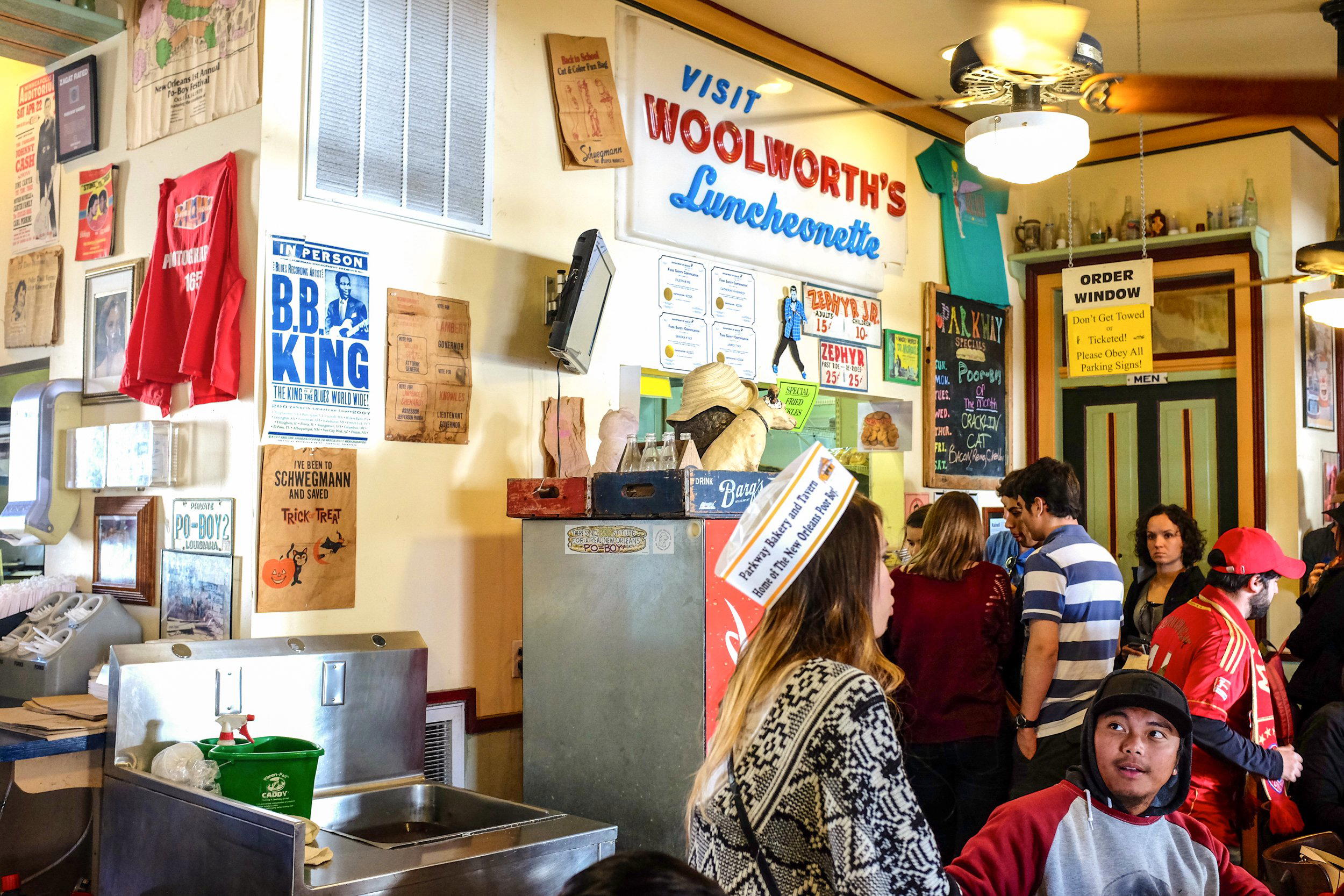
A Counter Built Around One Sandwich
Hagan Avenue in Mid-City does not announce itself as a dining destination. The street runs through a residential block well north of the French Quarter and well west of the Warehouse District's newer restaurant cluster, and Parkway Bakery & Tavern sits within that fabric without architectural ceremony. The building is low, functional, and worn in the way that working establishments earn over decades. Picnic tables occupy the outdoor area. Inside, the counter setup and the overhead menu boards make the transaction immediate and unambiguous. This is a room organized entirely around the po-boy, and nothing about the physical space pretends otherwise.
That directness is, in itself, an editorial statement about how certain New Orleans food traditions operate. The po-boy is a sandwich with documented roots in the 1920s labor movement, specifically in the support offered to striking streetcar workers, and the city's relationship to the format has never been casual. What distinguishes the serious operators from the perfunctory ones is the bread, the protein temperature, and the ratio between filling and French bread. Parkway's place in that hierarchy is not self-proclaimed; it has been confirmed externally and repeatedly.
What the Awards Actually Confirm
Michelin's Bib Gourmand designation sits in a specific tier of the guide's architecture. It does not indicate a starred kitchen or a tasting-menu format. What it signals, precisely, is that the inspectors found the quality-to-price ratio notable at a level below fine dining. That distinction matters in a city like New Orleans, where the full restaurant register runs from white-tablecloth Creole dining at Commander's Palace through ambitious contemporary formats like Saint-Germain and Re Santi e Leoni, through the mid-tier represented by Zasu and Bayona, and down to the counter-service and street-level formats where much of the city's most distinctive cooking actually lives. Parkway occupies the last of those tiers with awards recognition that places it alongside kitchens operating at a fundamentally different price point and format.
Opinionated About Dining's Cheap Eats rankings add a second independent axis. Parkway appeared at #34 in 2023, moved to #29 in 2024, and settled at #32 in 2025. The consistency across three annual cycles is worth noting: it rules out the single-year anomaly and positions Parkway as a sustained reference point rather than a trending moment. For comparison, the fine-dining tier of OAD's lists features venues like Le Bernardin in New York City, Alinea in Chicago, The French Laundry in Napa, and Atomix in New York City, the fact that a po-boy counter in Mid-City occupies the same annual conversation, even at the cheap-eats tier, speaks to how seriously the guide treats format-agnostic quality assessment.
The Physical Logic of the Space
The editorial angle that applies to Parkway is not atmosphere as hospitality industry professionals define the term. There are no considered lighting schemes, no acoustically engineered dining rooms, no progression from bar to table to dessert counter. The physical space at Parkway is organized around throughput and function: a counter at which orders are placed, a kitchen behind it, indoor seating that prioritizes volume over comfort, and outdoor tables that fill in the overflow. The walls carry the visual record of years of operation, photographs, clippings, and the accumulated signage of a place that has not re-branded itself to meet successive waves of food-media interest.
That kind of space communicates something the designed-for-Instagram dining room cannot easily replicate. The absence of aesthetic ambition is itself a form of authenticity signal, though that word has been stretched so thin by food marketing that it requires qualification here. The point is more specific: when a room's design budget has clearly been zero, and the awards have arrived anyway, the awards are about the food. This is a useful corrective for visitors arriving from cities where the relationship between interior design investment and critical recognition runs in one direction. New Orleans counter culture, from Parkway through the city's network of neighborhood lunch spots, operates on a different set of assumptions.
Mid-City as a Dining Coordinate
The address on Hagan Avenue places Parkway in Mid-City, a neighborhood that functions as a residential and culinary counterweight to the tourist-dense zones closer to the river. The area around City Park and the Bayou St. John corridor has developed its own dining character over the past decade, and Parkway predates much of that development. Its presence in Mid-City is not a function of neighborhood positioning strategy; the restaurant's history at this location stretches back well before the neighborhood became a destination.
For visitors working from a broader New Orleans itinerary, Parkway requires a deliberate trip. It does not sit on the path between hotel and French Quarter. The practical upside is that Mid-City lunch crowds, while substantial at Parkway, do not carry the same density as the Quarter's more visible options. Visitors who have already worked through the city's refined Cajun and Creole options, Emeril's for the Cajun canon, the neighborhood fine-dining set for contemporary Louisiana cooking, often find that Parkway sits in a completely different register of the city's food conversation, one that the awards history confirms is worth the navigation.
For anyone building a complete picture of the city's food culture, the EP Club guides cover the full range: our full New Orleans restaurants guide, our full New Orleans bars guide, our full New Orleans hotels guide, our full New Orleans wineries guide, and our full New Orleans experiences guide. Parkway represents one specific register of what the city does well, counter-service food with documented quality credentials and a physical space that has not been optimized for anything except making the sandwich.
Planning Your Visit
Parkway Bakery & Tavern is located at 538 Hagan Ave in the Mid-City neighborhood. The format is counter-service, and the operation does not take reservations, this is a walk-in establishment where queue length at peak lunch hours is the primary variable to manage. Google's 4.7-star rating across more than 5,400 reviews suggests consistent execution, but arriving during the midweek mid-morning or in the early afternoon typically means shorter waits than a weekend noon arrival. The kitchen is led by Jay Nix. Phone and website details are not confirmed in current records, so checking hours before traveling, particularly on weekdays versus weekends, is advisable through a direct search prior to arrival.
Budget and Context
Comparable venues nearby, for context on price, style, and recognition.
| Venue | Cuisine | Price | Awards | Notes |
|---|---|---|---|---|
| Parkway Bakery & TavernThis venue — the venue you are viewing | Po-Boys | $$ | Bib Gourmand | Not listed |
| Cochon | Arts District, Modern Cajun | $$ | Bib Gourmand | Not listed |
| Atchafalaya | East Riverside, Contemporary Creole | $$ | Michelin Plate | Not listed |
| Pêche Seafood Grill | Arts District, Modern Seafood Grill | $$$ | Michelin Plate | Not listed |
| Turkey & the Wolf | Not listed | $$ | Bib Gourmand | Saint Thomas Development, Gourmet American Sandwiches |
| Ruby Slipper CBD | Not listed | $$ | Not listed | Central Business District, New Orleans Brunch |
Recognition history
Dated appearances from independent guides and award organizations, with the underlying list record or original source where available.
Opinionated About Dining Cheap Eats in North America Ranked #52
Opinionated About Dining
Michelin Bib Gourmand
Michelin
Opinionated About Dining Cheap Eats in North America Ranked #32
Opinionated About Dining
Opinionated About Dining Cheap Eats in North America Ranked #29
Opinionated About Dining
Opinionated About Dining Cheap Eats in North America in Ranked #34
Opinionated About Dining
Continue exploring
More in New Orleans
Restaurants in New Orleans
Browse all →
Bars in New Orleans
Browse all →
At a Glance
- Classic
- Lively
- Rustic
- Well Known
- Casual Hangout
- Family
- Group Dining
- Historic Building
- Beer Program
- Craft Cocktails
Current opening hours
- Monday
- Closed
- Tuesday
- Closed
- Wednesday
- 10 AM–6 PM
- Thursday
- 10 AM–6 PM
- Friday
- 10 AM–6 PM
- Saturday
- 10 AM–6 PM
- Sunday
- 10 AM–6 PM
Hours can change for holidays and private events. Last verified .