Okonomiyaki Kitaro

Okonomiyaki Kitaro is a Nishinomiya counter-and-table address for okonomiyaki and stir-fried noodles, selected for Tabelog 100 Okonomiyaki 2025. The appeal is rooted in Kansai’s everyday griddle culture rather than ceremony: compact seating, family-friendly use, and a dinner budget that sits in the accessible middle of the city’s dining range.
Pearl is the En Primeur Club membership app — saves, bookings, and concierge access live there. Same editors, same standards.
- Address
- 7-4 Miyanishicho, Nishinomiya, Hyogo 662-0976, Japan
- Phone
- +81 798-35-2289
- Website
- okonomi-kitaro.com
 Saves & bookings on Pearl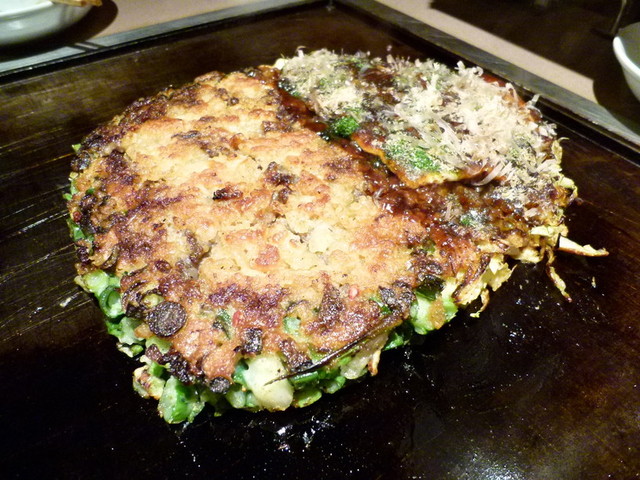
A Kansai okonomiyaki room declares itself before the first order: griddle heat, close counter sightlines, quick decisions, and a menu of batter, cabbage, noodles, sauce, and small calibrations that separate casual supper from specialist shop. Nishinomiya sits between Kobe and Osaka, so its dining rhythm is neighbourhood repetition rather than destination theatre. That matters for okonomiyaki, which rewards familiar formats judged closely for texture, timing, browning, sauce balance, and how a shop handles family meals, after-work plates, and drinks-led nights.
Okonomiyaki Kitaro belongs to that specialist register. Its Tabelog 100 Okonomiyaki 2025 recognition places it on a national category list, not a general fine-dining ranking, a useful distinction in Japan, where single-dish depth often matters more than broad-menu ambition. Its 3.53 score should be read in Japanese review-site context: evidence of steady approval, not a luxury signal, in a category where locals compare details with little patience for novelty for its own sake.
Okonomiyaki in Nishinomiya is everyday food judged by specialist standards
Okonomiyaki is often flattened in English as a Japanese savoury pancake, but in Kansai it is a social category: inexpensive enough for repeat visits, adaptable for groups, and technical enough to inspire loyalties. Osaka gives the form its loudest international association, Hiroshima its layered counterargument, yet Hyogo’s suburban cities have their own tradition. The benchmark here is not spectacle, but whether a small room can turn a griddle into dinner for regulars without reducing the food to snack status.
Nishinomiya’s comparison set makes that clear. Sumibi Kushiyaki Senmon Ten Toriten sits in a higher dinner band at JPY 6,000 to JPY 7,999, while Sanka Udon Hangeshou is a lower noodle-house bracket around JPY 1,000 to JPY 1,999. tonkatu butashou is closer to Okonomiyaki Kitaro, at JPY 3,000 to JPY 3,999, but with a different meal architecture: pork cutlet focus rather than griddle sharing. That spread defines okonomiyaki’s role here: not merely cheap eating, not formal dining, but a mid-range local format where repeatability is part of the value.
The scale reinforces that reading. Eighteen seats, split between counter seating and tables, make this a compact neighbourhood specialist rather than a large group restaurant. Counter seats keep the griddle central; tables suit families and friends. The category listing includes okonomiyaki and stir-fried noodles, a natural Kansai griddle pairing. Drinks include sake, shochu, and wine, signalling dinner use rather than a quick lunch-only stop.
The reputation rests on category focus, not chef mythology
Japan’s category awards are often more useful than broad prestige lists because they sort by what a diner is seeking. A Tabelog 100 Okonomiyaki selection compares Okonomiyaki Kitaro not with French tasting menus, sushi counters, or hotel dining, but with other okonomiyaki rooms where guests know the dish’s rules. Its appeal is placement within that tightly defined field. Format, price band, and seating count all point to a shop built for disciplined repetition.
That matters in Nishinomiya, easily misread as a pass-through between larger food capitals. The stronger way to eat here is through neighbourhood scale. Bakeries, curry shops, udon counters, grills, sweets shops, and small restaurants form a map less about one grand meal than accumulated local specificity. Readers comparing nearby options might look at Akash, ameen’s oven, Asai, Boulangerie Miyanaga, and Cake House Tsumagari Kouyouen honten to see how varied the city’s everyday food culture becomes when judged beyond station convenience.
For broader Kansai itineraries, the question is not whether okonomiyaki can replace a high-ceremony meal. It cannot, and should not try. Its value is revealing another kind of Japanese dining intelligence: small menus, quick heat, social pacing, and a price point that feels lived-in rather than staged. Category recognition matters because it points to excellence based on repetition and local trust, not rarity.
How to place it in a Nishinomiya eating day
Okonomiyaki works well when not overplanned as the day’s sole event. In Nishinomiya, it fits after a bakery stop, before a quiet bar, or as the savoury anchor in an itinerary built around trains and residential neighbourhoods. The city’s appeal is partly its refusal to behave like a single-district dining capital. A visitor using Our full Nishinomiya restaurants guide can pair griddle cooking with bread, sweets, udon, or tonkatsu without forcing a formal progression.
The planning logic extends beyond restaurants. Nishinomiya rewards travellers who treat food, hotels, bars, wineries, and experiences as separate layers rather than one checklist. For that wider view, see Our full Nishinomiya hotels guide, Our full Nishinomiya bars guide, Our full Nishinomiya wineries guide, and Our full Nishinomiya experiences guide. The same principle applies outside Hyogo: category-led eating can reveal more than status-led eating, whether that means -Grilled beef Sukiyaki- KAMAKURA TANUKIAN 鎌倉 たぬき庵 in Kamakura. 鮪と炭火焼き うお炭 秋葉原店 in Tokyo.cafe in Osaka.know in Kumamoto, (Shoku) Vietnam in Kawasaki, [Curry Senmon Ten] Maruyama Kyoju. in Sapporo, Jōdo Saké Bar in Los Angeles, or Onigiri Time in Pasadena.
The editorial case is simple: this is a compact Nishinomiya okonomiyaki specialist with enough category recognition to justify attention, especially for diners who care about Kansai food beyond the obvious Osaka route. Understand it as part of a local griddle tradition, not a trophy reservation. That frame sets the right expectation: a focused, social, mid-priced dinner format where the culture of the dish carries the meal.
Budget Reality Check
Comparable venues by cuisine and price in the same metro.
| Venue | Cuisine | Price | Notes |
|---|---|---|---|
| Okonomiyaki KitaroThis venue — the venue you are viewing | Not listed | $$ | Not listed |
| Ramen Tanron Honten | Nishinomiya, Ramen | $$ | Not listed |
| tonkatu butashou | Not listed | $$ | Shukugawa, Modern Tonkatsu & Izakaya-Style Japanese |
| Sumibi Kushiyaki Senmon Ten Toriten | Not listed | $$ | Sakurashukugawa, Traditional Yakitori & Kushiyaki |
| Asai | Not listed | $$ | Kurakuenguchi, Okonomiyaki (Japanese savory pancakes) counter |
| Men Sho Kuukai | Dining | Not listed | Not listed |
Recognition history
Dated appearances from independent guides and award organizations, with the underlying list record or original source where available.
Tabelog 100 #89 · No. 89
Tabelog · Tabelog 100 - Okonomiyaki - 2025
Continue exploring
More in Nishinomiya
Restaurants in Nishinomiya
Browse all →



Bars in Nishinomiya
Browse all →



Hotels in Nishinomiya
Browse all →



Wineries in Nishinomiya
Browse all →
At a Glance
- Lively
- Cozy
- Classic
- Family
- Casual Hangout
- Group Dining
- After Work
- Solo
- Standalone
- Local Sourcing
Current opening hours
- Monday
- Closed
- Tuesday
- 5–9:30 PM
- Wednesday
- 5–9:30 PM
- Thursday
- 5–9:30 PM
- Friday
- 5–9:30 PM
- Saturday
- 5–9:30 PM
- Sunday
- 5–9:30 PM
Hours can change for holidays and private events. Last verified .
Casual, compact okonomiyaki restaurant with the rhythmic sound of grilling on the teppan, a warm neighborhood feel, and a cozy, slightly bustling atmosphere typical of classic Japanese pancake shops.