Our verdict
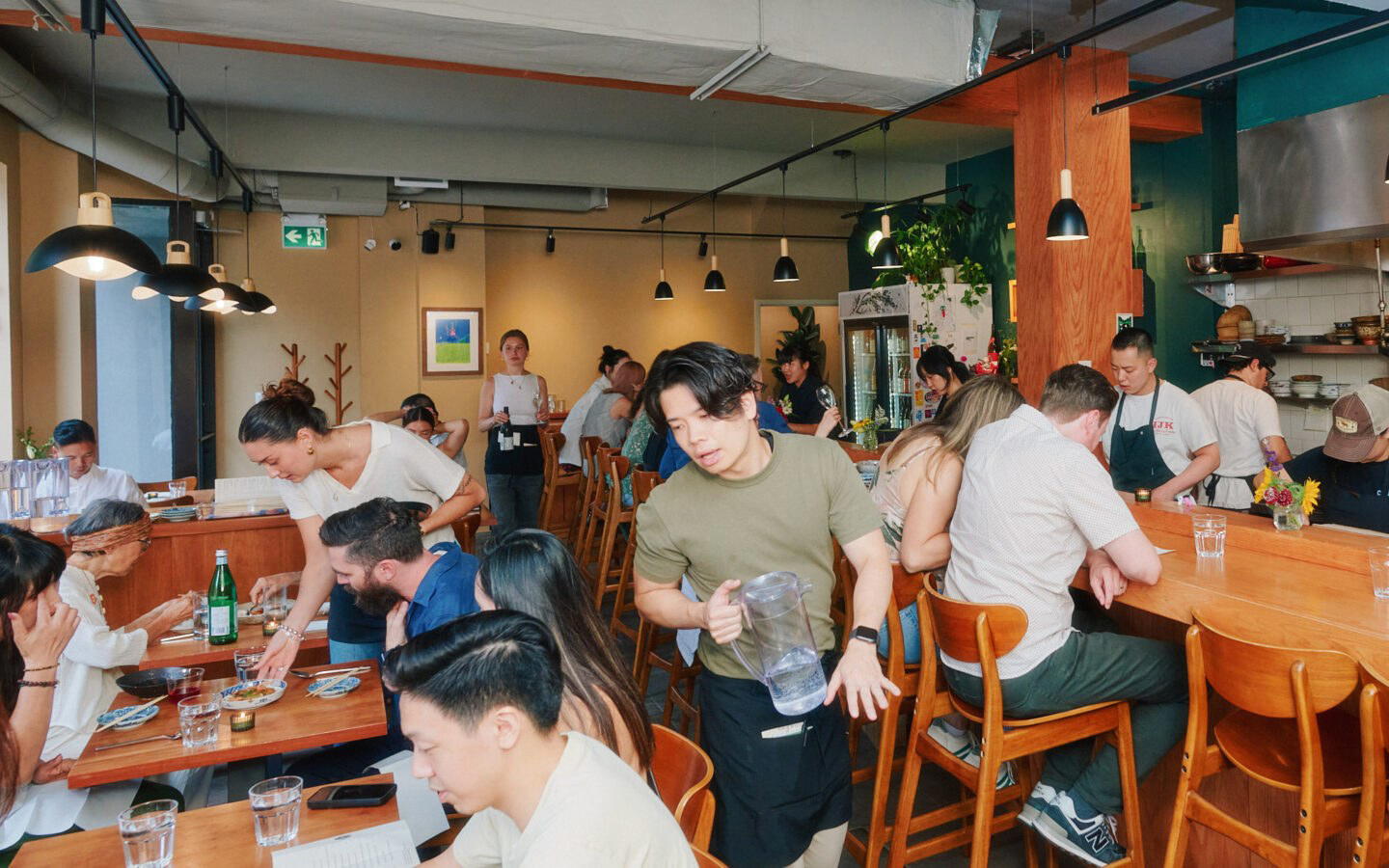
NODO on St Clair Avenue West occupies a stretch of Toronto's mid-city where neighbourhood loyalty runs deep and restaurants earn their reputations over years of repeat visits rather than opening-week press. The kitchen operates in a mode familiar to its regulars: consistent, focused, and oriented around a dining room that fills with faces you recognise rather than tourists working through a list.

Pearl is the En Primeur Club membership app, where members save venues, book tables and use the concierge.

St Clair West and the Rhythm of a Neighbourhood Restaurant
Toronto's dining conversation tends to cluster around a handful of postcodes: the Financial District tasting-menu tier, the King West hospitality corridor, the downtown Italian rooms that have anchored the city's food identity for decades. St Clair Avenue West operates at a different frequency. The stretch between Dufferin and Oakwood has built a restaurant culture based on proximity and return visits rather than destination traffic. Regulars here know their tables, their servers know their orders, and the restaurants that survive are the ones that earn that loyalty season after season. NODO, at 794 St Clair Ave W, sits in that category of neighbourhood anchor.
This part of the city draws useful comparisons to dining corridors in other Canadian cities where the neighbourhood-first model has proved durable: the kind of room you find sustaining a loyal following in areas that rarely appear in a national magazine's annual list, but whose regulars would defend it against any equivalent across town. For Toronto specifically, the contrast with the city's $$$$ omakase counters and tasting-menu flagships, places like Sushi Masaki Saito or Aburi Hana, is instructive. Those rooms ask you to plan months ahead and price against international peer sets. A room like NODO asks something simpler: that you come back.
What Keeps Regulars Returning
The regulars' perspective on any neighbourhood restaurant is a useful diagnostic. What they return for is rarely the thing a press release would highlight. It tends to be consistency at a specific price point, a kitchen that doesn't overcomplicate its core offer, and a room temperature, social, not thermostatic, that makes a Tuesday dinner feel like a reasonable idea. These are harder things to manufacture than a striking interior or a media-friendly tasting menu, and they're what separates a neighbourhood institution from a venue that cycles through openings and closures every eighteen months.
Toronto's Italian-leaning neighbourhood rooms have a particular track record in this regard. The city's relationship with Italian cooking runs from old-school red-sauce rooms in the west end through to the contemporary Italian format represented by places like DaNico and the more formal tier occupied by Don Alfonso 1890. NODO operates in a different register from both of those, neighbourhood-scaled, repeat-visit-oriented, without the architectural ambition of the downtown tasting rooms.
For the regulars at a room like this, the unwritten menu matters as much as the printed one. It's the knowledge of which nights are quieter, which dishes the kitchen handles with particular care, and the point at which the server stops asking whether you've been before. That accumulated knowledge is a form of value that doesn't show up in a rating but shapes the actual experience of eating there over time.
NODO in the Toronto Context
Toronto's restaurant scene has matured considerably in the past decade, producing a tier of formal, internationally recognised rooms, Alo being the clearest example at the Contemporary fine dining level, alongside a broader, denser layer of mid-market neighbourhood restaurants that service the actual weekly dining habits of the city's residents. It's the latter layer that most visitors underestimate and most residents depend on.
The St Clair West corridor feeds into the Wychwood, Hillcrest, and Corso Italia neighbourhoods, each with a distinct character but a shared preference for restaurants that function as community infrastructure rather than event destinations. A room that survives and accumulates regulars in this environment has demonstrated something that a downtown press launch cannot simulate: the ability to hold an audience through ordinary weeks, not just special occasions.
Across Canada, the neighbourhood-anchor model shows up in different forms. AnnaLena in Vancouver occupies a similar position in Kitsilano, a room with critical recognition that still functions primarily as a local constant. Jérôme Ferrer's Europea in Montreal sits at a more formal tier but carries the same quality of earned municipal loyalty. The pattern holds across formats and price points: restaurants that survive long-term in residential neighbourhoods do so because they've made themselves useful to the people who live nearby.
Further afield in Ontario, the contrast with destination-format rooms is instructive. Eigensinn Farm in Singhampton and Restaurant Pearl Morissette in Lincoln both require planning, travel, and a specific kind of commitment from their diners. A St Clair West neighbourhood room asks none of that. Its value proposition is built entirely on proximity and recurrence.
The comparison group is neighbourhood rooms that have built durable followings: places where the dining room fills mid-week, where the bar seats see the same faces on a rotating schedule, and where the kitchen has enough repeat diners to reward consistency over novelty. This is a competitive environment in a different way from the award-circuit rooms. There are no Michelin reviewers scoring the Tuesday service; the judges are the people who live eight minutes away and have three other options on the same street.
Toronto's Italian neighbourhood rooms in particular operate in a format where the food is less likely to be the primary differentiator than the sum of the experience: room feel, server familiarity, value at the price point. Rooms like this compete on aggregate performance across dozens of visits, not on the strength of a single, orchestrated tasting menu. For further context on the Toronto dining scene at multiple price tiers, see our full Toronto restaurants guide.
For comparison points beyond Ontario, the neighbourhood-Italian format appears across Canadian cities in ways that illuminate what the format can achieve: Tanière³ in Quebec City shows what happens when a neighbourhood-rooted room acquires national critical attention without losing its local character. Narval in Rimouski demonstrates the same principle in a smaller market. Closer to Toronto, The Pine in Creemore and Barra Fion in Burlington represent the format operating outside the city proper, where the local-anchor logic applies with even greater force.
Know Before You Go
- Address: 794 St Clair Ave W, Toronto, ON M6C 1B6
- Neighbourhood: St Clair West / Wychwood
- Getting there: St Clair West station on the Yonge-University line is within walking distance; the 512 St Clair streetcar stops nearby
- Leading timing: Mid-week visits tend to offer more relaxed service in neighbourhood rooms of this type
Frequently asked questions
Where do I go for NODO?
NODO is located at 794 St Clair Ave W, Toronto, ON M6C 1B6, Canada, Toronto.
Is NODO a good option for dinner in the St Clair West neighbourhood compared to downtown Toronto restaurants?
NODO sits at 794 St Clair Ave W, a corridor that operates outside the formal tasting-menu tier concentrated downtown around King West and the Financial District. The draw here is a neighbourhood register: fewer covers, a more consistent clientele, and a pace that differs from the high-turnover rooms further south. For Toronto diners who find the downtown occasion-dining circuit overly produced, St Clair West rooms like NODO represent a deliberate alternative.
What should I eat at NODO?
EP Club does not currently hold confirmed menu data for NODO. For neighbourhood rooms at 794 St Clair Ave W in Toronto's mid-market tier, asking staff about daily specials and house staples is the most reliable approach. Regulars at rooms of this format typically return for a short, seasonally adjusted menu rather than a fixed tasting structure.
What's the best way to book NODO?
For St Clair West neighbourhood rooms that draw consistent local traffic, booking at least a week ahead for weekend sittings is standard practice in Toronto's mid-market category. Checking the venue's social channels directly is the most practical route to current reservation contacts.
Awards and Standing
Comparable venues nearby, for context on price, style, and recognition.
| Venue | Cuisine | Price | Notes |
|---|---|---|---|
| NODOThis venue (the venue you are viewing) | Casual Italian Pizza & Pasta | $30–50 | Not listed |
| Bella Vista | Authentic Italian Trattoria | $30–50 | Palmerston-Little Italy |
| A3 Napoli | Neapolitan Street Food Friggitoria | Not listed | Little Italy |
| Maker Pizza Cameron | Modern Pizza | $20–30 | Chinatown |
| Pizzeria Badiali | New York-Style Pizza | $10–20 | Trinity Bellwoods |
| La Pizza & La Pasta | Neapolitan Pizza & Pasta | $20–30 | Yorkville |