

Nobuya brings Japanese Contemporary cuisine to a quiet street near Piazzale Cadorna, framing it inside a minimalist room of dark wood and subdued lighting that reads as authentically Japanese within a Milanese context. The menu splits between a vegetarian omakase, titled 'Mi affido a te', and a lunchtime bento format, a structural choice that signals intent well before the first dish arrives. Michelin Plate recognition in both 2024 and 2025 places it in a credible mid-tier bracket for the city's Japanese dining scene.
Pearl is the En Primeur Club membership app — saves, bookings, and concierge access live there. Same editors, same standards.
- Address
- Via San Nicolao, 3a, 20123 Milano MI, Italy
- Phone
- +39 331 808 8558
- Website
- nobuya.it
- Directions
- Get directions
 Saves & bookings on Pearl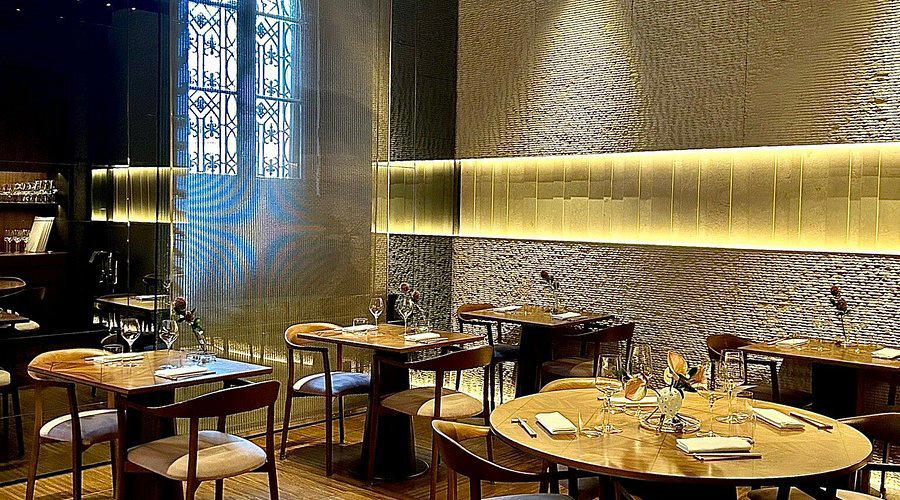
A Room That Explains the Menu Before You Sit Down
A short walk from Piazzale Cadorna, it sits in a part of central Milan that functions rather than performs: transport links, studio spaces, the functional edge of the Magenta district. The exterior of Nobuya does little to interrupt that rhythm. Inside, the register shifts. Brown tables, dark wooden ceiling beams, and lighting calibrated low enough to make the illuminated wine cabinet the room's focal point, the design vocabulary is Japanese minimalism applied with enough warmth to sit comfortably in an Italian context. What strikes you early is that the space is not performing Japanese-ness. It is simply organised by it.
That distinction matters because it tells you something about how the kitchen operates. Restaurants that import aesthetic codes wholesale tend to use them as spectacle; the ones that absorb them into a local setting tend to be more interested in the food. At Nobuya, the room is calm enough that your attention moves to the table quickly. That's by design.
How the Menu Is Built, and What That Architecture Signals
Nobuya's menu structure is worth reading carefully before you order, because it does more interpretive work than the individual dishes alone. The kitchen runs two distinct formats at lunch: a bento box, lighter in scope and evidently pitched at the midday trade from the surrounding area, and an omakase tasting menu titled 'Mi affido a te', Italian for 'I entrust myself to you,' the phrase that translates the omakase concept for an audience that may not arrive with fluency in the Japanese format.
That translation decision is deliberate. The name 'Mi affido a te' signals cultural attentiveness rather than cultural dilution. It tells a Milanese diner what omakase means emotionally, a transfer of agency, a decision to follow the chef's sequence rather than assert your own preferences, without requiring them to bring prior knowledge. For a restaurant operating in a city where Japanese Contemporary dining remains a smaller, more specialist niche than in Tokyo or London, that framing is a practical choice with editorial consequences: it opens the format to diners who might otherwise default to the à la carte safety of a more familiar structure.
The omakase here is fully vegetarian. In the context of Japanese Contemporary cuisine in Europe, that's a meaningful constraint. Most high-end omakase formats are built around fish and seafood, dashi, nigiri progressions, cooked fish courses. A vegetarian sequence requires the kitchen to build comparable depth of flavour, umami progression, and textural variety through plant-based ingredients and Japanese technique. Executed well, it signals genuine command of the cuisine. It also differentiates Nobuya sharply from its Milanese comparable set: the city's four-star creative dining rooms, Enrico Bartolini (Creative), Cracco in Galleria (Modern Cuisine), Andrea Aprea (Modern Italian, Italian Contemporary), and Seta (Modern Italian), all sit at €€€€ and operate within Italian-led creative frameworks. Nobuya operates at €€€, under Japanese discipline, with a format that has no direct equivalent in those rooms.
The bento format at lunch is the more accessible entry point. Bento as a restaurant format carries different expectations than bento as convenience food: at this level, the structure typically involves careful compartmentalisation of flavours, temperatures, and textures within a single service. It suits the lunchtime pace without reading as a reduced version of the kitchen's capability.
Where Nobuya Sits in Milan's Japanese Dining Scene
Milan's Japanese restaurant landscape runs from conveyor-belt and ramen formats through to credentialed contemporary kitchens. Izu represents another point in the contemporary Japanese tier of the city. Nobuya's Michelin Plate recognition in 2024 and 2025 places it inside the tier of restaurants worth including in a serious city-level dining map.
For context on the broader Italian fine dining scene, the starred rooms that define the country's upper tier, Osteria Francescana in Modena, Enoteca Pinchiorri in Florence, Uliassi in Senigallia, Dal Pescatore in Runate, Quattro Passi in Marina del Cantone, and Atelier Moessmer Norbert Niederkofler in Brunico, operate within Italian-rooted culinary frameworks at higher price points. Nobuya occupies a different register entirely: Japanese technique, mid-range pricing relative to Milan's fine dining tier, and a format structure that requires the diner to meet the kitchen on its own terms.
Internationally, the Japanese Contemporary format has found traction in several European cities. The Japanese Restaurant in Andermatt and Eika in Taipei represent the category across different geographies. In each case, the question the kitchen faces is the same: how much does the format adapt to local preference, and how much does it ask the diner to come toward it? Nobuya's answer, at least in its naming choices and menu architecture, leans toward gentle translation without compromise of structure.
That sample size is modest by the standards of high-volume restaurants, which is itself an indicator: Nobuya is an intimate room, not a large-scale operation, and its audience arrives with intention rather than proximity.
The Case for the Omakase Over the Bento
If you are deciding between the two lunch formats, the logic runs this way: the bento serves the meal. The omakase serves the restaurant's point of view. In a room built around Japanese minimalism and a kitchen with Michelin recognition, arriving at the bento when the omakase is available is a category error. The vegetarian omakase sequence is where the kitchen's specific position, its discipline, its constraints, its approach to flavour architecture without animal protein, is fully stated. That is what you are there to assess.
Know Before You Go
- Address: Via San Nicolao, 3a, 20123 Milan, Italy
- Nearest landmark: Piazzale Cadorna (walking distance)
- Price range: €€€€
- Cuisine: Japanese-Italian Fusion
- Awards: 4 total awards 7 (125 reviews)
- Menu formats: Omakase ('Mi affido a te', fully vegetarian) and bento box (lunch)
- Booking: recommended
What Should I Eat at Nobuya?
The vegetarian omakase, 'Mi affido a te', is the menu that leading represents what the kitchen is doing. Choosing the omakase means handing sequence and pacing to the chef, appropriate for a room with consecutive Michelin Plate recognition and a format built around Japanese culinary discipline. The bento is the more casual lunchtime option, suited to shorter visits or lighter appetites, but the omakase is where the cuisine's architecture is fully expressed. If the kitchen's Japanese Contemporary approach is what draws you to Via San Nicolao, that is the format to commit to.
Fast Comparison
Comparable venues nearby, for context on price, style, and recognition.
| Venue | Cuisine | Price | Awards | Notes |
|---|---|---|---|---|
| NobuyaThis venue — the venue you are viewing | Japanese-Italian Fusion | $$$$ | Michelin Plate | Not listed |
| Hazama | Authentic Japanese Kaiseki | $$$$ | Michelin Plate | Porta Genova |
| Wicky's Innovative Japanese Cuisine | Innovative Japanese Fusion | $$$$ | Michelin Plate | Duomo |
| Bentoteca Milano | Japanese-Italian Izakaya Fusion | $$$$ | Michelin Plate | Magenta - S. Vittore |
| Aalto | Modern Japanese-Italian Fusion | $$$$ | Not listed | Porta Garibaldi - Porta Nuova |
| Zero Milano | Modern Japanese Sushi | $$$ | Michelin Plate | Magenta - S. Vittore |
Recognition history
Dated appearances from independent guides and award organizations, with the underlying list record or original source where available.
Michelin Plate
Michelin
Star Wine List
Star Wine List
Michelin Plate
Michelin
Michelin Plate
Michelin
Continue exploring
More in Milan
Restaurants in Milan
Browse all →
Bars in Milan
Browse all →
Hotels in Milan
Browse all →

At a Glance
- Elegant
- Intimate
- Minimalist
- Sophisticated
- Date Night
- Special Occasion
- Business Dinner
- Open Kitchen
- Extensive Wine List
Current opening hours
- Monday
- 12:30–2 PM, 7:30–11 PM
- Tuesday
- 12:30–2 PM, 7:30–11 PM
- Wednesday
- 12:30–2 PM, 7:30–11 PM
- Thursday
- 12:30–2 PM, 7:30–11 PM
- Friday
- 12:30–2 PM, 7:30–11 PM
- Saturday
- 12:30–2 PM, 7:30–11 PM
- Sunday
- Closed
Hours can change for holidays and private events. Last verified .
Minimalist elegance with brown tables, dark wooden beams, subdued lighting, and an illuminated wine cabinet creating a warm, refined Japanese atmosphere.