
Negiyaki Yamamoto Honten puts Osaka’s griddle culture in its leaner, scallion-driven register rather than the heavier okonomiyaki stereotype. The Juso counter has 20 seats, no reservations, Tabelog 100 Okonomiyaki selections across multiple years, and a JPY 2,000–2,999 spend that keeps it in the everyday dining bracket despite its reputation.
Pearl is the En Primeur Club membership app — saves, bookings, and concierge access live there. Same editors, same standards.
- Address
- 大阪府大阪市淀川区十三本町1-8-4
- Phone
- +81663084625
- Website
- negiyaki-yamamoto.com
 Saves & bookings on Pearl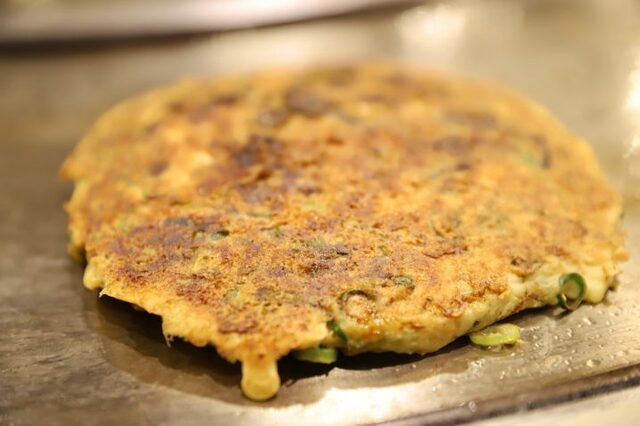
Juso is not the polished Osaka of hotel lobbies and department-store dining floors. It is railway Osaka: narrow streets, quick decisions, steam from griddles, and restaurants built for regulars as much as visitors. That setting matters for negiyaki, a dish too often flattened into the foreign shorthand of “Osaka pancake.” The better reading is more specific: a griddle tradition where batter is only part of the structure, scallions do much of the talking, and the counter is not theatre so much as a working line.
Negiyaki Yamamoto Honten belongs to that category of Osaka restaurant where the format explains the city. The room is counter-led, with 20 seats, and the menu sits around okonomiyaki and stir-fried noodles rather than the broader tasting-menu grammar that defines many premium Japanese dining rooms. Its repeated selection for Tabelog 100 Okonomiyaki, including 2025, 2024, 2023, 2022, 2019 and 2018, gives the place a public credential inside a genre that is usually judged locally, informally, and over many repeat meals.
Why negiyaki changes the Osaka griddle conversation
Okonomiyaki is often treated as Osaka’s default comfort dish, but negiyaki narrows the focus. The name points to negi, scallions, and the style shifts attention away from bulk and toward a thinner, greener, more savoury construction. That distinction is useful for travellers who arrive expecting a single Osaka griddle canon. The city’s konamon culture, food built around flour-based batters and doughs, runs from takoyaki and okonomiyaki to yakisoba and beyond, but each format carries its own balance of starch, sauce, heat and speed.
The Honten address in Juso places the dish outside the more internationally trafficked Namba and Umeda circuits, though it remains in central Osaka’s dining orbit. That geography is part of the point. Juso has long functioned as a practical interchange neighbourhood rather than a luxury dining enclave, and griddle restaurants make sense here: fast enough for weekday meals, substantial enough for groups, and technical enough that locals still debate the details. For broader city planning, pair this stop with Our full Osaka restaurants guide, then use Our full Osaka hotels guide, Our full Osaka bars guide, Our full Osaka wineries guide, and Our full Osaka experiences guide to build the rest of the trip around the city rather than around a single meal.
A counter format with everyday pricing and serious recognition
The useful tension here is price against reputation. A JPY 2,000–2,999 lunch or dinner budget keeps Negiyaki Yamamoto Honten in a range closer to everyday Osaka eating than destination fine dining. In the same city, Chuka Soba Kirimen Souhonten occupies a lower JPY 1,000–1,999 ramen-adjacent bracket, Nomiba Umeda sits in a similar JPY 2,000–2,999 spend, while Meganeya moves higher at JPY 4,000–4,999. That spread makes the Juso counter a clear case of genre prestige without luxury pricing.
Recognition also needs the right interpretation. Tabelog’s Hyakumeiten lists are not Michelin stars, and they do not turn a griddle counter into a formal restaurant. They do signal sustained attention from Japan’s restaurant-review ecosystem within a defined category. For okonomiyaki and related griddle cooking, that matters because the field is dense, local and price-sensitive. A restaurant can be culturally important without white tablecloths, a wine pairing, or a chef biography built for export.
Osaka’s wider casual dining range helps put the choice in perspective. Travellers comparing snack, bakery and casual counters might look at 551 Horai (551蓬莱), 52CHO-ME BAKERY.cafe, 99 Pizza Napoletana Gourmet, or a canto (Italian) for entirely different readings of the city’s appetite. The Juso meal is narrower: counter seating, griddle cooking, and a local dish whose reputation depends less on luxury ingredients than on timing, proportion and heat management.
How to read the room before you go
The practical signals are unusually clear. Reservations are unavailable, so the experience belongs to the walk-in rhythm of the neighbourhood rather than scheduled destination dining. The restaurant is listed as non-smoking, private rooms are unavailable, private use is unavailable, take-out is offered, and children are welcome. Payment is cash-oriented: credit cards, electronic money and QR code payments are not accepted. For visitors accustomed to frictionless urban dining, that detail matters more than any decorative description of the room.
Hours run daily from 11:30 AM to 9:00 PM, with irregular closures and possible changes, so timing is part of the planning. Juso Station is the nearest station, and the listed access is a short walk from the west exit. Parking is unavailable, which further underlines the railway-neighbourhood character of the meal. The better editorial stance is simple: treat this as a focused Osaka griddle stop, not a long-form restaurant evening.
For readers building a wider Japan itinerary around specialist casual food, the comparison is less about cuisine than format discipline. A tightly defined counter in Osaka has more in common, structurally, with places such as [ki:] in Kyoto, [Curry Senmon Ten] Maruyama Kyoju. in Sapporo.know in Kumamoto, (Shoku) Vietnam in Kawasaki. 鮪と炭火焼き うお炭 秋葉原店 in Tokyo, and -Grilled beef Sukiyaki- KAMAKURA TANUKIAN 鎌倉 たぬき庵 in Kamakura than with formal dining rooms. Abroad, the same lesson applies to focused Japanese formats at Jōdo Saké Bar in Los Angeles or Onigiri Time in Pasadena: the format works when its limits are part of the appeal.
The verdict is not that every Osaka visitor needs to chase a queue in Juso. It is that negiyaki gives a sharper reading of Osaka’s griddle culture than a generic okonomiyaki stop, and this counter has the recognition, price point and neighbourhood setting to make that reading credible. Go for specificity: scallion-led konamon, counter pacing, and a meal that explains why Osaka’s casual food traditions remain more precise than their tourist shorthand suggests.
Where It Fits
Comparable venues by category and price.
| Venue | Cuisine | Price | Notes |
|---|---|---|---|
| Negiyaki Yamamoto HontenThis venue — the venue you are viewing | Japanese Negiyaki | $$ | Not listed |
| Ramen Chonmage Osaka Tenroku | Japanese Ramen | $$ | Tenjinbashi |
| Naniwa Menjiro Zen | Japanese Ramen | $$ | Kita |
| CHIKICHIKI Hanshin umeda ten | Modern yakitori in Hanshin Umeda | $$ | Kita |
| Okonomi Tamachan Viva | Okonomiyaki, Teppanyaki & Korean Izakaya | $$ | Nishi |
| Junkissa American | Traditional Japanese Kissaten / Cafe | $$ | Chūō |
Recognition history
Dated appearances from independent guides and award organizations, with the underlying list record or original source where available.
Tabelog 100 #10 · No. 10
Tabelog · Tabelog 100 - Okonomiyaki - 2025
Continue exploring
More in Osaka
Restaurants in Osaka
Browse all →



Bars in Osaka
Browse all →




Hotels in Osaka
Browse all →



Wineries in Osaka
Browse all →
At a Glance
- Classic
- Cozy
- Casual Hangout
- Solo
- Family
- Standalone
A compact, local, no-frills neighborhood spot with a lively, line-at-the-door feel and a classic Osaka soul-food atmosphere.