
Moriyama Ya belongs to Osaka’s compact, ritual-driven curry culture rather than the city’s high-spend tasting-menu circuit. Its Tabelog Curry WEST 100 selections, 13-seat format and no-photography rule point to a meal built around focus, pace and repeat local use, with Indian curry as the anchor rather than spectacle.
Pearl is the En Primeur Club membership app — saves, bookings, and concierge access live there. Same editors, same standards.
- Address
- 大阪府大阪市北区西天満2-3-15 千都ビル 1F
- Phone
- +81663624080
- Website
- tabelog.com
 Saves & bookings on Pearl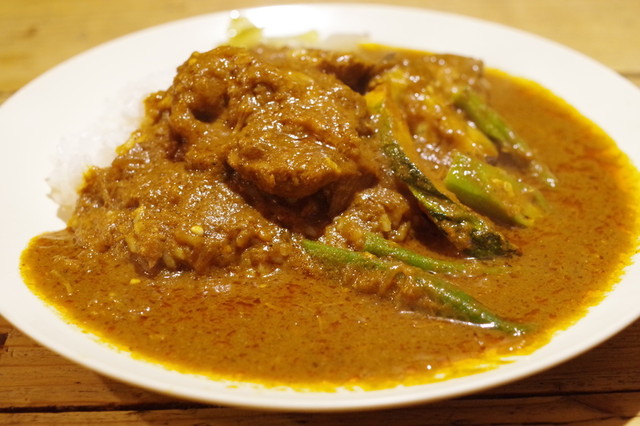
Nishitenma changes the tempo of Osaka dining. The district sits close to the office gravity of Umeda and the legal-commercial blocks around Oebashi, but its smaller restaurants often feel more disciplined than showy: counters, short menus, regulars who know when to arrive, and meals that do not need theatre to hold attention. Moriyama Ya fits that pattern. The room is compact, with counter seating and a few tables, and the dining ritual is shaped by concentration: order, eat, move on, and leave the camera out of it.
That last point matters. Osaka is a city where food queues and phone photography can turn modest rooms into public stages. A restaurant that does not permit photography inside, including the food, makes a clear statement about pace. It puts curry back into the category it has long occupied in Japan: a serious everyday meal, not a performance. The price band also keeps the experience in that register, closer to a repeatable city lunch or casual dinner than to the expense account dining nearby.
Nishitenma curry, measured against Osaka's higher-spend rooms
Osaka’s restaurant map often gets flattened into two familiar ideas: Dotonbori appetite and high-counter precision. Nishitenma complicates that reading. Around this part of Kita-ku, small-format rooms can sit beside much more expensive reservations, and the contrast is useful. Sushi shizuku Nishitenma sits in a far higher spend bracket, while Ren, Goichi Nishitenma ten and Sumibi Yakitori Ikoka Nishitenma all point to the neighbourhood’s stronger evening-dining economy. Against that field, Moriyama Ya occupies a different lane: Indian curry, Indian and curry categories, a lower spend, and a format that rewards directness rather than ceremony.
The Tabelog Curry WEST 100 selection in 2024 gives the room a credible public marker without changing the nature of the meal. Curry in Japan has never been only one thing. It can mean naval-style comfort, kissaten lunch, spice-led independent shops, South Asian cooking translated through Japanese habits, or hybrid plates that have become local vernacular. In Osaka, where casual food is often judged by repetition as much as novelty, recognition in a curry-specific list is more meaningful than a generic popularity badge. It places the restaurant inside a defined category, where price, queue tolerance, speed and spice preference matter more than linen or glassware.
The useful comparison is not with temples of luxury but with other small Osaka addresses that ask diners to understand the format before they arrive. 52CHO-ME BAKERY and .cafe speak to the city’s daytime precision; 551 Horai (551蓬莱) represents a mass-market Osaka craving with its own etiquette; 99 Pizza Napoletana Gourmet and a canto (Italian) show how imported forms get localized through Japanese service habits. Curry belongs in that same conversation when it is treated as a practiced meal rather than a backup option.
The ritual is compact: curry, counter discipline and no camera pause
Service format matters because small curry rooms operate on rhythm. With 13 seats split between counter and table seating, the meal is naturally scaled for solo diners, pairs and friends rather than large groups. Counter seating changes the etiquette: orders need to be clear, lingering is limited by the room’s size, and the experience depends on the room turning without feeling rushed. In this context, the no-photography rule is not a quirk. It protects a sequence that is otherwise easily broken by phones, lighting adjustments and social posting.
Moriyama Ya has appeared in Tabelog’s curry selections across multiple years, including Curry WEST 100 in 2019, 2020, 2023 and 2024, plus curry list recognition in 2017 and 2022. That pattern says more than a single award year would. For a low-price curry specialist, sustained selection suggests consistency within a category where locals compare portion, spice balance, timing and value with unforgiving regularity. It also explains why the venue is better read as part of Osaka’s everyday expertise than as a destination built around a chef narrative.
The absence of a public chef persona is a strength for this kind of page. Japanese curry shops often run on repetition and house style, not celebrity authorship. The diner’s decision is less about following a named figure and more about choosing a format: a compact Nishitenma room, Indian curry as the category, a recognized curry-list track record, and a meal that does not require a long evening. For travellers, that can be more useful than another formal booking in a city already rich with counters and tasting menus.
How to place it in an Osaka eating day
This is the kind of address that works when Osaka’s schedule needs one focused meal rather than another sprawling reservation. It pairs naturally with Kita-ku plans, especially for travellers already moving between Umeda, Oebashi and Nakanoshima. The lack of parking and the central station catchment make rail the sensible approach, and the cash-only payment setup rewards a little preparation. Reservations are available, which is worth noting because curry specialists in small rooms can be harder to read from the outside than higher-priced restaurants with formal booking systems.
For a wider Osaka plan, place it among practical city eating rather than ceremony. Use Our full Osaka restaurants guide for the broader dining map, then separate the meal from hotel, bar and cultural planning through Our full Osaka hotels guide, Our full Osaka bars guide, Our full Osaka wineries guide and Our full Osaka experiences guide. For Japan comparisons beyond Osaka, the same practical lens applies to [Curry Senmon Ten] Maruyama Kyoju. in Sapporo, [ki:] in Kyoto, -Grilled beef Sukiyaki- KAMAKURA TANUKIAN 鎌倉 たぬき庵 in Kamakura. 鮪と炭火焼き うお炭 秋葉原店 in Tokyo.know in Kumamoto and (Shoku) Vietnam in Kawasaki. Further afield, Jōdo Saké Bar in Los Angeles and Onigiri Time in Pasadena show how Japanese dining rituals travel when format is treated seriously.
Style and Standing
Comparable venues at similar price and category levels.
| Venue | Cuisine | Price | Notes |
|---|---|---|---|
| Moriyama YaThis venue — the venue you are viewing | Indian-style Curry House | $ | Not listed |
| Curry Ya Nunkui | Curry / Indian Curry | $ | Sakai Ward |
| Osaka Halal Restaurant | Traditional Pakistani Halal Restaurant | $ | Nishiyodogawa |
| Satch's Curry | Indian-style Curry Shop | $ | Kita |
| Nepal & Indian Manakamana | Nepalese & Indian Curry House | $ | Chūō |
| ANNAPURNA | Traditional Indian Curry House | $ | Kita |
Recognition history
Dated appearances from independent guides and award organizations, with the underlying list record or original source where available.
Tabelog 100 #60 · No. 60
Tabelog · Tabelog 100 - Curry - WEST - 2024
Continue exploring
More in Osaka
Restaurants in Osaka
Browse all →




Bars in Osaka
Browse all →




Hotels in Osaka
Browse all →




Wineries in Osaka
Browse all →
At a Glance
- Cozy
- Quiet
- Classic
- Solo
- Casual Hangout
- After Work
- Business Dinner
- Standalone
An intimate, non-smoking curry hideout with just a counter and a few tables, described as calm and easy to enjoy, with a relaxed, low-key atmosphere suited to solo diners and small groups rather than loud gatherings.