
Mori no Restaurant Lucky Garden gives Ikoma’s dining map a different center of gravity: Sri Lankan, cafe and curry cooking in a house-restaurant setting rather than another station-side quick stop. Its selection for Tabelog 100 Asian cuisine / Ethnic cuisine WEST 2024 places it in a regional conversation where spice, sourcing and setting matter as much as formality.
Pearl is the En Primeur Club membership app — saves, bookings, and concierge access live there. Same editors, same standards.
- Address
- 奈良県生駒市鬼取町168
- Phone
- +81743777936
- Website
- luckygarden.jp
 Saves & bookings on Pearl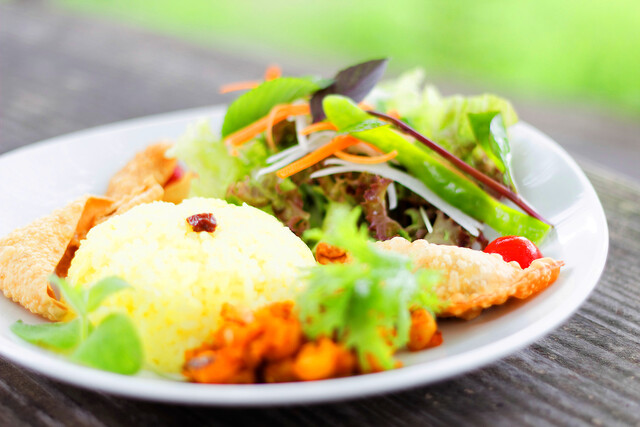
The approach to Ikoma’s hillside dining is part of the argument here. This is not the Nara meal built around temple-town polish or the Osaka meal shaped by speed and density; it is a slower, more rural-feeling version of Kansai eating, where the room, terrace and surrounding green space change how curry and Sri Lankan cooking register at the table. The category matters. Sri Lankan food in Japan often gets flattened into the broad language of “curry,” but the stronger examples rely on contrast: rice as anchor, spice as structure, vegetables and accompaniments doing as much work as the main sauce.
Mori no Restaurant Lucky Garden sits inside that more interesting lane for Ikoma, a city better known to many travelers as a mountain-edge stop between Nara and Osaka than as a destination for regional ethnic cooking. Its inclusion in Tabelog 100 Asian cuisine / Ethnic cuisine WEST 2024 gives the restaurant a clearer signal than atmosphere alone. The recognition also places it beside a wider western Japan field where South Asian, Southeast Asian and hybrid cafe formats compete less on luxury cues than on consistency, ingredient handling and a sense of place.
Ikoma's hillside changes the way Sri Lankan curry reads
Urban curry counters tend to compress the experience: quick service, tight seating, a focused plate. A house-restaurant format in Ikoma stretches that rhythm. The point is not that rural air improves spice by magic; it is that the setting makes the sourcing question more visible. In a terrace-led, family-friendly environment, vegetables, rice, pickles, sambols and curry elements are not side details. They are the architecture of the meal, and they carry the difference between generic heat and cooking with balance.
That distinction is useful for travelers mapping Ikoma’s restaurants. Ramen Torikaji Ippai represents the city’s tighter, lower-spend noodle lane, while Kimiya and æ æ¨ point to a broader local spread. This restaurant’s Sri Lankan, cafe and curry identity gives Ikoma another register: not formal destination dining, not commuter food, but a meal where spice and landscape sit in the same frame.
The sourcing angle is also where Sri Lankan cooking gains its force in Japan. Kansai diners understand seasonality through kaiseki, soba, tempura and home cooking, but curry houses often have to prove that ingredients matter beyond sauce intensity. Here, the stronger editorial reading is not about novelty. It is about how an imported culinary grammar adapts to a Japanese mountain-side setting without turning into theme-restaurant theatre. The open terrace and house-restaurant context make produce, texture and pacing more legible than they would be in a basement counter.
Recognition without the luxury costume
The Tabelog 100 selection is a useful trust signal because this is not a high-price tasting-menu proposition. The category rewards restaurants that hold attention across everyday formats: curry houses, ethnic restaurants, cafes with serious cooking, and regional specialists outside the usual central-city dining circuits. In that context, a Tabelog score of 3.53 and selection for the 2024 WEST list indicate traction among diners who compare across a wide field rather than only within Ikoma.
Comparison clarifies the role. YAMAOKA PIZZA gives the wider area a casual pizza reference; A VOTRE SANTE works in a French lane; Sosakukushinomise Rindo belongs to kushiage. Those are different cravings and different measures of success. Sri Lankan curry asks whether spice, rice, vegetable elements and service rhythm cohere. Mori no Restaurant Lucky Garden is strongest as a change of register for travelers who have already scheduled the obvious Nara standards and want a meal that reflects Kansai’s suburban and mountain-edge food culture.
The practical profile reinforces that reading. This is a family-friendly, pet-friendly venue with take-out and private-use availability, so the experience is less hushed dining room than social hillside restaurant. That does not reduce its seriousness; it simply defines the lane. Some award-tracked restaurants ask for ceremony. This one belongs to the group where the better decision is to arrive with an appetite for spice, a tolerance for a looser cafe rhythm and an interest in why regional ethnic cooking in Japan often thrives outside the dense urban core.
How to place it in an Ikoma itinerary
Ikoma rewards travelers who do not treat it as a pass-through. The mountain setting, cable-car associations and Nara proximity give the city a different tempo from central Osaka, and restaurants here often work better as part of a half-day plan than as isolated dinner trophies. For a broader sweep, use Our full Ikoma restaurants guide alongside Our full Ikoma hotels guide, Our full Ikoma bars guide, Our full Ikoma wineries guide and Our full Ikoma experiences guide.
Readers building a wider Japan food route can use contrast rather than similarity. Pair this kind of hillside Sri Lankan-curry stop with beef sukiyaki at -Grilled beef Sukiyaki- KAMAKURA TANUKIAN 鎌倉 たぬき庵 in Kamakura, casual seafood-and-charcoal cooking at. 鮪と炭火焼き うお炭 秋葉原店 in Tokyo, cafe culture at.cafe in Osaka, Kumamoto’s contemporary lane at.know in Kumamoto, Vietnamese cooking at (Shoku) Vietnam in Kawasaki, Sapporo curry at [Curry Senmon Ten] Maruyama Kyoju. in Sapporo, Kyoto’s compact modern dining at [ki:] in Kyoto, and Nara-area meat dining at #肉といえば松田 奈良本店 in Kashihara. For North American counterpoints in Japanese-adjacent casual dining, Jōdo Saké Bar in Los Angeles and Onigiri Time in Pasadena show how format and ingredient identity travel in another direction.
Quick Comparison
Comparable venues by cuisine and price in the same metro.
| Venue | Cuisine | Price | Notes |
|---|---|---|---|
| Mori no Restaurant Lucky GardenThis venue — the venue you are viewing | Sri Lankan curry & cafe in a forest garden | $$ | Not listed |
| æ æ¨ | japanese | Not listed | Ikoma District |
| Kimiya | Special Select Wagyu Yakiniku | $$$$ | Gakken Nara Tomigaoka |
| Ramen Torikaji Ippai | Specialty Chicken Ramen Shop | $ | Ikoma |
| Jazz Bar Gentry | Jazz Bar | $$ | Kintetsu Nara |
| NUWARA KADE | Authentic Sri Lankan Curry & Biryani | $$ | Nishi |
Recognition history
Dated appearances from independent guides and award organizations, with the underlying list record or original source where available.
Tabelog 100 #66 · No. 66
Tabelog · Tabelog 100 - Asian cuisine / Ethnic cuisine - WEST - 2024
Continue exploring
More in Ikoma
Restaurants in Ikoma
Browse all →




Bars in Ikoma
Browse all →


Hotels in Ikoma
Browse all →



Wineries in Ikoma
Browse all →
At a Glance
- Scenic
- Rustic
- Cozy
- Whimsical
- Family
- Group Dining
- Casual Hangout
- Date Night
- Celebration
- Garden
- Terrace
- Courtyard
- Standalone
- Garden
- Mountain
Relaxed and rustic, with a countryside feel in the forest at the foot of the Nara–Ikoma mountains; guests dine overlooking greenery and seasonal flowers, creating a cozy, slightly whimsical atmosphere more like a mountain garden retreat than a typical city restaurant.