
Tabelog 100 #67
Our verdict
Mori no Ohagi puts Osaka’s wagashi culture into a small-format, takeaway-only frame in Toyonaka, where ingredient clarity matters more than dining-room ceremony. Its selection for Tabelog 100 Japanese traditional sweets / Japanese sweets cafe WEST 2023 gives it a useful trust marker for travellers looking beyond central Osaka’s restaurant routes.

Pearl is the En Primeur Club membership app, where members save venues, book tables and use the concierge.
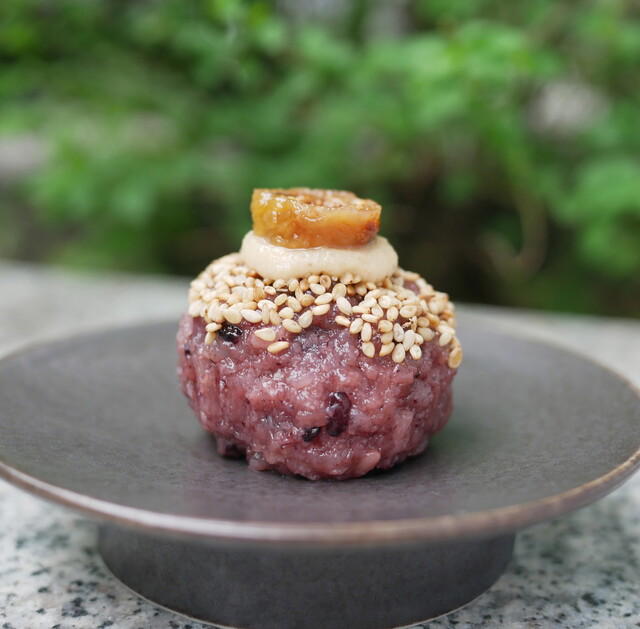
The menu
What to order
- 小豆あん雑穀もち
- 深煎きなこ雑穀もち
- ほうじ茶黒米もち
- 本醸造みたらし雑穀もち
- くるみ黒米もち
Approaching a wagashi shop in Osaka brings a different dining anticipation: less clatter and theatre, more attention to the day’s small edible calendar. The category rewards restraint. Rice, beans, sugar, seasonal produce and texture carry the argument, and a strong shop does not need a long menu or dining-room spectacle to prove it. Mori no Ohagi belongs to that tradition, keeping the sweets themselves at the centre.
Osaka is often read through takoyaki, kushikatsu and late-night counter food, but its sweet culture has its own grammar. Wagashi shops sit close to daily life: tea, gifts, household visits and seasonal shifts. For travellers, the pleasure is not simply dessert after lunch. It is a separate genre, built around portion, timing and freshness. In Osaka, beyond the densest tourist circuit, the format can feel especially local in scale.
Ohagi as a test of rice, beans and restraint
Ohagi looks modest beside elaborate kaiseki sweets, but it is demanding. Balance depends on glutinous rice, bean paste, grain texture and sweetness that stops before fatigue. Ingredient sourcing sits quietly behind the result: bean quality, rice handling and seasonal additions decide whether the sweet feels heavy or clean. The leading examples avoid visual excess and make a compact case for freshness and proportion.
Mori no Ohagi’s recognition by Tabelog Hyakumeiten in 2023 places it in a selection where consistency matters. That award signal helps because wagashi is not always legible to visitors who judge restaurants by tasting menus, counter seats or wine lists. This category competes on another axis: craft repeated in small pieces, day after day, often with a narrow service window and limited production.
Price changes the decision too. This is not an expensive luxury stop like a high-end sushi counter or French dining room. The listed spend sits under JPY 1,000, making it a precise addition to an Osaka food day rather than the anchor meal. That low price should not be mistaken for low ambition. In Japanese sweets, accessibility and discipline often share the same counter.
For travellers building a day around Osaka’s range, the city’s scale becomes interesting here. A morning bakery stop, a casual comfort-food marker, or a more restaurant-shaped evening all tell different city stories. Wagashi adds another register: quieter, older in cadence, and less dependent on a full seated service.
Osaka gives the shop its useful context
Osaka is not only the city of neon shorthand. Its food appeal is also residential, practical and everyday, which suits a Japanese traditional sweets shop better than a theatrical central address. The local context matters because wagashi is often bought with a purpose: to take home, carry to a host, or eat soon after purchase. The appeal is not built on spectacle; it clarifies the transaction.
Within the comparison set around Osaka, the shop occupies a different lane from Lime Light, Soratobu Udon Yamabuki Ya, Toyonaka Mente Tsu, Kodou and Nick&Renée Toyonaka honten. Those names point to meal categories and broader spend bands, while Mori no Ohagi is a low-ticket specialist. That distinction is the editorial point. Do not measure it against a full lunch; it functions as a targeted stop for a specific craft.
The sourcing angle is why wagashi rewards timing. These sweets are not built for long holding like packaged souvenirs. The format favours buying close to eating, especially when rice texture and bean paste are central. In that sense, the shop sits closer to a bakery or onigiri counter than to a display designed for extended browsing. Compare that with other practical, ingredient-led formats: different foods, similar respect for timing.
Visitors using Osaka as a base can fold this stop into a broader route rather than isolate it as a grand occasion. EP Club’s full Osaka restaurants guide is the natural place to compare dining formats, while the full Osaka hotels guide, full Osaka bars guide, full Osaka wineries guide and full Osaka experiences guide help decide how it fits the day’s geography.
Where it fits in an Osaka itinerary
The strongest reason to make room for Mori no Ohagi is calibration, not spectacle. After Osaka’s salt, smoke, broth and fried batter, a small wagashi purchase shows another side of Kansai appetite: measured sweetness, rice texture, bean depth and seasonality in miniature. Travellers who only chase long dinners miss that daily rhythm.
This is still a specialist stop, not a fallback café. The format suits people comfortable planning around Japanese traditional sweets and eating them at the right moment. It also suits travellers who care about regional food culture beyond famous savoury dishes. Pairing it with a casual Osaka crawl can make more sense than treating it as a standalone detour.
For a broader sense of how casual and specialist formats travel across cities, compare the category logic with other bakeries, sweets counters, casual kitchens, bars and ingredient-led dining rooms. The lesson is consistent across categories: a narrow brief can reveal more about place than a sprawling menu.
Mori no Ohagi earns attention because it keeps the frame tight. The award recognition supplies the external credential, the price keeps the risk low, and the sweets feel tied to the day rather than staged for a long meal. For Osaka travellers willing to leave the obvious dining grid, that is a useful, edible correction to the city’s louder reputation.
Cuisine Context
Comparable venues for cuisine and category context.
| Venue | Cuisine | Price | Awards | Notes |
|---|---|---|---|---|
| Mori no OhagiThis venue (the venue you are viewing) | Creative Japanese ohagi & wagashi shop | $1–10 | Tabelog 100 #67 | Not listed |
| isato | Ramen shop in Suita | $10–20 | Tabelog 100 #52 | Suita |
| Osaka Naniwaya | Japanese taiyaki & kakigori sweets shop | $10–20 | Tabelog 100 #34 | Kita |
| Deiribashi Kintsuba Ya | Traditional Japanese Wagashi & Kintsuba Café | $10–20 | Tabelog 100 #3 | Kita |
| Spice and Curry Ougon no Kaze | Japanese spice curry | Not listed | Tabelog 100 #11 | Kita |
| Menya Hanabusa | Nagoya Cochin chicken ramen & chuka soba | $10–20 | Tabelog 100 #29 | Chūō |
Recognition history
Dated appearances from independent guides and award organizations, with the underlying list record or original source where available.
Tabelog 100 #67 · No. 67
Tabelog · Tabelog 100 - Japanese traditional sweets / Japanese sweets cafe - WEST - 2023
Continue exploring
More in Osaka
Restaurants in Osaka
All restaurants in Osaka →


Bars in Osaka
All bars in Osaka →

Hotels in Osaka
All hotels in Osaka →




Wineries in Osaka
Browse all →
Details
- Cozy
- Classic
- Solo
- After Work
- Casual Hangout
- Standalone
- Local Sourcing
- A La Carte
Current opening hours
- Monday
- Closed
- Tuesday
- 10 AM–1 PM, 2–5 PM
- Wednesday
- 10 AM–1 PM, 2–5 PM
- Thursday
- 10 AM–1 PM, 2–5 PM
- Friday
- 10 AM–1 PM, 2–5 PM
- Saturday
- 10 AM–1 PM, 2–5 PM
- Sunday
- Closed
Hours can change for holidays and private events. Last verified .
A small, traditional Japanese sweets shop focused on takeaway, with a calm, understated feel and a showcase of handmade rice cakes that change with the seasons rather than a sit-down café atmosphere.