
Tabelog 100 #25
Our verdict
Mochisho Shizuku Shinmachi ten is a compact Osaka wagashi and daifuku address in Shinmachi, with counter seating, take-out service, and repeat Tabelog 100 selections for western Japan sweets categories. It sits in the accessible JPY 1,000–1,999 tier, making it useful for a precise afternoon stop rather than a full restaurant booking.

Pearl is the En Primeur Club membership app, where members save venues, book tables and use the concierge.
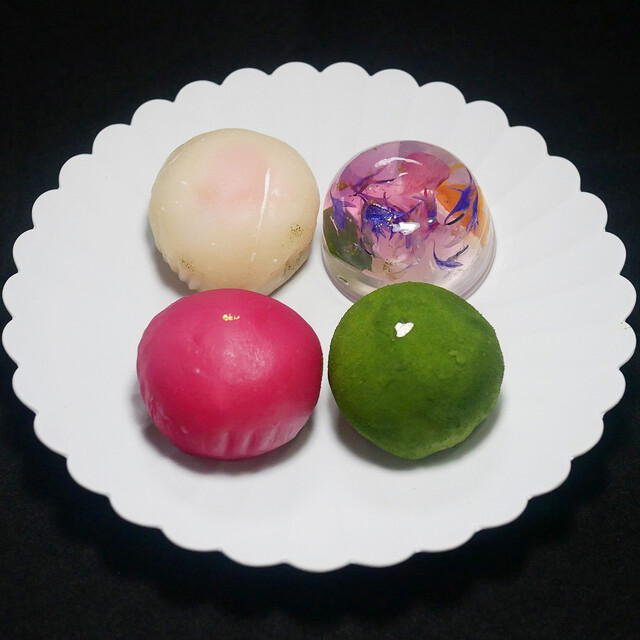
The menu
What to order
- Daifuku (red bean paste rice cake)
- Seasonal fruit daifuku
- Raspberry mochi
- Traditional wagashi assortment
Osaka’s quieter sweets culture changes the rhythm of eating in the city. Osaka is often read through late-night counters, takoyaki queues, and department-store food halls, but its wagashi culture works on a smaller clock: restrained service, focused rooms, and sweets built for tea rather than spectacle. Mochisho Shizuku Shinmachi ten fits that register. The format is best understood as a specialist sweets stop, closer to a focused wagashi address than a café designed for long lingering.
That matters in Osaka because wagashi is not a dessert add-on here. It is a separate discipline, with its own grammar of rice flour, beans, fruit, seasonality, packaging, and gifting. Daifuku in particular sits at the meeting point between everyday comfort and technical control: the wrapper must hold, the filling must balance sweetness and texture, and the whole piece has to travel if it is being taken away. The contemporary version often borrows from patisserie-level precision while remaining anchored in Japanese ingredients and presentation codes.
Osaka wagashi, judged by restraint rather than restaurant theatre
Osaka’s premium sweets scene rewards focus. The city has plenty of casual bakery and café options, but wagashi specialists operate under a different kind of scrutiny. Recognition comes less from room design or menu sprawl and more from consistency across a narrow craft. Mochisho Shizuku Shinmachi ten’s 2023 Tabelog Hyakumeiten recognition places it within that specialist bracket for Japanese traditional sweets, daifuku, and café culture.
The distinction is useful for visitors planning Osaka meals. Other Osaka dining rooms speak to the city’s high-volume comfort-food muscle, while international-leaning restaurants reflect its appetite for imported technique. Wagashi sits between those poles. It is indigenous in ingredient logic, but exacting in method; modern shops often feel closer to pastry laboratories than nostalgic sweet counters.
Mochisho Shizuku Shinmachi ten’s category listing is telling: Japanese traditional sweets, daifuku, and café. That combination places the shop in a narrow lane where the craft is legible even to travellers who do not read the full regional calendar of Japanese confectionery. Daifuku gives the format a familiar entry point, while the café element keeps the pace measured. This is not Osaka at full volume. It is the city in a quieter register, where a small purchase can carry as much local specificity as a long dinner.
Local materials, contemporary discipline
The stronger end of Japanese sweets culture depends on compression. Rice, beans, fruit, sugar, and tea can look simple from a distance, but the work is in proportion and handling. Osaka has long absorbed outside food techniques without losing its local appetite for practicality; the same impulse can be seen across the city’s dining spread, from casual counters to international kitchens. In wagashi, that exchange shows up as polish rather than fusion: clean lines, controlled sweetness, and pieces designed to be eaten with attention.
This is where the “local ingredients, global technique” lens becomes useful. Wagashi does not need imported flavours to feel current. Its modernity often comes from precision associated with pastry craft: portioning, temperature discipline, packaging, and an eye for seasonal produce when used. The result is a sweet culture that can feel contemporary without abandoning Japanese structure. In a city where travellers often chase heat, smoke, and sauce, this is the corrective: quiet sugar, rice texture, and café pacing.
The shop’s Tabelog recognition also signals that it is not merely a convenience stop. In Japan, user-driven recognition has particular weight in categories where Michelin coverage is less relevant. For wagashi and cafés, selection can be more meaningful than a chef biography, because the product has to satisfy regular local use as well as destination interest. The focused category listing reinforces that scale: this is a specialist sweets address, not a broad-service restaurant trying to cover multiple occasions.
How to place it in an Osaka day
The strongest use case is daytime planning. Traditional sweets fit neatly between lunch and dinner, especially when an Osaka itinerary needs a calmer counterpoint to the city’s heavier eating routes. The provided JPY 1,000 - JPY 1,999 price band also makes it practical for travellers who prefer to fold wagashi into a pause rather than build a full sit-down stop around it.
There is a useful planning contrast within Osaka. Jyonetsu Don Hokuto, yobareya, YAMAMOTO KASHITEN, Pizzeria da Tigre, and 青地 all point to different ways of building a day around food, while Mochisho Shizuku Shinmachi ten keeps the focus tightly on Japanese traditional sweets, daifuku, and café use. It belongs to an approachable specialist lane: serious enough to merit a dedicated detour for wagashi-minded travellers, but not structured like a tasting-menu restaurant or formal dessert course.
For a wider Osaka itinerary, treat this as a precision stop rather than the day’s centre of gravity. Pair it with broader Osaka restaurant planning, then decide whether the trip needs a hotel base, a nightcap, regional drinking context, or cultural structure. Readers building a broader Japan food map can also compare this kind of focused sweets format with other dining in Osaka and beyond, keeping Mochisho Shizuku Shinmachi ten in mind as a concise example of how much specificity a small wagashi stop can carry.
Frequently asked questions
Is Mochisho Shizuku Shinmachi ten child-friendly?
Public listing details provided here do not specify a child policy. The venue is best understood as a compact Osaka stop for Japanese traditional sweets, daifuku, and café use, with a listed price band of JPY 1,000–JPY 1,999.
What's the vibe at Mochisho Shizuku Shinmachi ten?
It is a restrained wagashi-focused venue rather than a full-scale dining room. Tabelog recognized it in 2023, and its categories, Japanese traditional sweets, daifuku, and café, point to a quiet, specialist Osaka sweets experience.
What does dinner at Mochisho Shizuku Shinmachi ten typically cost?
A dinner budget is not listed for Mochisho Shizuku Shinmachi ten. The provided price band and lunch budget are JPY 1,000 - JPY 1,999.
What are the opening hours for Mochisho Shizuku Shinmachi ten?
Specific opening hours are not provided here. Check the venue directly before visiting Mochisho Shizuku Shinmachi ten in Osaka.
Budget Reality Check
Comparable venues for orientation by cuisine and category.
| Venue | Cuisine | Price | Awards | Notes |
|---|---|---|---|---|
| Mochisho Shizuku Shinmachi tenThis venue (the venue you are viewing) | Artisanal Japanese Wagashi & Mochi Cafe | $10–20 | Tabelog 100 #25 | Not listed |
| Moeyo Mensuke (燃えよ麺助) | Duck & Shellfish Ramen | $10–20 | Tabelog 100 #71 | Fukushima, Duck Ramen Specialist |
| Tanaka no Chuka Soba | Japanese Ramen | Not listed | Tabelog 100 #43 | Nishi, Japanese Ramen |
| Stand Tsumamigui | Standing Japanese izakaya & curry bar | $20–30 | Tabelog 100 #23 | Naniwa, Standing Japanese izakaya & curry bar |
| Kitahama Choji | Donburi-style Japanese curry | $20–30 | Tabelog 100 #14 | Chūō, Donburi-style Japanese curry |
| Osake to Gohan Taku | Tuna-focused Japanese Izakaya | $20–30 | Tabelog 100 #59 | Kita, Tuna-focused Japanese Izakaya |
Recognition history
Dated appearances from independent guides and award organizations, with the underlying list record or original source where available.
Tabelog 100 #25 · No. 25
Tabelog · Tabelog 100 - Japanese traditional sweets / Japanese sweets cafe - WEST - 2023
Continue exploring
More in Osaka
Restaurants in Osaka
All restaurants in Osaka →



Bars in Osaka
All bars in Osaka →

Hotels in Osaka
All hotels in Osaka →


Wineries in Osaka
Browse all →
Details
- Minimalist
- Quiet
- Cozy
- Modern
- Solo
- Date Night
- Casual Hangout
- Family
- After Work
- Standalone
- Design Destination
- Zero Proof
- Farm To Table
- Organic
- Local Sourcing
- Sustainable Seafood
- A La Carte
- Counter Dining
- Tea
- Coffee
- Non Alcoholic
- Organic Focus
Current opening hours
- Monday
- 10:30 AM–6 PM
- Tuesday
- 10:30 AM–6 PM
- Wednesday
- 10:30 AM–6 PM
- Thursday
- 10:30 AM–6 PM
- Friday
- 10:30 AM–6 PM
- Saturday
- 10:30 AM–6 PM
- Sunday
- 10:30 AM–6 PM
Hours can change for holidays and private events. Last verified .
A small, minimalist space with clean concrete lines and an aesthetic, gallery-like feel; calm and relaxing with a quiet atmosphere suited to slow tea and sweets rather than bustling cafe traffic.