Our verdict
On a cobbled lane in Antibes' medieval quarter, Michelangelo occupies the kind of address that rewards visitors who look beyond the harbour restaurants. The Rue des Cordiers setting places it squarely inside old-town dining, where provenance-led cooking and neighbourhood atmosphere count for more than waterfront spectacle. For the Antibes dining scene, it represents the dependable mid-register that sits between casual Provençal bistros and the area's €€€€ fine-dining tier.

Pearl is the En Primeur Club membership app, where members save venues, book tables and use the concierge.
The menu
What to order
- Rigatoni Polpetta
- Truffle Ravioli
- Truffle Pizza
- Spalla d’Agnello
- Tiramisu
Old Antibes and the Logic of Rue des Cordiers
Antibes' medieval quarter runs tight and shaded between the ramparts and the market hall, and Rue des Cordiers is one of its quieter residential streets. The pattern here is familiar across the Côte d'Azur's older towns: ground-floor restaurants occupy buildings that have housed trades, families, and craftsmen for centuries, and the cooking that emerges tends to reflect the immediate surroundings rather than the grand-hotel ambitions visible along the coast. Michelangelo, at number 4, fits that mould. The address puts it away from the tourist drag of Cours Masséna and the pressure-tested restaurant rows near the port, which tends to attract a crowd that comes for the neighbourhood first and the meal second.
This matters for how you read the experience. In a town where the dominant dining conversation happens between the Michelin-recognised addresses Le Figuier de Saint-Esprit at the top end of regional cuisine and Les Pêcheurs representing serious Mediterranean cooking, there is a middle register that rarely gets written about but does most of the daily work. Old-town restaurants on lanes like Rue des Cordiers occupy that register. They are the places locals actually use, and their continued presence through the shoulder months, when the summer crowd thins, is the clearest indicator of whether they have genuine local support or depend entirely on seasonal footfall.
Where Michelangelo Sits in Antibes' Dining Tiers
Antibes has a more layered dining scene than its coastal geography sometimes suggests. At the high end, the Cap d'Antibes peninsula hosts Louroc at the Hôtel du Cap-Eden-Roc, where modern cuisine aligns with one of the Riviera's most loaded address books. Below that tier, the old town and port area offer a wide band of restaurants where price, format, and ambition vary considerably. The Provençal bistro end is represented by addresses like Chez Jules Le Don Juan at a €€ level, and casual neighbourhood tables like Chez Josy sit alongside them.
Michelangelo operates in the space between those poles. The Italian resonance in the name is not incidental. The relationship between the Côte d'Azur and Ligurian cooking traditions is longstanding, Nice was part of the Kingdom of Sardinia until 1860, and Antibes' proximity to the Italian border means pasta, pesto, and olive-forward preparations have always had legitimate roots here rather than being imports.
The Côte d'Azur's Italian Culinary Thread
The most coherent way to read a restaurant called Michelangelo in old Antibes is against the backdrop of that Italian-Provençal overlap. Across the French Riviera, the line between Niçois cuisine and Ligurian cooking is deliberately blurred in many kitchens. Socca, pissaladière, and stockfish preparations in Nice draw from the same pantry as the focaccia, farinata, and acciughe of Genoa. A restaurant leaning into Italian references in this geography is not signalling a departure from the local tradition; it is, in many cases, pointing back toward it.
This culinary thread runs through the broader French fine-dining tradition as well. Regional identity anchored in specific geography is what separates, say, the garden-rooted cooking at Mirazur in Menton, which sits at the French-Italian border and won the 2019 World's 50 Best leading position, from more abstract haute cuisine. Further afield, the same logic of place-rooted cooking appears at Bras in Laguiole, at Auberge de l'Ill in Illhaeusern, and at Flocons de Sel in Megève. The ambition scale differs enormously, but the argument, that a restaurant's geography should be legible on the plate, connects them.
For a small old-town address like Michelangelo, the claim is narrower and more immediate: that what arrives at the table should make sense in the context of the street it is on, the market that supplies it, and the tradition that shaped the region's palate. Whether it delivers against that standard is the relevant question, and one that current public data does not allow for a definitive verdict.
Planning a Visit: What to Know
Michelangelo is located at 4 Rue des Cordiers in the old town of Antibes, a five-minute walk from the Marché Provençal on Cours Masséna. The old town is navigable on foot, and the Antibes train station connects the town to Nice (roughly 25 minutes) and Cannes (roughly 15 minutes) on the Marseille-Ventimiglia line. The area around Rue des Cordiers is residential rather than heavily touristic, which makes parking marginally easier than near the port, though old-town streets remain narrow.
For a restaurant at this address and scale, it is reasonable to expect that reservation availability in July and August is tighter than in the shoulder months of May, June, and September, when the Riviera retains its warmth but sheds the volume of high-summer visitors. Contacting the restaurant directly before arriving is the practical approach, particularly for weekend evenings in peak season.
Readers building a broader Antibes itinerary will find the full dining picture in our Antibes restaurants guide, which covers the range from neighbourhood bistros to the fine-dining tier. For high-performing urban addresses with a different scale and ambition, AM par Alexandre Mazzia in Marseille represents the closest regional comparison at a serious level, while Assiette Champenoise in Reims, Au Crocodile in Strasbourg, Le Bernardin in New York, and Atomix in New York illustrate how regional identity and technical ambition interact at different price and acclaim levels.
Frequently asked questions
What's Michelangelo's location?
Michelangelo is located at 4 Rue des Cordiers, 06600 Antibes, France, Antibes.
How does Michelangelo compare to other Italian restaurants on the French Riviera?
The Côte d'Azur has a long-established Italian dining tradition shaped by proximity to the Italian border and centuries of cross-cultural exchange, but most of the region's recognisable names cluster around Nice and Menton rather than Antibes. Michelangelo at 4 Rue des Cordiers gives Antibes a representative within that tradition, positioned in the old town rather than the resort-facing dining strip, which tends to attract a more local rather than transient crowd.
What should I eat at Michelangelo?
Michelangelo sits squarely within the Italian-Provençal cooking tradition that runs along this stretch of the Côte d'Azur, where Italian culinary influence and southern French produce have overlapped for centuries. Expect dishes that draw on both sides of that border. For specific current menu details, contacting the restaurant directly at 4 Rue des Cordiers is the most reliable approach.
Is Michelangelo reservation-only?
Rue des Cordiers is a quiet residential street in old Antibes, not a high-footfall tourist corridor, which means walk-ins may be feasible on slower weeknights. That said, Antibes' medieval quarter fills up during summer, and securing a table in advance is advisable from June through August. Reservation policy details are best confirmed by reaching out to the restaurant directly.
What has Michelangelo built its reputation on?
Michelangelo occupies a specific position in Antibes' dining tiers: a neighbourhood-level Italian address in the old town, set apart from the high-end Cap d'Antibes peninsula restaurants and the tourist-facing brasseries near the port. Its address at 4 Rue des Cordiers places it among the more residential pockets of the medieval quarter, where repeat local clientele typically define a venue's standing over time.
Can Michelangelo accommodate dietary restrictions?
Italian cooking in this region naturally accommodates a range of preferences, with vegetable-forward antipasti, pasta, and fish dishes common across the tradition. For specific allergen or dietary requirements, direct contact with the restaurant before visiting is the only way to get accurate, current information.
At a Glance
Comparable venues nearby, for context on price, style, and recognition.
| Venue | Cuisine | Price | Notes |
|---|---|---|---|
| MichelangeloThis venue (the venue you are viewing) | Authentic Italian Trattoria | $50–100 | Not listed |
| Les Vieux Murs | Mediterranean French Bistro | $50–100 | Vieil Antibes, Mediterranean French Bistro |
| YÚKØ | Latin-Asian Fusion Tapas | Not listed | Boulevard d'Aguillon, Latin-Asian Fusion Tapas |
| MamaBoon | Authentic Vietnamese Street Food | $20–30 | Vieil Antibes, Authentic Vietnamese Street Food |
| Restaurant de la Gravette | Traditional Provençal Seafood Bistro | $20–30 | Old Town / Port d'Antibes, Traditional Provençal Seafood Bistro |
| Restaurant Le J | Modern French Bistronomique with Tahitian Influences | $30–50 | Juan-les-Pins, Modern French Bistronomique with Tahitian Influences |
Continue exploring
More in Antibes
Restaurants in Antibes
All restaurants in Antibes →
Bars in Antibes
All bars in Antibes →
Hotels in Antibes
All hotels in Antibes →
Wineries in Antibes
Browse all →

Details
- Elegant
- Rustic
- Intimate
- Sophisticated
- Celebration
- Business Dinner
- Group Dining
- Special Occasion
- Private Dining
- Terrace
- Historic Building
- Extensive Wine List
- Local Sourcing
- A La Carte
- Vegetarian Friendly
Current opening hours
- Monday
- Closed
- Tuesday
- 12–2 PM, 7–11 PM
- Wednesday
- 12–2 PM, 7–11 PM
- Thursday
- 12–2 PM, 7–11 PM
- Friday
- 12–2 PM, 7–11 PM
- Saturday
- 12–2 PM, 7–11 PM
- Sunday
- Closed
Hours can change for holidays and private events. Hours as of .
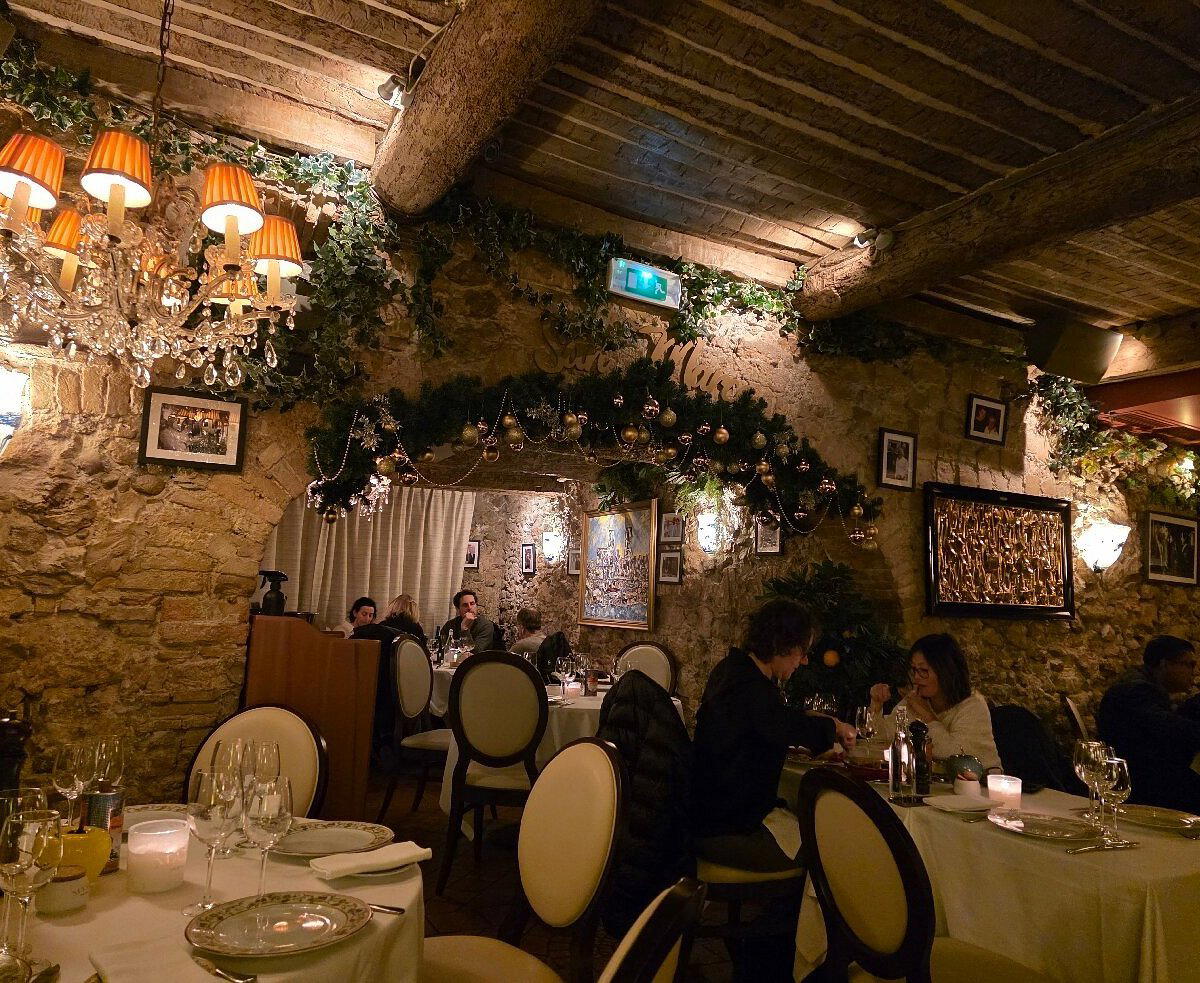
Rustic-chic with vaulted ceilings, terracotta tiles, stone walls, and art-filled gallery-style decor blending Italian warmth with Riviera elegance.