
Men Ippai belongs to Osaka’s disciplined ramen counter culture rather than its tourist-facing dining circuit. The Tsukamoto shop has Tabelog Ramen OSAKA “Tabelog 100” selections from 2023 to 2025, with earlier WEST selections from 2020 to 2022, placing it among the city’s closely watched noodle rooms for serious ramen eaters.
Pearl is the En Primeur Club membership app — saves, bookings, and concierge access live there. Same editors, same standards.
- Address
- 大阪府大阪市西淀川区柏里2-1-25
- Phone
- +81661955870
- Website
- tabelog.com
 Saves & bookings on Pearl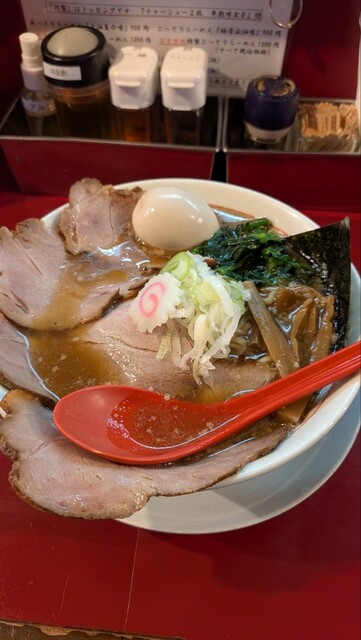
Approaching a serious Osaka ramen counter is rarely theatrical. The cues are smaller: a narrow room, counter seats, a short rhythm of orders, bowls leaving the pass with little ceremony. Men Ippai fits that grammar. It is not trying to compete with the grand dining rooms of Umeda or the night-market energy of Namba; it belongs to the quieter, more exacting ramen culture that rewards diners who cross a few neighbourhood boundaries for a single bowl.
Osaka’s food identity is often flattened into takoyaki, okonomiyaki, and kuidaore excess, but ramen occupies a different register here. The city’s stronger ramen addresses tend to be compact, technically focused, and judged by repeat local use as much as by destination traffic. Men Ippai’s repeated inclusion in Tabelog Ramen selections, including OSAKA “Tabelog 100” in 2023, 2024, and 2025, gives it a measurable place in that circuit. The point is not decoration or chef mythology; the point is whether the bowl has enough structure to survive comparison in a city that eats noodles with a sharp memory.
A counter-led Osaka ramen room with the discipline of a small format
Counter-only ramen changes the way a meal behaves. There is less distance between kitchen and diner, less tolerance for drift, and little room for a sprawling menu to disguise inconsistency. In that setting, the house has to communicate through pacing, broth clarity, noodle texture, and the directness of the bowl. Men Ippai’s format places it in the same practical universe as Osaka ramen specialists such as Shoyu to Kai to Men Soshite Hito to Yume and Chuka Soba Kirimen Souhonten, where the experience is built around a tight noodle proposition rather than a long restaurant evening.
The cultural appeal of this style is its compression. A ramen counter can carry the seriousness of a tasting menu without adopting its length or price theatre. Osaka is particularly good at this middle register: everyday formats executed with near-obsessive attention. That is why a modest ramen room can sit in the same city conversation as French cooking at ku:de kiyo, regional comfort at Negiyaki Yamamoto Honten, or polished beef-focused dining at Wagyu Teppanyaki OUSAKA. The comparison is not about luxury; it is about how Osaka assigns credibility across different formats.
Within ramen, repeat recognition matters because the category is crowded and volatile. A single season of attention can follow novelty; a multi-year run points to staying power. The restaurant’s sequence from Tabelog Ramen WEST selections in 2020, 2021, and 2022 to OSAKA selections in 2023, 2024, and 2025 suggests a shop that has remained visible as the award geography narrowed. That is a useful signal for travellers who have time for one dedicated ramen detour and want evidence beyond social-media heat.
Tsukamoto shows another side of Osaka dining
Tsukamoto is not the Osaka most first-time visitors build an itinerary around. That is part of the argument for going. The city’s central dining zones are efficient and rewarding, but they can make Osaka feel too legible: station complexes, department-store floors, famous queues, snack streets. A neighbourhood ramen counter shifts the scale. The meal becomes less about sightseeing and more about how residents actually distribute their appetite across the city.
This matters because ramen in Japan is intensely local even when its vocabulary is national. Tokyo may dominate international ramen mythology, but Kansai’s shops often work in a leaner, less performative mode, with the room functioning as a quick social contract: arrive, order, eat, make space. The restaurant’s solo-friendly reputation fits that pattern. It is a counter for people who are comfortable letting the bowl, rather than the room, carry the meal.
The shop’s Tabelog score of 3.69 also needs reading in Japanese context. On Tabelog, high scores are harder to accumulate than many global review platforms, and ramen shops compete in a category with heavy local scrutiny. A number in that range, paired with repeated Hyakumeiten selection, is a stronger signal than it may look to travellers used to inflated five-star systems. It says the shop has earned attention from diners who compare bowls frequently, not casually.
How to place it within an Osaka eating itinerary
The restaurant makes sense when the day is built around contrast. Pairing a compact ramen stop with the broader city gives a clearer read of Osaka than stacking only famous formats. For a bakery-led morning, 52CHO-ME BAKERY or .cafe shows the city’s quieter daytime register. For snack culture, 551 Horai (551蓬莱) sits at the opposite end of the appetite spectrum: fast, familiar, and woven into station life. For a longer dinner, a canto (Italian) or 99 Pizza Napoletana Gourmet underline how international cooking has been absorbed into Osaka without erasing the city’s preference for direct pleasure.
Travellers building a wider Kansai and Japan food map can use ramen as one anchor rather than the whole thesis. [ki:] in Kyoto, -Grilled beef Sukiyaki- KAMAKURA TANUKIAN 鎌倉 たぬき庵 in Kamakura. 鮪と炭火焼き うお炭 秋葉原店 in Tokyo.know in Kumamoto, (Shoku) Vietnam in Kawasaki, and [Curry Senmon Ten] Maruyama Kyoju. in Sapporo each speak to a different everyday format. Across the Pacific, Jōdo Saké Bar in Los Angeles and Onigiri Time in Pasadena show how Japanese casual food culture travels, though the compact Osaka ramen counter remains a different kind of encounter: shorter, stricter, and more dependent on local repetition.
For city planning, use Our full Osaka restaurants guide to place the restaurant among other meals, then widen the trip through Our full Osaka hotels guide, Our full Osaka bars guide, Our full Osaka wineries guide, and Our full Osaka experiences guide. The useful move is not to treat ramen as a quick filler between larger reservations. In Osaka, a disciplined bowl can explain as much about the city’s dining culture as a longer, costlier meal.
Style and Standing
Comparable venues to calibrate price, style, and recognition.
| Venue | Cuisine | Price | Notes |
|---|---|---|---|
| Men IppaiThis venue — the venue you are viewing | Ramen | $ | Not listed |
| Chiikawa Bakery | Chiikawa-themed Japanese bakery café | $ | Umeda |
| Chuka Soba Kirimen Souhonten | Ramen & Tsukemen | $ | Yodogawa |
| Kokoro ni Amai Anpanya Umeda ten | Japanese Anpan Bakery | $ | Kita |
| Osaka Naniwaya | Japanese taiyaki & kakigori sweets shop | $ | Kita |
| Kikujudo Yoshinobu | Traditional Japanese wagashi & tea cafe | $ | Chūō |
Recognition history
Dated appearances from independent guides and award organizations, with the underlying list record or original source where available.
Tabelog 100 #72 · No. 72
Tabelog · Tabelog 100 - Ramen - OSAKA - 2025
Continue exploring
More in Osaka
Restaurants in Osaka
Browse all →




Bars in Osaka
Browse all →




Hotels in Osaka
Browse all →



Wineries in Osaka
Browse all →
At a Glance
- Classic
- Cozy
- Solo
- Casual Hangout
- Standalone
A small, no-frills house-style ramen shop with counter seating and a focused, workmanlike atmosphere centered on the bowl rather than décor.