
Tabelog 100 #71
Our verdict
A compact Maruyama soup-curry address with Tabelog Curry EAST 100 selections in 2019, 2020, 2023, and 2024, MATALE Maruyama ten belongs to Sapporo’s everyday-value curry culture rather than its occasion-dining tier. The draw is the ratio: recognised specialist cooking, family-friendly usability, takeout and delivery, and a location near Maruyama Koen without the spend associated with the city’s formal counters.

Pearl is the En Primeur Club membership app, where members save venues, book tables and use the concierge.
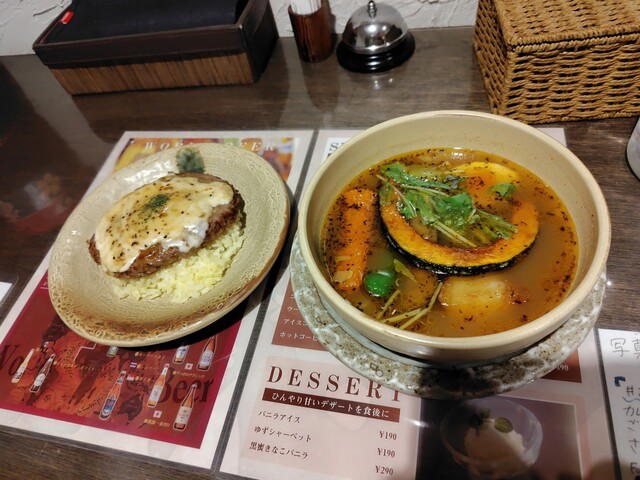
Sapporo changes pace quickly: apartment blocks, small shops, everyday foot traffic, and the calmer residential side of the city’s dining map. In that setting, soup curry reads less like a tourist assignment than a local habit, the kind of meal built around heat, broth, vegetables, rice, and repetition. MATALE Maruyama ten sits in that practical Sapporo category, where the question is not ceremony but value: how much recognised curry craft can a diner get without moving into the city’s expensive sushi or kaiseki bracket?
Sapporo’s soup-curry culture rewards specialization. The format is distinct from Japanese curry rice: broth remains looser, spice structure is more visible, and the bowl usually carries a greater sense of assembly than a single ladled sauce. That makes consistency harder than it looks. A shop has to manage soup base, spice level, rice, vegetables, protein, and pacing while serving guests who may want a quick lunch or an easy casual meal. Recognition in Tabelog’s Hyakumeiten source for 2024 places MATALE Maruyama ten within a recognised field for soup curry, not merely within Sapporo’s everyday curry circuit.
Soup curry as Sapporo value, not a formal dining performance
The useful comparison in Sapporo is not only between curry shops. It is between forms of appetite. A formal counter such as Sushi Kai operates in a different spending universe, while names such as L’Espérance, タカオ, 日本料理 潤花, and 東雲 belong to the city’s more composed restaurant conversation. Soup curry answers a different need: depth of flavour, speed, and accessibility without surrendering local specificity. That is why the format matters for travellers who want Sapporo beyond seafood markets and tasting menus.
MATALE Maruyama ten’s value case rests on clear signals: soup curry as its category, a Tabelog score of 3.57 in the supplied recognition data, and a listed budget of Dinner: JPY 1,000 - JPY 1,999; Lunch: JPY 1,000 - JPY 1,999. Those details point to a restaurant best understood through category focus and everyday usability rather than luxury framing. For a city where winter weather can turn dining logistics into a factor, a straightforward, modestly priced curry meal has real weight.
Sapporo itself sharpens the appeal. Compared with late-night entertainment zones or transit-driven dining clusters, a calmer city itinerary can make a curry stop feel especially natural: walk, shop, pause, then a meal that does not require dressing up or committing half a day. Readers mapping a fuller food route should cross-check Our full Sapporo restaurants guide, then compare curry-specific choices with other Sapporo dining rooms and unnamed local specialists.
Where the recognition matters, and where expectations should stay grounded
Tabelog’s Hyakumeiten lists are useful in Japan because they often identify depth within a category rather than glamour across categories. A 2024 Tabelog Hyakumeiten recognition signal is not the same kind of signal as a Michelin star, and that distinction matters. It says the shop is part of a recognised curry field, not that the meal should be treated like a luxury tasting-menu event. For MATALE Maruyama ten, the better reading is category authority: a soup-curry specialist with published recognition in a city strongly associated with the style.
That framing prevents the common travel mistake of over-formalising casual Japanese dining. Soup curry is at its strongest when judged by balance, customization, and repeatability, not linen or choreography. A meal here belongs in the same planning tier as Sapporo’s other focused, lower-ceremony specialists, including ramen and curry rooms where the spend stays modest but the local signal is high. Travellers comparing adjacent cravings can keep the comparison generic: heat, broth, rice, noodles, and other casual formats all answer different appetites without needing to become trophy reservations.
The broader point is that Sapporo’s dining strength is not concentrated in one genre. Curry, ramen, sushi, French-influenced rooms, izakaya cooking, and sweets all compete for itinerary space. MATALE Maruyama ten earns attention because it solves a specific traveller problem: it gives access to a Sapporo curry tradition with credible recognition and low-friction usability. That is a stronger proposition than chasing formality for its own sake.
How to place it in a Sapporo itinerary
Use Sapporo as the organising clue. This is a casual curry stop rather than a late-night bar-crawl plan, so it fits better around daytime city exploration than around a sequence of formal reservations. The listed lunch and dinner budget both sit at JPY 1,000 - JPY 1,999, which makes the restaurant easier to place between bigger meals. For travellers trying to balance cost, local flavour, and time, that practical profile is central to the appeal.
For a wider trip, separate the curry meal from the city’s heavier evening reservations. Pairing it with hotels, bars, wineries, or experiences depends on the traveller’s route rather than the restaurant alone: use Our full Sapporo hotels guide, Our full Sapporo bars guide, Our full Sapporo wineries guide, and Our full Sapporo experiences guide to avoid building a day around a single bowl. Travellers continuing through Japan or beyond can keep the same specialist-first logic by looking for compact, focused places generically rather than assuming that every worthwhile meal has to be formal, expensive, or destination-led.
The editorial call is simple: treat this as a high-utility Sapporo curry stop with credible category recognition, not as a trophy reservation. In a city where food itineraries can skew expensive quickly, that distinction is the point.
Frequently asked questions
Where exactly is MATALE Maruyama ten?
Sapporo.
Is MATALE Maruyama ten expensive?
Pricing at MATALE Maruyama ten is listed as JPY 1,000 - JPY 1,999 JPY 1,000 - JPY 1,999, with the supplied budget shown as Dinner: JPY 1,000 - JPY 1,999; Lunch: JPY 1,000 - JPY 1,000 - JPY 1,999.
What days is MATALE Maruyama ten closed?
Those details are not provided in the supplied venue facts. Check the venue directly for current opening days and hours.
What makes MATALE Maruyama ten worth seeking out?
Its strongest supplied credential is Tabelog Hyakumeiten recognition for 2024, alongside a listed score of 3.57 and a soup curry category in Sapporo.
Can MATALE Maruyama ten handle vegetarian requests?
Those details are not published in the supplied venue facts. For vegetarian requests, the safest approach is to check directly before going. Check the venue's official channels for the latest details.
Awards and Standing
Comparable venues by category and price.
| Venue | Cuisine | Price | Awards | Notes |
|---|---|---|---|---|
| MATALE Maruyama tenThis venue (the venue you are viewing) | Hokkaido soup curry | $10–20 | Tabelog 100 #71 | Not listed |
| IN CURRY | Sapporo soup curry | Not listed | Tabelog 100 #7 | Nishi |
| Ramen Arata | Sapporo ramen with Korean-inspired options | $10–20 | Tabelog 100 #59 | Chūō |
| Curry Tamashii Destroyer | Japanese Soup Curry | $10–20 | Tabelog 100 #73 | Kita |
| MEN SHOUKI | Modern Japanese Ramen & Tsukemen | $10–20 | Tabelog 100 #73 | Higashi |
| Menya Ozawa | Hokkaido Ramen | $1–10 | Tabelog 100 #78 | Shiroishi |
Recognition history
Dated appearances from independent guides and award organizations, with the underlying list record or original source where available.
Tabelog 100 #71 · No. 71
Tabelog · Tabelog 100 - Curry - EAST - 2024
Continue exploring
More in Sapporo
Restaurants in Sapporo
All restaurants in Sapporo →![[Curry Senmon Ten] Maruyama Kyoju. restaurant in Sapporo](https://cdn.enprimeurclub.com/storage/v1/object/public/images/rehost/ccd9bb9e-2fd2-483e-85fa-c573b12dbc08/hero1.jpg?width=3840&quality=75)
Bars in Sapporo
All bars in Sapporo →



Details
- Cozy
- Casual
- Solo
- Family
- Casual Hangout
- Group Dining
- After Work
- Standalone
- A La Carte
- Soft Drinks
- Beer
Current opening hours
- Monday
- 11:30 AM–8:15 PM
- Tuesday
- 11:30 AM–8:15 PM
- Wednesday
- 11:30 AM–8:15 PM
- Thursday
- Closed
- Friday
- 11:30 AM–8:15 PM
- Saturday
- 11:30 AM–8:15 PM
- Sunday
- 11:30 AM–8:15 PM
Hours can change for holidays and private events. Hours as of .
Casual, neighborhood-style soup curry restaurant with a cozy, relaxed atmosphere that works for both solo diners and families; typically conversational in noise level rather than loud.