MAQTUB
Our verdict
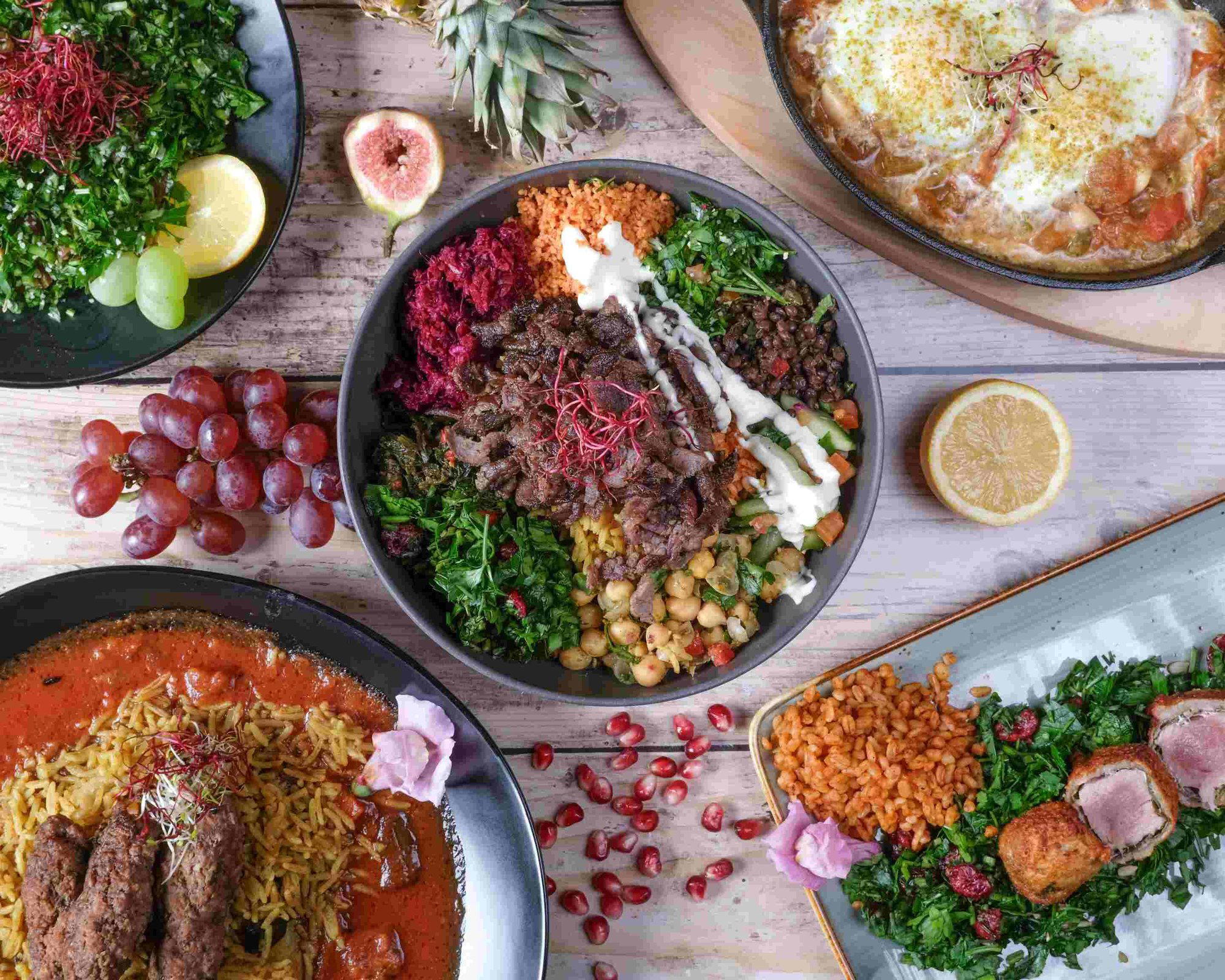
MAQTUB serves Modern Arabic Street Food in Düsseldorf with casual, conversational service, and dishes such as MaQtub Bowl mit hausgemachten Falafeln and Hummus Klassisch.

Pearl is the En Primeur Club membership app — saves, bookings, and concierge access live there. Same editors, same standards.
- Address
- Hammer Str. 17, 40219 Düsseldorf, Germany
- Phone
- +491628458025
- Hours
- Mon–Thu 12–10 PMFri–Sat 12 PM–12 AMSun 12–10 PM
- Website
- maqtubbyarabesq-dsseldorf.de
- Directions
- Get directions
The menu
What to order
- MaQtub Bowl mit hausgemachten Falafeln
- Hummus Klassisch
- Za'atar Thymianbrot Labaneh
Where Hammer Strasse Meets the Eastern Mediterranean
Düsseldorf's left bank of the Rhine, the stretch running south from the Altstadt through Bilk and into the quieter residential blocks around Hammer Strasse, has developed a dining character distinct from the city's more publicised Japanese quarter or the polished addresses along the Königsallee. Here, the clientele tends to be local and repeat; the restaurants earn loyalty through consistency rather than celebrity. MAQTUB, at Hammer Str. 17, sits within that lower-profile but dependable tier of the city's dining fabric.
The name itself signals something. Maqtub is an Arabic word loosely translated as "it is written" — a phrase carrying the weight of fate, of things meant to be. It sets a register before you have read the menu or taken a seat. In Düsseldorf, a city with a historically significant Arab and North African diaspora community alongside its better-documented Japanese population, a restaurant willing to lead with cultural depth rather than generic "Mediterranean" branding makes a particular kind of statement about its intent.
The Intersection of Global Technique and Regional Influence
Across European dining cities, the more interesting development of the past decade has not been fusion for its own sake, but the application of French or contemporary fine-dining technique to ingredients and flavour profiles drawn from the Levant, the Maghreb, and the broader Arab world. Atomix in New York — one of the sharper examples of this pattern globally, applying Korean flavour logic through a haute-dining format, demonstrates how anchoring technical ambition in a specific culinary tradition produces more coherent results than generic innovation. A parallel argument applies in a German context, where places willing to commit to a specific geographical flavour identity, rather than a blurred pan-Mediterranean or pan-Asian vagueness, tend to hold local audiences more effectively.
MAQTUB's address places it in a neighbourhood where the restaurant's potential reference points, the spice markets of the Arab world, the slow-cooked traditions of North Africa, the herb-forward cooking of the Levant, have genuine community roots nearby. That grounding matters. Restaurants that cook from a tradition with authentic local demand tend to calibrate differently than those performing a cuisine for novelty-seeking outsiders.
Reading the Düsseldorf Context
Düsseldorf's dining scene occupies an interesting position in the German hierarchy. It lacks the density of Michelin-starred addresses found in Munich or the experimental energy of Berlin, but it maintains a serious mid-market and a handful of upper-tier destinations. For the highest technical register in the wider region, the reference points are venues like Vendôme in Bergisch Gladbach or, further afield, Aqua in Wolfsburg and Schwarzwaldstube in Baiersbronn, all operating at three-Michelin-star level and setting the ceiling for what the country's kitchen craft can reach. MAQTUB does not appear to be competing in that tier, but that is not the relevant comparison. These are restaurants whose credibility rests on specificity, not scale.
The city's casual dining range includes strong contenders at the direct end: Alanya Döner on the Turkish fast-food spectrum, 3h's burger and chicken for the American-format casual tier. For something leaning into the wine-and-small-plates format, Amuni Wein- und Käsebar represents the European bar-table style.
The Broader Pattern: Arab-Influenced Cooking in European Capitals
The European restaurants that have made the most coherent case for Levantine and North African cooking in a fine-dining or upper-casual context tend to share certain characteristics: a willingness to use classical French structure (the sauce work, the precise heat management, the composed plate) while keeping the spice logic and ingredient sourcing faithful to source traditions. Le Bernardin in New York, not an Arab restaurant, but a reference point for how rigorous technique applied to a specific oceanic tradition produces authority rather than affectation, illustrates what commitment to a culinary identity at high technical level looks like in practice. The same logic applies at smaller scale across European cities where diaspora communities have created genuine demand for cooking that knows what it is.
In Germany specifically, the restaurants that have brought this approach to sustained critical attention tend to operate outside the traditional fine-dining circuit. CODA Dessert Dining in Berlin demonstrated that a German restaurant could win Michelin recognition by committing to a format the guide had not previously rewarded systematically. JAN in Munich showed that an international perspective applied with precision could hold two Michelin stars in the country's most conservative dining city. The pattern across all of these is commitment over compromise.
Planning Your Visit
MAQTUB is located at Hammer Str. 17, 40219 Düsseldorf, in the Bilk area south of the city centre, accessible by tram and a short distance from the Rhine embankment. Those extending the trip toward the higher end of German fine dining should also consider the region's standout addresses: Restaurant Haerlin in Hamburg, Schanz in Piesport, ES:SENZ in Grassau, Waldhotel Sonnora in Dreis, and Victor's Fine Dining by Christian Bau in Perl, each representing a distinct approach to what top-tier German hospitality looks like in 2024 and beyond.
Frequently asked questions
What's the address for MAQTUB?
MAQTUB is located at Hammer Str. 17, 40219 Düsseldorf, Germany, Dusseldorf.
How does MAQTUB fit into Düsseldorf's broader dining scene compared to other Eastern Mediterranean restaurants in Germany?
Düsseldorf has fewer Michelin-flagged addresses than Munich or Berlin, which means upper-casual restaurants with a defined cuisine identity, such as MAQTUB on Hammer Str. 17, occupy a more prominent position in the local conversation than they might in those larger cities. Across Germany, coherent Levantine and North African cooking at this register remains a thin category, with most competition concentrated in Berlin. That relative scarcity gives MAQTUB a clearer lane in the Rhine-Ruhr market.
What should I eat at MAQTUB?
MAQTUB's kitchen works within an Eastern Mediterranean framework, meaning the most coherent choices tend to follow the Levantine and North African traditions that define the restaurant's identity at Hammer Str. 17. Given the cuisine orientation, dishes built around slow-cooked proteins, spiced pulses, and herb-forward preparations are likely to represent the kitchen at its most purposeful. Checking the current menu directly with the venue before visiting is advisable, as seasonal rotation is common in this cooking tradition.
Do they take walk-ins at MAQTUB?
17, Düsseldorf. Restaurants in Bilk operating at the upper-casual tier typically hold some counter or bar seating for walk-ins, but availability varies by evening. Contacting the venue directly before arriving without a reservation is the safer approach.
What's MAQTUB best at?
MAQTUB's defining position in Düsseldorf is the application of European technique to Eastern Mediterranean source material, a combination that the city's dining scene has relatively few addresses pursuing with this degree of focus. The Bilk location on Hammer Str. 17 positions it outside the more tourist-facing restaurant clusters, which tends to attract a neighbourhood-rooted clientele rather than passing trade. That context usually pushes kitchens toward consistency over spectacle.
Is MAQTUB good for vegetarians?
Levantine and North African cooking traditions are structurally well-suited to vegetarian diners, with legumes, grains, roasted vegetables, and dairy-based preparations forming a large share of the canon. Whether MAQTUB's current menu reflects that breadth fully is best confirmed with the restaurant at Hammer Str. 17 before booking, as menu depth varies by season and kitchen direction.
Is eating at MAQTUB worth the cost?
What can be said is that the Bilk neighbourhood context generally supports mid-to-upper casual pricing rather than the premium tier associated with the city's Michelin-listed addresses. For a read on current prices, the restaurant at Hammer Str. 17 is the reliable source.
Credentials Lens
Comparable venues nearby, for context on price, style, and recognition.
| Venue | Cuisine | Price | Notes |
|---|---|---|---|
| MAQTUBThis venue — the venue you are viewing | Modern Arabic Street Food | $20–30 | Not listed |
| Li Beirut | Lebanese | $20–30 | Oberkassel |
| Imbiss Beirut | Lebanese Street Food | $10–20 | Oberbilk |
| Chidonkey | Fresh Mexican Tex-Mex | $10–20 | Hafen |
| Hulala – Pretty Burger & Drinks | Pretty Vegan Burgers & Drinks | $10–20 | Altstadt |
| Die Kurve | Modern Israeli Mezze | $20–30 | Pempelfort |