
Los Sitios brings Spanish bar cooking into Osaka’s compact, counter-led dining culture rather than treating it as a formal European import. The room’s small scale, Tabelog 100 Spanish cuisine selection in 2026, and à la carte format place it in a useful middle tier for travellers who want Osaka informality with more editorial credibility than a casual drinking stop.
Pearl is the En Primeur Club membership app — saves, bookings, and concierge access live there. Same editors, same standards.
- Address
- Japan, 〒550-0011 Osaka, Nishi Ward, Awaza, 1 Chome−10−2 阿波座ビル 1F ボンジュール
- Phone
- +81 6-6536-1414
- Website
- los-sitios.com
 Saves & bookings on Pearl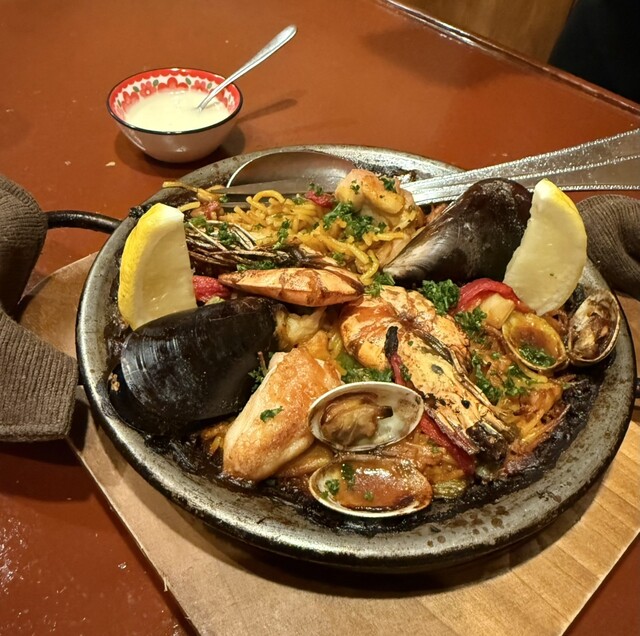
Awaza is not Osaka at neon volume. West of Hommachi’s office grids, the evening rhythm is lower and more local: shutters half-down, small ground-floor rooms lit from within, and restaurants relying less on spectacle than on regulars knowing where to sit. Spanish bar cooking fits that setting. It rewards proximity, conversation, and repeated small orders, habits Osaka understands without translation.
Los Sitios belongs to the compact end of the city’s dining scene, where the room shapes the meal as much as the cuisine label. The category may read Spanish, dining bar, and Spanish-style bar, but the useful read is an Osaka counter restaurant using Iberian grammar: wine, cocktails, à la carte ordering, and a neighbourhood-tavern scale rather than a destination dining room.
A Spanish bar room built for Osaka's counter culture
Osaka has long reduced dining to essentials: a seat, a counter, a cook within sight, and a pace without ceremony. Smaller non-Japanese restaurants here often work best when they avoid imported formality. Spanish bar dining, with drinking food, incremental ordering, and close quarters, fits neatly.
The room is part of the argument. With 20 seats, including counter seating and tables, Los Sitios sits between solo-friendly bar and small-group restaurant. In Osaka, the difference between a serious meal and a night of grazing can be seating geometry. Counter seats set a faster, more conversational tempo; tables add flexibility for friends without turning the room into a private-party venue.
Recognition separates a casual bar from a venue with a wider critical footprint. Selection for Tabelog 100 Spanish cuisine in 2026 places Los Sitios inside a national category, not just a neighbourhood recommendation. In Japan, where Spanish restaurants range from wine-led bars to structured modern kitchens, that matters because it positions the venue within a cuisine-specific field rather than a generic popularity list.
The Osaka comparison is instructive. DENDA occupies a similar dinner spend tier, while lower-priced city options such as Chuka Soba Kazura or Spice Shokudo Nikki answer different needs. Alarde belongs to a more formal Spanish conversation. The restaurant sits in the middle: not a quick bowl, not a tasting-menu temple, but a compact Spanish bar with enough recognition to justify crossing town.
Why the format matters more than chef mythology
Spanish food in Japan often succeeds when it resists becoming a museum piece. The stronger Osaka examples translate the social structure of the bar first, then let the cooking follow. Wine and cocktails have equal practical importance to food, and à la carte ordering is not a lack of ambition; it is the architecture of the evening.
The absence of a chef-led public narrative is not a weakness. In this category, more useful signals are operational: counter seating, a small room, drinking built into the format, and recognition from a cuisine-specific award list. Those details tell travellers more than a manifesto would. They suggest a restaurant designed around repeatable habits, not one grand performance.
For visitors building a wider Osaka itinerary, Spanish dining need not be an outlier. The city’s map is broad enough to hold pork buns at 551 Horai (551蓬莱), bakery stops such as 52CHO-ME BAKERY, coffee at .cafe, and Italian cooking at a canto (Italian) or 99 Pizza Napoletana Gourmet. The restaurant extends that logic into Spanish territory: small scale, direct service, and a room that encourages eating in increments.
That breadth is why Osaka rewards planning by format, not cuisine alone. A counter-led Spanish bar can sit beside ramen, curry, bakeries, and casual drinking rooms because the shared local value is compression. The city likes places that do not waste space or time. For broader planning, Our full Osaka restaurants guide is the natural starting point, with adjacent context in Our full Osaka hotels guide, Our full Osaka bars guide, Our full Osaka wineries guide, and Our full Osaka experiences guide.
How to place it in a Japan dining itinerary
The strongest use case is dinner when a formal meal would feel too rigid. The pricing tier places it above a casual snack stop and below a destination restaurant that takes over a whole evening, making it useful for travellers who want a recognized Osaka address without losing the looseness of a bar-led night.
Its Tabelog score of 3.61 should be read in Japanese context, where mid-3 ratings can indicate meaningful local credibility, especially within narrower cuisine categories. The Tabelog 100 Spanish cuisine selection is the sharper signal: it identifies the restaurant within a defined national field in 2026 and supports treating it as more than a convenient Hommachi-area option.
There is a design lesson here. In Japan, non-Japanese dining often splits between polished, reservation-heavy rooms and casual import concepts without depth. A small Spanish bar with counter seating occupies a more interesting lane. It borrows enough local restaurant architecture to feel native to Osaka, while keeping enough Spanish structure in the drinks-and-à-la-carte format to avoid generic dining-bar territory.
Travellers comparing Japanese dining across cities will find useful contrasts elsewhere: beef sukiyaki at -Grilled beef Sukiyaki- KAMAKURA TANUKIAN 鎌倉 たぬき庵 in Kamakura, tuna and charcoal cooking at. 鮪と炭火焼き うお炭 秋葉原店 in Tokyo, Kumamoto dining at.know in Kumamoto, Vietnamese cooking at (Shoku) Vietnam in Kawasaki, Sapporo curry at [Curry Senmon Ten] Maruyama Kyoju. in Sapporo, and Kyoto’s [ki:] in Kyoto. For a transpacific counterpoint, Jōdo Saké Bar in Los Angeles and Onigiri Time in Pasadena show how Japanese formats shift abroad.
The editorial case is clear: choose the restaurant when the desired Osaka meal is intimate, drink-compatible, and rooted in the city’s small-room discipline. Its value is not spectacle. It is Spanish bar culture compressed into a local dining shape that Osaka handles unusually well.
Comparable Spots
Comparable venues at the same tier for side-by-side context.
| Venue | Cuisine | Price | Notes |
|---|---|---|---|
| Los SitiosThis venue — the venue you are viewing | Spanish Bar / Tapas | $$ | Not listed |
| DENDA | Basque / Spanish restaurant and wine store | $$$ | Nishi |
| É nye | Spanish Restaurant | $$$ | Chūō |
| utage dotonbori | Modern standing wine bar with Spanish-style small plates | $$ | Chūō |
| Labyrinth | Original Spice Creative Curry & Asian Fusion | $$ | Nishi |
| MIKI FRUITS CAFE | Dining | Not listed | Nishi |
Recognition history
Dated appearances from independent guides and award organizations, with the underlying list record or original source where available.
Tabelog 100 #1 · No. 1
Tabelog · Tabelog 100 - Spanish cuisine - 2026
Continue exploring
More in Osaka
Restaurants in Osaka
Browse all →




Bars in Osaka
Browse all →

Hotels in Osaka
Browse all →



Wineries in Osaka
Browse all →
At a Glance
- Cozy
- Lively
- Casual
- After Work
- Date Night
- Casual Hangout
- Group Dining
- Solo
- Standalone
- Extensive Wine List
- Beer Program
- Zero Proof
Current opening hours
- Monday
- 5:30–11:30 PM
- Tuesday
- 5:30–11:30 PM
- Wednesday
- 5:30–11:30 PM
- Thursday
- 5:30–11:30 PM
- Friday
- 5:30–11:30 PM
- Saturday
- 5:30–11:30 PM
- Sunday
- 5:30–11:30 PM
Hours can change for holidays and private events. Last verified .
Friendly, informal, and social, with a relaxed bar atmosphere meant for conversation, drinks, and sharing regional Spanish dishes.