At 53-57 Rue de Grenelle in the 7th arrondissement, L'Izakaya Dassai par Yannick Alléno represents one of Paris's more deliberate culinary experiments: a collaboration between a multi-Michelin-starred French chef and Dassai, the Asahi Shuzo sake house, that transplants the izakaya format into a Left Bank address. The result sits at the intersection of French technique and Japanese drinking-food culture, a pairing that the city's high-end dining scene has circled around for years.
Pearl is the En Primeur Club membership app — saves, bookings, and concierge access live there. Same editors, same standards.
- Address
- 53-57 Rue de Grenelle, 75007 Paris, France
- Phone
- +33184742121
- Website
- lizakaya-alleno.com
- Directions
- Get directions
 Saves & bookings on Pearl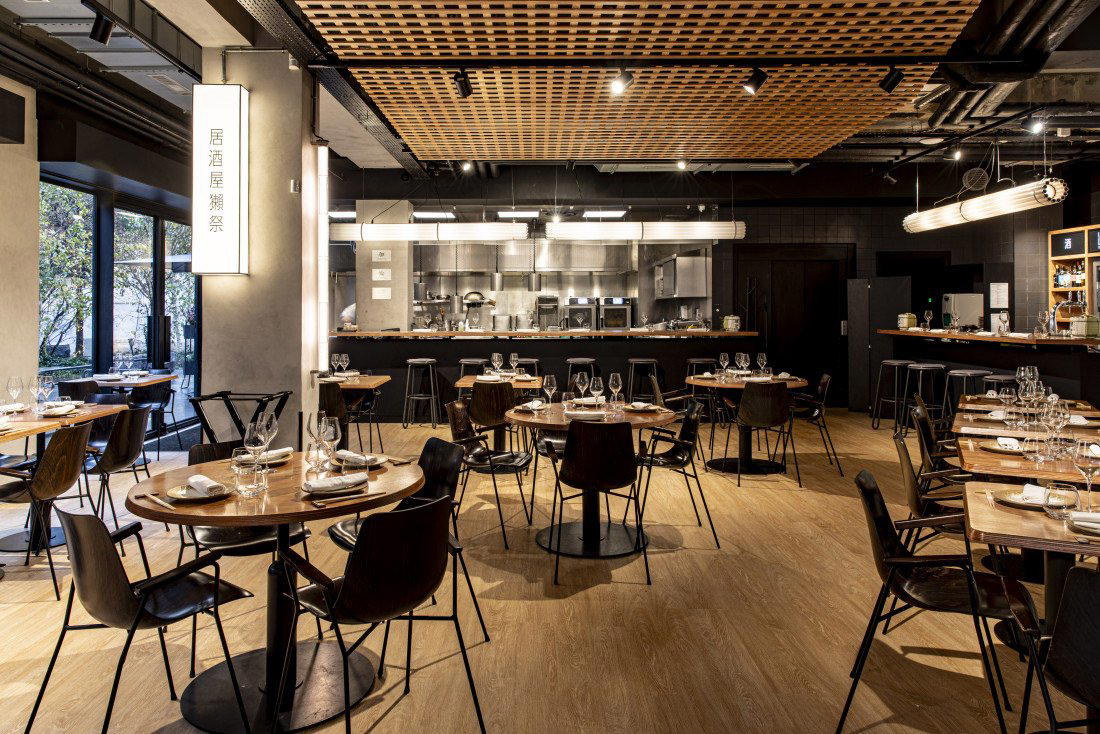
When French Haute Cuisine Moved Into an Izakaya
The izakaya format has traveled outward from Japan's cities, arriving in London, New York, and Sydney in forms that range from faithful neighborhood drinking dens to loose interpretations built around premium spirits. Paris took longer to produce a version with serious culinary weight behind it. When L'Izakaya Dassai par Yannick Alléno opened at 53-57 Rue de Grenelle in the 7th arrondissement, it did so as a structural collaboration: Dassai, the Yamaguchi-based sake producer whose Asahi Shuzo parent has become among the more recognized names in premium sake outside Japan, paired with a chef whose name already anchors one of the city's most consequential addresses at Alléno Paris au Pavillon Ledoyen. The premise was not a fusion restaurant in the conventional sense, nor a Japanese restaurant with French garnish. It set out as something more structurally specific: a French chef's reading of what the izakaya proposition could mean with premium sake at the center of the beverage program.
The Reinvention That Rue de Grenelle Demanded
The evolution of Franco-Japanese dining in Paris has moved through several distinct phases. The first generation arrived as Japanese chefs trained in classical French kitchens and then either stayed within that tradition or grafted Japanese precision onto French formats. Kei, with its three Michelin stars, represents the cleanest expression of that trajectory: a Japanese chef working in a French idiom at the highest level, the cooking unmistakably of both traditions. The second generation moved in a different direction, with French chefs engaging with Japanese ingredients and techniques. L'Izakaya Dassai sits in a third and less populated category: a collaboration built around a Japanese institution, Dassai sake, which has effectively used the restaurant as both a Paris showcase and a test of whether the izakaya format can hold its shape inside a French fine-dining neighborhood.
That tension between formats matters for understanding what the restaurant is and what it has become. The 7th arrondissement sets certain expectations, with nearby addresses among the city's most architecturally serious restaurants. Arpège is a short walk. L'Ambroisie anchors the Place des Vosges a few arrondissements over. The Left Bank's dining register tends toward the considered and formal. An izakaya, even a premium one, carries a different social contract: smaller dishes, a drinking-led occasion, the meal shaped by the table's pace rather than a fixed tasting sequence. Holding that format in this neighborhood required a genuine editorial commitment to the izakaya structure rather than defaulting to the tasting-menu conventions that would have been easier to sell to a Parisian clientele accustomed to the likes of Le Cinq.
Sake at the Center
The Dassai name does specific work here. Asahi Shuzo produces several Dassai expressions, including the Dassai 23, a junmai daiginjo built from rice polished down to 23% of its original grain, placing it in one labor-intensive and delicate tier of sake production. Within the broader French market, where sake has historically been treated as a novelty rather than a serious cellar category, the Dassai range occupies a recognized, allocated, and priced position. Building a restaurant around this beverage program rather than around a wine list was itself a statement about where the collaboration intended to sit relative to the dozens of high-end French addresses, from Flocons de Sel in Megève to Mirazur in Menton, that French fine dining already covered comprehensively.
The crossover between premium sake and French technique is not without precedent at the ingredient level. French chefs have used sake in cooking, particularly in sauces and marinades, for long enough that it reads as a familiar tool rather than an exotic one. What distinguishes the format here is the inversion: sake is not used to season French dishes, but French technique is used in the service of dishes designed to be drunk alongside sake. That reordering of priorities changes the flavour logic of the menu and distinguishes L'Izakaya Dassai from the Franco-Japanese crossover model that dominates the category in Paris and elsewhere. For context on how French chefs have approached this kind of boundary-drawing in other formats, the work at Troisgros, Auberge de l'Ill, and Bras illustrates different models of how a French chef's identity can absorb external influence.
Where It Sits in the Paris Picture
Paris currently operates several tiers of Japanese-influenced dining. At the summit of the formal end, addresses like Kei hold Michelin recognition and price in the €€€€ band alongside French peers such as L'Ambroisie and Le Cinq. Below that, a dense and competitive mid-tier of izakayas and Japanese bistros serves a clientele that may not want the commitment of a full tasting-menu evening. L'Izakaya Dassai occupies a gap between those tiers: the format is deliberately informal relative to the gastronomic ceiling its chef's name implies, but the beverage program and address place it outside the everyday Japanese restaurant category. That positioning is not distinctive to Paris. Atomix in New York operates in a comparable space, where the format signals accessibility relative to the chef's full capabilities while the execution reads at a higher technical register than the format typically implies. The broader question for restaurants in this position, as AM par Alexandre Mazzia in Marseille and Assiette Champenoise in Reims both demonstrate in different ways, is whether the format choice is maintained over time or gradually absorbed back into more conventional fine-dining conventions as a restaurant matures.
Planning Your Visit
L'Izakaya Dassai par Yannick Alléno is located at 53-57 Rue de Grenelle in the 7th arrondissement, within walking distance of the Rue du Bac metro station and the broader Saint-Germain-des-Prés dining cluster.
Comparable Options
Comparable venues nearby, for context on price, style, and recognition.
| Venue | Cuisine | Price | Notes |
|---|---|---|---|
| L'IZAKAYA DASSAI par Yannick AllénoThis venue — the venue you are viewing | Modern Japanese Izakaya | $$$ | Not listed |
| Ojii | Modern Japanese Fine Dining | $$$ | Saint-Germain-des-Prés |
| Azabu | Authentic Japanese Teppanyaki | $$$ | Saint-Michel |
| Tsukizi | Authentic Japanese Sushi | $$$ | Saint-Germain-des-Prés |
| Shin Izakaya | Japanese Izakaya | $$ | Saint-Germain-des-Prés |
| NOBISAN - Marais | Modern Japanese Temaki Bar | $$$ | Le Marais |
Continue exploring
More in Paris
Restaurants in Paris
Browse all →
Bars in Paris
Browse all →
Hotels in Paris
Browse all →
Wineries in Paris
Browse all →
At a Glance
- Modern
- Cozy
- Elegant
- Lively
- Date Night
- Group Dining
- Casual Hangout
- Special Occasion
- Open Kitchen
- Terrace
- Sake Program
Warm and friendly atmosphere true to izakaya spirit, with modern dining room featuring raw concrete walls, black and white manga art, open kitchen, and expansive L-shaped terrace in a leafy walkway.