.png)

L'Alchimia on Viale Premuda holds consecutive Michelin Plates for 2024 and 2025, positioning it among Milan's dependable mid-tier modern Italian addresses rather than the city's starred upper bracket. Under Giuseppe Postorino, the kitchen runs classic Italian recipes alongside more personalised preparations, housed in a room of parquet, timber beams, and exposed brick that shifts convincingly from lunch canteen to evening dining destination.
 Discover on Pearl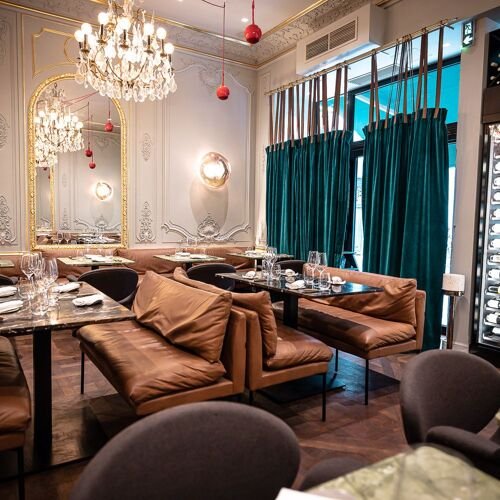
A Room That Changes Its Register
The stretch of Viale Premuda that connects the Porta Venezia grid to the quieter streets approaching Piazza Cinque Giornate is not a dining corridor in the way that the Brera or Navigli quarters tend to be framed. Restaurants here succeed or fail on neighbourhood loyalty and the repeat-visit logic of professionals working nearby rather than on tourist traffic or destination-dining buzz. L'Alchimia sits in that context: a room of parquet flooring, wood-beamed ceilings, and exposed brickwork that reads as a genuinely inhabited space rather than a designed one. During daylight it functions as a bright, airy lunch address; after dark, the shift to soft lighting converts the same room into something considerably more considered. The brick-vaulted wine cellar below, open to visitors, completes a picture of a building that has accumulated character rather than constructed it.
That physical layering matters because it is also the clearest signal of how L'Alchimia has positioned itself over time: as a place that earns its standing through accumulated credibility rather than a single high-concept pivot. In a city where the modern Italian conversation is increasingly dominated by tasting-menu formats at the €€€€ tier — see Cracco in Galleria or the two-starred kitchens at Andrea Aprea and Seta — L'Alchimia occupies a different position. It operates at €€€ and holds consecutive Michelin Plates for 2024 and 2025, a recognition tier that signals consistent kitchen quality without the production overhead of a full starred operation.
The Evolution of a Mid-Tier Address
The Michelin Plate is often misread as a consolation signal, but in the context of Milan's broader restaurant ecology it marks something more useful: kitchens that Michelin inspectors consider worth returning to, even if the format or ambition stops short of star territory. The distinction matters in a city where the gap between a Plate-level address and a one-starred room like Cracco in Galleria is often less about cooking quality than about format, pricing architecture, and the kind of occasion the room is designed to serve.
What the consecutive Plates for 2024 and 2025 confirm is that L'Alchimia's kitchen has not slipped in the way that mid-tier restaurants in Italian cities often do after an initial period of recognition. Consistency at this price point is harder to sustain than it appears: ingredient costs are nearly identical to starred kitchens, but the average cover is lower, which compresses margins and puts pressure on sourcing decisions. That L'Alchimia continues to draw on top-quality ingredients typical of Italian cuisine , the Michelin description's own framing , while maintaining the €€€ bracket is an operational choice that shapes everything about the meal.
The kitchen under Giuseppe Postorino runs classic Italian preparations alongside more personalised dishes, a balance that reflects how the restaurant has evolved from a neighbourhood room into something with broader reach. The classic strand gives regulars the continuity they expect; the personalised preparations give occasional visitors a reason to pay attention. It is a format common to the more durable tier of Italian restaurants, and one that the Italian dining public responds to more reliably than the full-innovation model adopted at the higher end of the market. Comparable trajectories can be observed at addresses like 28 Posti and Altriménti, where the commitment to ingredient quality within a mid-range format has proved more sustainable than chasing starred recognition.
Placement in the Milan Modern Italian Conversation
Milan's modern Italian dining tier is more stratified than it sometimes appears from the outside. At the leading, three-starred kitchens like Enrico Bartolini and two-starred operations like Seta and Andrea Aprea work within the international fine-dining grammar that connects them to European peers at Osteria Francescana in Modena, Le Calandre in Rubano, and Piazza Duomo in Alba. Below that tier, a larger group of restaurants operates with similar ingredient ambitions but different format logic, serving the city's professional and residential populations rather than destination diners.
L'Alchimia belongs firmly to the second group, and that placement is not a limitation , it is a competitive position. The adjacent bar-bistro that serves quick lunches and aperitifs functions as a separate offer within the same address, capturing daytime and early-evening occasions that a fully formal restaurant cannot serve without compromising the evening operation. That dual-format approach is increasingly common among Milan's more commercially resilient mid-tier addresses. The aperitivo offering in particular connects L'Alchimia to a Milanese social ritual that goes well beyond food service, and one that generates loyalty in a way that dinner covers alone rarely do.
For visitors working through Milan's broader hospitality context , the full picture is available in our full Milan restaurants guide, alongside hotels, bars, wineries, and experiences , L'Alchimia represents the kind of address that rewards visitors who want to eat at the level the city's professional population actually eats at, rather than at the level the restaurant guides tend to emphasise. It is a different proposition from the destination-dining logic of Enoteca Pinchiorri in Florence or Atelier Moessmer Norbert Niederkofler in Brunico, and a more useful one for readers spending more than two days in the city.
The Wine Cellar and the Aperitivo Bar
The brick-vaulted wine cellar , described as small and beautiful in the Michelin record, and open to visitors , represents the kind of ancillary asset that mid-tier Italian restaurants deploy to signal a seriousness about wine that the main dining room alone cannot communicate. In a country where the wine program at any serious restaurant is expected to be as considered as the kitchen, the cellar visit gives the wine offer a physical credential. Italian dining at this level has always treated the cantina as part of the hospitality, not an afterthought, and the accessible cellar at L'Alchimia is consistent with that tradition.
The bar-bistro component deserves separate attention. Milan's aperitivo culture is genuinely functional , it is how the city manages the gap between the end of the working day and dinner service , and a restaurant that can deliver excellent aperitifs within a coherent food-and-drink identity is tapping into the social logic of the city rather than simply adding a revenue line. Addresses like Ceresio 7 and Acanto operate at different price points and scales, but they share the same understanding that in Milan, the bar and the kitchen are not separate businesses , they are two expressions of the same hospitality logic.
Know Before You Go
| Address | Viale Premuda, 34, 20129 Milan |
| Cuisine | Modern Italian |
| Price Range | €€€ |
| Awards | Michelin Plate 2024, Michelin Plate 2025 |
| Google Rating | 4.4 from 914 reviews |
| Features | Main dining room; brick-vaulted wine cellar (open to visitors); adjacent bar-bistro for lunch and aperitifs |
| Neighbourhood | Porta Venezia / Viale Premuda corridor, Milan |
Frequently Asked Questions
A Minimal Peer Set
A compact peer set to orient you in the local landscape.
| Venue | Notes | Price |
|---|---|---|
| L’Alchimia | This venue | €€€ |
| Enrico Bartolini | Creative, €€€€ | €€€€ |
| Cracco in Galleria | Modern Cuisine, €€€€ | €€€€ |
| Andrea Aprea | Modern Italian, Italian Contemporary, €€€€ | €€€€ |
| Seta | Modern Italian, €€€€ | €€€€ |
| Contraste | Progressive Italian, Modern Cuisine, €€€€ | €€€€ |
Need a table?
Our members enjoy priority alerts and concierge-led booking support for the world's most difficult tables.
Get Exclusive Access