Lafayette Coney Island
Our verdict
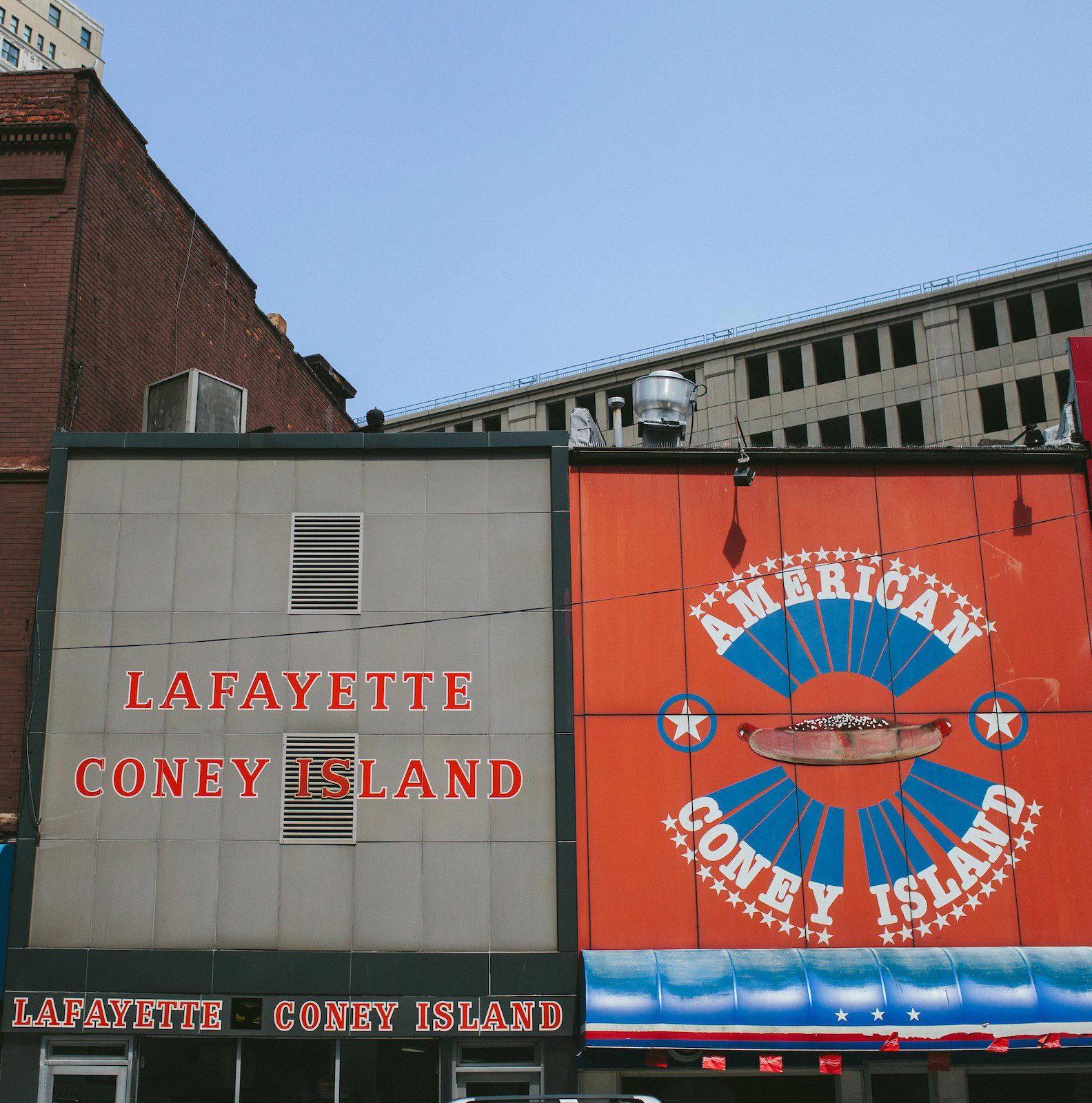
Lafayette Coney Island at 118 W Lafayette Blvd is one of Detroit's most enduring lunch counter institutions, operating in the shadow of its longtime rival next door. The Coney dog, a steamed frankfurter in a soft bun, blanketed in beef-heart chili, yellow mustard, and diced white onion, is the singular focus here. No reservations, no dress code, no detours: this is Detroit's working-class dining ritual distilled to its purest form.

Pearl is the En Primeur Club membership app, where members save venues, book tables and use the concierge.
The menu
What to order
- Coney Island Hot Dog
- Loose burgers
- Chili fries
The Counter That Defines Detroit's Coney Ritual
Walk west on Lafayette Boulevard toward the corner of Michigan Avenue and you will hear the debate before you see the restaurant. Two nearly identical storefronts share the same block, separated by a wall thin enough to feel the argument radiating through it. Lafayette Coney Island, at 118 W Lafayette Blvd, and its immediate neighbor American Coney Island have occupied this corner since the early twentieth century, and the rivalry between them has calcified into civic mythology. Locals pick sides. Visitors are forced to choose. The disagreement is, in its own way, a form of Detroit pride.
The room itself does not invite contemplation. Fluorescent lighting, a formica counter, stools bolted to the floor, and the controlled chaos of short-order service in full motion: these are the environmental constants. There is nothing here that a design-minded restaurateur would describe as intentional atmosphere, and that is precisely the point. The Coney Island format belongs to a category of American dining institution where the ritual is the room, where the physical environment signals, without ambiguity, that the food is what you came for and speed is part of the contract.
What the Coney Dog Teaches You About Detroit
American cities with significant early-twentieth-century immigrant populations often developed highly localized fast food traditions that bore only a geographic resemblance to their nominal origins. Detroit's Coney dog is one of the clearest examples. Greek and Macedonian immigrants who arrived in the city in the 1910s and 1920s adapted the eastern European frankfurter to local tastes, layering it with a beef-heart chili sauce, yellow mustard, and raw white onion. The result has almost nothing in common with a New York hot dog or a Chicago-style frank. It is an entirely Detroit invention that happened to borrow a name from a New York landmark.
The ritual at Lafayette follows a grammar that regulars absorb without instruction. You sit at the counter or at one of the tables. A server, often the same server who has been working this floor for years, arrives almost immediately. You order Coneys, specifying your quantity. They arrive fast, the chili sauce applied with practiced efficiency, the onions sharp and raw, the mustard line straight. The bun is steamed soft. The frankfurter snaps. You eat quickly, because the counter needs to turn. This is not lingering dining in the manner of, say, The French Laundry in Napa or Atomix in New York City, it operates on entirely opposite principles, where velocity and repetition are the form of mastery, not its absence.
Detroit's broader dining scene has expanded considerably in recent years. New American kitchens like Selden Standard, East African cooking at Baobab Fare, and modern Mexican at Vecino have given the city a more varied dining identity. The full Detroit restaurants guide reflects that range. Against that backdrop, Lafayette occupies a different register entirely, not as a counterpoint to ambition, but as a reminder that some dining formats achieve their own kind of rigor through narrowness rather than breadth.
The Coney Counter in the Context of American Ritual Dining
Across American cities, there are institutions where the format has become more culturally durable than any individual dish could explain. The Coney Island counter belongs in that category, alongside the New Orleans po'boy shop, the Philadelphia cheesesteak stand, and the Chicago Italian beef window. These are not places that compete with tasting-menu destinations. Venues like Le Bernardin in New York City, Lazy Bear in San Francisco, Smyth in Chicago, Blue Hill at Stone Barns in Tarrytown, Providence in Los Angeles, Single Thread Farm in Healdsburg, Addison in San Diego, Emeril's in New Orleans, The Inn at Little Washington, and Atelier Moessmer Norbert Niederkofler in Brunico occupy an entirely different tier of dining investment, both financial and temporal. Lafayette operates on none of those terms. Its authority is categorical: it does one thing, it has done it for over a century, and the city has built a cultural argument around it.
Detroit's restaurant scene also includes newer arrivals working in more elaborate registers. ADELINA, Alpino, and Amore da Roma represent the city's more recent fine-dining and European-influenced directions. Even 313 Cinnamon Rolls signals the kind of single-focus specialist model that has gained traction in American food cities. Lafayette predates all of them by decades and operates on a logic none of them share: no menu elaboration, no seasonal change, no chef biography to anchor a narrative. The dish is the brand, and the brand is the city.
Planning Your Visit
Lafayette Coney Island sits at 118 W Lafayette Blvd in downtown Detroit, walkable from most central hotels and a short distance from the financial district. There are no reservations and no booking system, this is a walk-in counter operation that has functioned on that basis throughout its history. Demand peaks during weekday lunch and late-night hours, when the counter fills quickly and turnover keeps pace. Come during off-peak windows if you prefer a slower experience, though the rhythm of the room is part of what you are visiting for. Cash has traditionally been the preferred payment format at counters of this type, and verifying current payment options before arrival is advisable. The address is direct to locate on any mapping application; parking downtown follows standard Detroit meter and garage patterns.
Frequently asked questions
What part of town is Lafayette Coney Island in?
Lafayette Coney Island is located at 118 W Lafayette Blvd, Detroit, MI 48226, Detroit.
How does Lafayette Coney Island compare to American Coney Island next door?
The two operations share a wall and trace back to the same founding family, having split into separate businesses in the early twentieth century, a division that became one of Detroit's most documented food rivalries. Both serve the same core format: steamed frankfurter, beef-heart chili, mustard, onions. The difference comes down to years of personal loyalty and minor variations in chili texture and seasoning that regulars debate with considerable conviction. Both are located on Lafayette Boulevard in downtown Detroit, and visiting both in a single sitting is a common approach.
What should I eat at Lafayette Coney Island?
Order the Coney dog. The format is a steamed frankfurter in a soft bun topped with beef-heart chili, yellow mustard, and diced onions, that is the singular point of the operation at 118 W Lafayette Blvd. Ordering anything else misses the purpose of the counter. One or two dogs with a side of fries covers the full scope of what this kitchen does and has done for decades.
What's the best way to book Lafayette Coney Island?
There is no booking system. Lafayette operates as a walk-in counter, consistent with how Coney Island lunch counters have functioned across Detroit since the early twentieth century. Arrive, take a seat at the counter or a table, and order directly. Peak lunch hours in downtown Detroit move quickly, so expect a short wait during busy periods.
What's Lafayette Coney Island best at?
The Coney dog, executed at the level of focused repetition that decades of counter service produces. This is not a broad-menu kitchen, the chili sauce recipe and the assembly format are the institutional product. That concentration of effort on a single item is precisely what gives the counter its standing in Detroit's food culture.
Is Lafayette Coney Island good for vegetarians?
No. The core product is a beef frankfurter with beef-heart chili, and the menu is oriented almost entirely around meat. Vegetarian visitors will find little here that suits them. Lafayette, at 118 W Lafayette Blvd in downtown Detroit, is built around one thing, and that thing is not plant-based.
Is Lafayette Coney Island overpriced or worth every penny?
The Coney dog sits at the low end of the American fast-food price range, this has always been working-class counter food, and the pricing reflects that origin. For the context of downtown Detroit, a full meal at Lafayette is among the more affordable options in the immediate area. The value argument is straightforward: the price is modest and the product is consistent.
Style and Standing
Comparable venues nearby, for context on price, style, and recognition.
| Venue | Cuisine | Price | Awards | Notes |
|---|---|---|---|---|
| Lafayette Coney IslandThis venue (the venue you are viewing) | Detroit Coney Dogs | $10–20 | Not listed | Not listed |
| Downtown Louie's Grill | Modern American with European influence | $30–50 | Not listed | East Necklace |
| Evie's Tamales | Authentic Mexican Tamales | $10–20 | Not listed | Hubbard-Richard |
| Pupuseria Y Restaurante Salvadoreno | Authentic Salvadoran | $10–20 | Not listed | Southwest Detroit |
| Presley's | Inspired American Brasserie | $30–50 | Not listed | East Necklace |
| Selden Standard | New American Small Plates | $50–100 | James Beard Award Semi Finalist | Midtown |
Continue exploring
More in Detroit
Restaurants in Detroit
All restaurants in Detroit →
Bars in Detroit
All bars in Detroit →




Details
- Classic
- Well Known
- Lively
- Casual Hangout
- Late Night
- Historic Building
- Beer Program
- A La Carte
Current opening hours
- Monday
- 9 AM–12 AM
- Tuesday
- 9 AM–12 AM
- Wednesday
- 9 AM–12 AM
- Thursday
- 9 AM–12 AM
- Friday
- 9 AM–2 AM
- Saturday
- 9 AM–2 AM
- Sunday
- 9 AM–12 AM
Hours can change for holidays and private events. Hours as of .
Vintage diner with tiled walls, stainless steel counters, and traditional stools evoking old-school Detroit industrial heritage.