Our verdict
La Cabane sits on the Rive Droite du Port in L'Éguille-sur-Seudre, a small harbour commune in the Charente-Maritime where oyster farming has shaped the local economy and table for generations. The setting places it squarely within one of France's most productive shellfish territories, where the distance between water and plate is measured in minutes rather than miles. For visitors arriving from La Rochelle or Saintes, this is the kind of address that rewards the detour.

Pearl is the En Primeur Club membership app — saves, bookings, and concierge access live there. Same editors, same standards.
- Address
- sur-seudre, Rive Droite Du Port, 17600 L'Éguille, France
- Phone
- +33546228307
- Hours
- Mon–Tue ClosedWed–Sat 12–2 PM, 7–8:30 PMSun 12–2:30 PM
- Website
- restaurant-lacabane.fr
- Directions
- Get directions
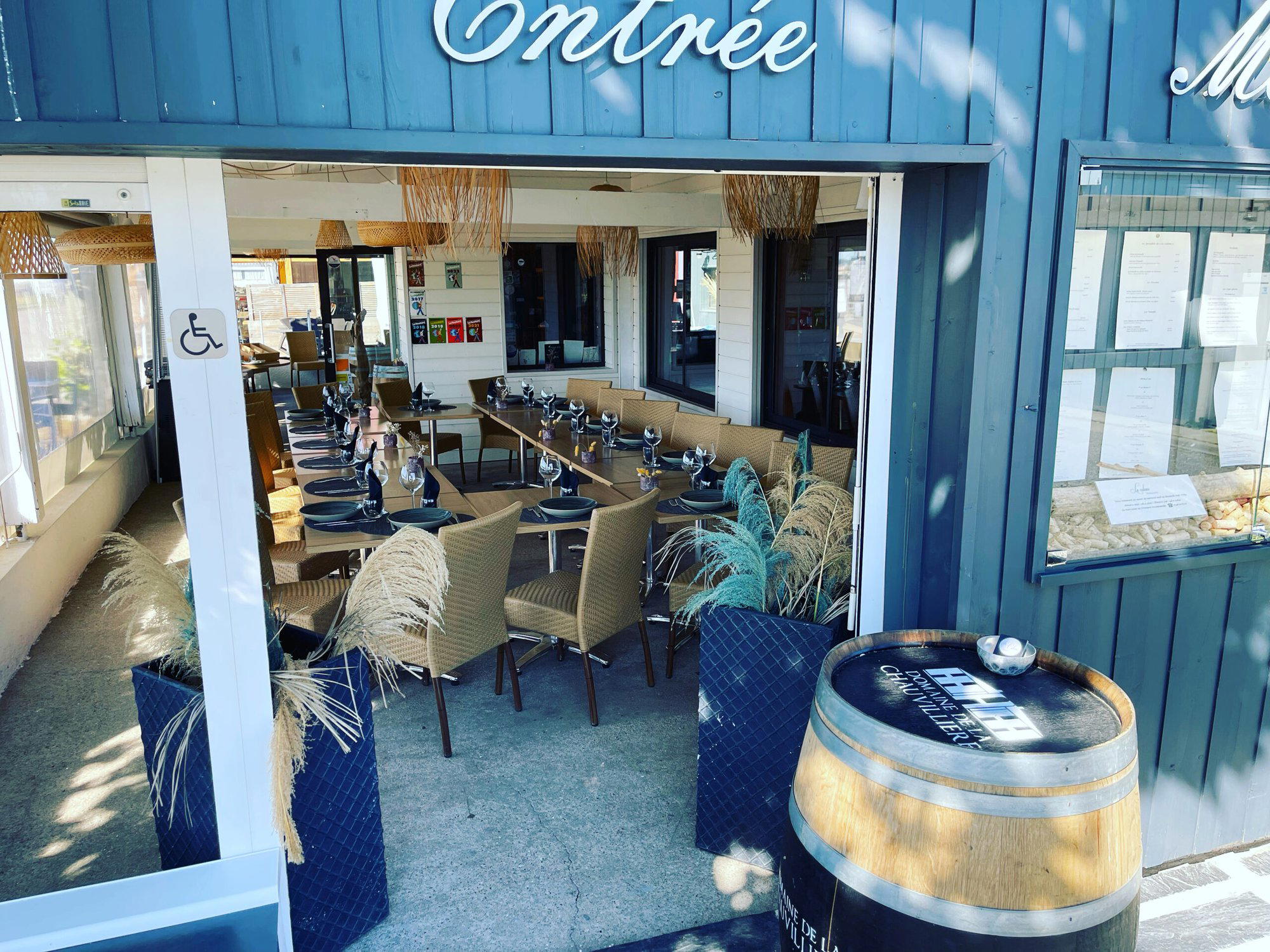
Where the Seudre Estuary Meets the Plate
The Rive Droite du Port in L'Éguille-sur-Seudre is not a dining address you arrive at by accident. The road follows the Seudre river through flat marshland, past oyster parks stacked at low tide and wooden cabanes that double as working storage and impromptu tasting counters. The air carries salt and iodine long before the estuary comes into view. La Cabane occupies this setting directly, positioned on the right bank of the port in a commune whose identity is inseparable from the shellfish beds that surround it. This part of the Charente-Maritime produces some of the most closely watched oysters in France, and the geography of the place — tidal rhythms, brackish water, the particular mineral character of the Seudre — is the first thing a visitor needs to understand before reading a menu.
L'Éguille itself sits within the broader Marennes-Oléron basin, the appellation that gives its name to the huître creuse finished in claires, the shallow earthen pools that line this stretch of Atlantic coastline. The greening of the oyster's gill in a claire, caused by a specific blue diatom found in these particular waters, is a process tied entirely to place. It cannot be replicated elsewhere, and it is why addresses along the Seudre estuary carry a sourcing argument that needs no embellishment. For a fuller picture of how this coastal French tradition compares to high-end seafood presentations elsewhere in France, the work at Christopher Coutanceau in La Rochelle, roughly 30 kilometres north, offers a useful reference point: a two-Michelin-star operation built entirely around the same Atlantic fishing grounds, treated with considerably more technical ambition but rooted in the same territorial logic.
The Sourcing Argument Along the Seudre
In a region where producers and restaurateurs often share the same family name, the distance between harvest and service is a structural feature rather than a marketing position. The cabane format, a term that refers literally to the wooden huts used by ostréiculteurs across the Charente-Maritime, evolved as a way for oyster farmers to sell direct from the port, cutting out intermediary distribution entirely. The format is informal by design: zinc-topped tables, paper placemats, cold Muscadet or Entre-Deux-Mers poured without ceremony. The product carries the weight of the experience, not the room.
This is a meaningful distinction in a country where the prestige dining circuit runs through addresses like Alléno Paris au Pavillon Ledoyen or Mirazur in Menton, where terroir is channelled through elaborate tasting menus and brigade kitchens. The cabane tradition operates from the opposite premise: that the most direct relationship between source and diner requires the least mediation. A dozen Marennes-Oléron oysters eaten within sight of the beds that produced them is an argument about provenance that no kitchen technique can improve upon. Seasonality here is not a menu concept but a physical reality, oyster quality shifts with water temperature, tidal patterns, and the annual cycle of the claire affinage, which runs most productively from autumn through spring.
That seasonal reality matters for planning. The Charente-Maritime coast draws significant visitor traffic from late spring through August, when the region's broader Atlantic tourism peaks and tables along the Seudre become harder to secure without advance notice. The shoulder months, April, May, September, October, offer the combination of strong oyster condition and quieter service. Visitors travelling from the wider region should note that the drive from Saintes takes roughly 30 minutes, and La Rochelle provides the nearest significant transport hub with rail connections to Paris Montparnasse. See our full L'Éguille restaurants guide for further context on the area's dining options.
Placing La Cabane in the French Coastal Dining Picture
France's coastal restaurant culture splits broadly between destination-format fine dining, where the location is context for ambitious cooking, and production-site formats, where the location is the point. La Marine in Noirmoutier-en-l'île sits at one end of that axis: a highly decorated address that transformed an Atlantic island's fishing heritage into a globally referenced tasting menu format. La Cabane occupies the opposite pole, where the format's value lies precisely in its refusal to mediate the sourcing relationship through culinary transformation.
Neither position is superior. They answer different questions. A traveller who has worked through the technical ambition at AM par Alexandre Mazzia in Marseille or the classical rigour at Auberge de l'Ill in Illhaeusern may find the directness of a port-side cabane meal more clarifying than any tasting menu. The editorial case for La Cabane is not that it competes with those addresses, it doesn't, and makes no attempt to, but that it represents a different and equally legitimate claim on the attention of serious eaters.
The Seudre estuary is one of France's genuinely irreplaceable sourcing environments. What is served here cannot be sourced identically anywhere else, and that geographical specificity is the trust signal that the format relies on. Readers interested in how French culinary identity extends across very different formats and regions will find useful comparisons in the multi-generational ambition at Troisgros in Ouches, the landscape-driven philosophy at Bras in Laguiole, or the sustained provençal authority of L'Oustau de Baumanière in Les Baux. Each of those operates through the logic of place, as does La Cabane, though the price points, formats, and levels of technical ambition differ considerably. For those venturing beyond France to see how coastal fine dining translates across cultures, Le Bernardin in New York City and Atomix offer instructive contrasts in how seafood sourcing and cultural tradition are framed at the highest levels.
Planning Your Visit
La Cabane's address on the Rive Droite du Port places it in a working port environment rather than a tourist quarter, which shapes the experience before the meal begins. The practical advice for any visit to this stretch of the Charente-Maritime is to arrive with enough time to walk the port before sitting down. The relationship between the physical environment and what arrives at the table is the thing that makes this kind of address legible, and it is lost entirely if you arrive directly from a car park. Further afield, the decorated dining room at Assiette Champenoise in Reims, the village institution of Georges Blanc in Vonnas, and the historic presence of Paul Bocuse in Collonges-au-Mont-d'Or all demonstrate how deeply French dining culture rewards engagement with the setting as much as the food itself. At La Cabane, setting and food are the same argument. Further regional context and booking guidance for addresses across the Charente-Maritime can be found in Auberge du Vieux Puits in Fontjoncouse and Au Crocodile in Strasbourg, two addresses that, like La Cabane, are embedded in regions where local produce defines the table as much as kitchen ambition does. For mountain contrast and a very different expression of French terroir dining, Flocons de Sel in Megève rounds out the picture of how France's sourcing traditions play across its geography.
Frequently asked questions
Is La Cabane good for families?
The cabane format on the Rive Droite du Port in L'Éguille is structured around informality, which makes it a practical choice for families. Port-side settings along the Seudre are working environments with open space rather than formal dining rooms, and the approach to seafood here is direct rather than ceremonial. Children comfortable with shellfish and simple coastal cooking fit naturally into this format.
Is La Cabane formal or casual?
La Cabane operates in the cabane tradition of the Charente-Maritime, where informality is the defining structural principle. This is not a dressed-down version of fine dining — it is a distinct format rooted in the port environment of L'Éguille-sur-Seudre, where proximity to the source shapes the register of the meal. Arrive accordingly: the setting is a working harbour address, not a destination dining room.
What makes dining at a Seudre estuary cabane in L'Éguille different from other French oyster destinations?
L'Éguille-sur-Seudre sits inside the Marennes-Oléron production zone, which carries an AOC-equivalent designation making it one of the few geographically protected oyster appellations in France. Eating at a cabane on the Rive Droite du Port means the shellfish has moved metres rather than kilometres from water to table — a sourcing condition that fewer French coastal addresses can claim with the same geographic precision. The estuary setting is not backdrop; it is the supply chain made visible.
What's the signature dish at La Cabane?
Any address operating in the cabane format along the Seudre estuary in L'Éguille takes its central reference from Charente-Maritime oysters, specifically those from the Marennes-Oléron production zone — one of the most precisely defined shellfish appellations in France. The sourcing geography here is short by design, with the estuary functioning as both the kitchen's supply chain and the view from the table.
What part of town is La Cabane in?
La Cabane is located at sur-seudre, Rive Droite Du Port, 17600 L'Éguille, France, L Eguille.
How far ahead should I plan for La Cabane?
July and August concentrate Atlantic coast tourism into the Charente-Maritime, and port-side addresses along the Seudre in L'Éguille fill quickly during those months. Planning two to four weeks ahead for a summer visit is a reasonable baseline; shoulder season visits in May, June, or September carry less pressure. For current booking availability, check the venue's official channels as hours and reservation policies are not published here.
What's the defining dish or idea at La Cabane?
The defining idea at La Cabane is territorial directness: shellfish and seafood from one of France's most tightly bounded production zones, served within sight of the Seudre estuary that supplies them. In the Charente-Maritime, the distance between harvest and plate is a structural feature of the regional food culture, not a selling point layered on top of it. L'Éguille's Rive Droite du Port is where that logic is most plainly expressed.
Quick Comparison
Comparable venues nearby, for context on price, style, and recognition.
| Venue | Cuisine | Price | Notes |
|---|---|---|---|
| La CabaneThis venue — the venue you are viewing | Traditional French Seafood | $30–50 | Not listed |
| Le Lion d'Or | Traditional French Médoc Bistro | $20–30 | Arcins |
| Boute en Train | Traditional French Bistro | $20–30 | Centre Ville |
| Le Bistro du Sommelier | Classic French Bistro | $30–50 | Centre ville |
| La Belle Saison | Seasonal French Bistronomic | $30–50 | La Bastide |
| La Saint Georges | Breton Crêperie | $20–30 | Centre ville |
Continue exploring
More in L Eguille
Restaurants in L Eguille
Browse all →
Bars in L Eguille
Browse all →
Hotels in L Eguille
Browse all →

Details
- Rustic
- Cozy
- Scenic
- Casual Hangout
- Family
- Terrace
- Waterfront
- Local Sourcing
- Waterfront
- A La Carte
Current opening hours
- Monday
- Closed
- Tuesday
- Closed
- Wednesday
- 12–2 PM, 7–8:30 PM
- Thursday
- 12–2 PM, 7–8:30 PM
- Friday
- 12–2 PM, 7–8:30 PM
- Saturday
- 12–2 PM, 7–8:30 PM
- Sunday
- 12–2:30 PM
Hours can change for holidays and private events. Last verified .
Relaxed quayside atmosphere with terrace seating overlooking the active port and estuary.