
Michelin Plate
Our verdict
Koka Wanton Noodles holds a Michelin Plate (2024) and operates from North Bridge Road at the single-dollar end of Singapore's hawker price tier. In a city where wanton mee draws the same critical apparatus applied to tasting-menu restaurants, this stall represents the accessible entry point into a recognized noodle tradition, straightforward, affordable, and editorially validated.

Pearl is the En Primeur Club membership app, where members save venues, book tables and use the concierge.
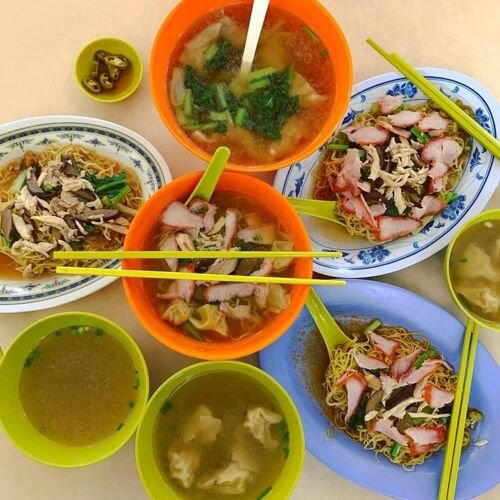
The Wanton Mee Counter as Critical Subject
Singapore's Michelin Guide has, since its 2016 debut, done something few national guides attempt: it treats hawker food with the same adjudicative seriousness applied to multi-course tasting menus. The result is a category of stalls, Plate-holders, Bib Gourmands, and the occasional starred operation, that sit inside the same critical ecosystem as Zén (three stars, European Contemporary at $$$$) and Hill Street Tai Hwa Pork Noodle, which holds a Michelin star at a price point barely above Koka's. The distance between a $5 bowl and a $500 tasting menu, in Singapore's critical vocabulary, is smaller than anywhere else in Southeast Asia. Koka Wanton Noodles, holding a Michelin Plate in 2024, occupies that ecosystem at its most accessible tier, a single-dollar price bracket, a North Bridge Road address, and a level of institutional recognition that positions it alongside the city's most documented hawker traditions.
Where Wanton Mee Sits in Singapore's Noodle Canon
Wanton mee is a Cantonese-rooted dish that arrived in Singapore through the same Nanyang migration currents that shaped the city's wider hawker culture. The format is deceptively spare: thin egg noodles, char siu, wontons (either boiled or fried), and a sauce that varies between stalls from dark soy-forward to lard-enriched. What distinguishes one stall from another is the noodle texture (springy, with enough alkaline bite to hold sauce without going limp), the quality of the char siu, and the wonton wrapper, whether it holds its integrity in broth or collapses. These are technical points, not romantic ones, and they explain why the dish attracts serious critical attention despite its modest price.
In the wider Singapore noodle conversation, wanton mee sits alongside prawn noodles and bak chor mee as the canonical wet-or-dry formats. Operations like 545 Whampoa Prawn Noodles and Adam Rd Noo Cheng Big Prawn Noodle occupy related territory, hawker-format, single-dollar pricing, Michelin-tracked, and the noodle circuit that connects these stalls is one of the most densely documented food trails in any city of comparable size. Koka is one data point in that map, not an isolated discovery.
The Michelin Plate Signal and What It Means in Practice
A Michelin Plate designation sits below Bib Gourmand and below starred recognition, but it is not an afterthought. The Plate category, introduced by Michelin as a formal tier, indicates that inspectors found the food to be of good quality within its category. At the hawker level, this is a meaningful signal: Singapore's guide covers hundreds of stalls, and Plate recognition filters the field meaningfully. For Koka, the 2024 Plate places it in the annually reviewed cohort of hawker operations that inspectors return to, which is a different kind of validation than a one-time listing or a review aggregator score.
North Bridge Road and the Civic District Hawker Context
The address at 10 North Bridge Road places Koka in the Civic District corridor, an area defined less by a single hawker centre and more by mixed-use buildings, office towers, and the kind of lunch-hour foot traffic that supports daytime hawker operations. This contrasts with the estate-hawker model of heartland Singapore, where stalls serve residential communities across multiple meal periods. The Civic District hawker format tends toward concentrated lunch service, shorter operating windows, and a customer base that skews toward workers and visitors moving between the Colonial Core and Bugis. Getting there from the Raffles Place or City Hall MRT interchange is a short walk; the North Bridge Road address is walkable from both.
For context on the regional street food conversation, this type of Michelin-tracked hawker format has parallels across the region. George Town in Penang operates a comparable critical apparatus, with stalls like 888 Hokkien Mee (Lebuh Presgrave) and Ah Boy Koay Teow Th'ng drawing the same kind of informed noodle-circuit attention. Singapore's version of this tradition is more formally institutionalized through the Michelin framework, but the underlying logic, that noodle technique at the hawker level deserves documentation, runs across the Straits.
Planning a Visit
Like most hawker-format operations, Koka does not take reservations; arrival timing matters more than advance planning. Lunch service at Civic District stalls typically runs from mid-morning to early afternoon, with sell-out closures common at operations with small-batch prep. Arriving before the peak office-lunch window reduces queue time. The price bracket is the single-dollar tier, consistent with the $ classification in the venue data.
Logistics at a Glance
| Venue | Format | Price | Michelin Recognition | Booking |
|---|---|---|---|---|
| Koka Wanton Noodles | Hawker / Street Food | $ | Plate (2024) | Walk-in |
| Hill Street Tai Hwa Pork Noodle | Hawker / Street Food | $ | 1 Star | Walk-in |
| A Noodle Story | Hawker / Street Food | $ | Michelin recognised | Walk-in |
| 91 Fried Kway Teow Mee | Hawker / Street Food | $ | Michelin recognised | Walk-in |
Frequently asked questions
What do regulars order at Koka Wanton Noodles?
Is Koka Wanton Noodles reservation-only?
Compact Comparison
Comparable venues nearby, for context on price, style, and recognition.
| Venue | Cuisine | Price | Awards | Notes |
|---|---|---|---|---|
| Koka Wanton NoodlesThis venue (the venue you are viewing) | Traditional Singaporean Wanton Mee | $1–10 | Michelin Plate | Not listed |
| Hong Peng La Mian Xiao Long Bao | Hand-Pulled La Mian & Xiao Long Bao | $10–20 | Michelin Guide Plate · Michelin Plate | PEARL'S HILL, Hand-Pulled La Mian & Xiao Long Bao |
| Hougang Traditional Famous Wanton Noodle | Traditional Singaporean Wanton Noodles | $1–10 | Michelin Guide Plate · Michelin Plate | ALJUNIED, Traditional Singaporean Wanton Noodles |
| Ji Ji Noodle House | Chinese Wanton Noodles | $1–10 | Michelin Guide Bib Gourmand · Michelin Plate | CHINA SQUARE, Chinese Wanton Noodles |
| Loong Kee Yong Tau Fu | Yong Tau Fu | $1–10 | Michelin Guide Plate · Michelin Plate | HONG KAH, Yong Tau Fu |
| 91 Fried Kway Teow Mee | Healthy Char Kway Teow | $1–10 | Michelin Guide Plate · Michelin Plate | CRAWFORD, Healthy Char Kway Teow |
Recognition history
Dated appearances from independent guides and award organizations, with the underlying list record or original source where available.
Michelin Plate
Michelin
Continue exploring
More in Singapore
Restaurants in Singapore
All restaurants in Singapore →
Bars in Singapore
All bars in Singapore →
Details
- Classic
- Late Night
- Casual Hangout
- Standalone
- A La Carte
Current opening hours
- Monday
- 10:30 p.m.–2:30 a.m.
- Tuesday
- 10:30 p.m.–2:30 a.m.
- Wednesday
- Closed
- Thursday
- Closed
- Friday
- 10:30 p.m.–2:30 a.m.
- Saturday
- 10:30 p.m.–2:30 a.m.
- Sunday
- Closed
Hours can change for holidays and private events. Hours as of .
Unpretentious hawker stall atmosphere with fluorescent lighting, quiet hustle run by an elderly couple late into the night.