Kendall's Brasserie
Kendall's Brasserie occupies a distinct position in Los Angeles dining: a French brasserie format anchored to the Music Center on Grand Avenue, where the pre-theatre crowd has shaped its rhythm for decades. Situated in the heart of the city's civic and cultural core, it operates where classical French hospitality tradition meets the practical demands of a major performing arts campus.
Pearl is the En Primeur Club membership app — saves, bookings, and concierge access live there. Same editors, same standards.
- Address
- Music Center, 135 N Grand Ave, Los Angeles, CA 90012
- Phone
- (213) 972-7322
- Website
- kendallsla.com
- Directions
- Get directions
 Saves & bookings on Pearl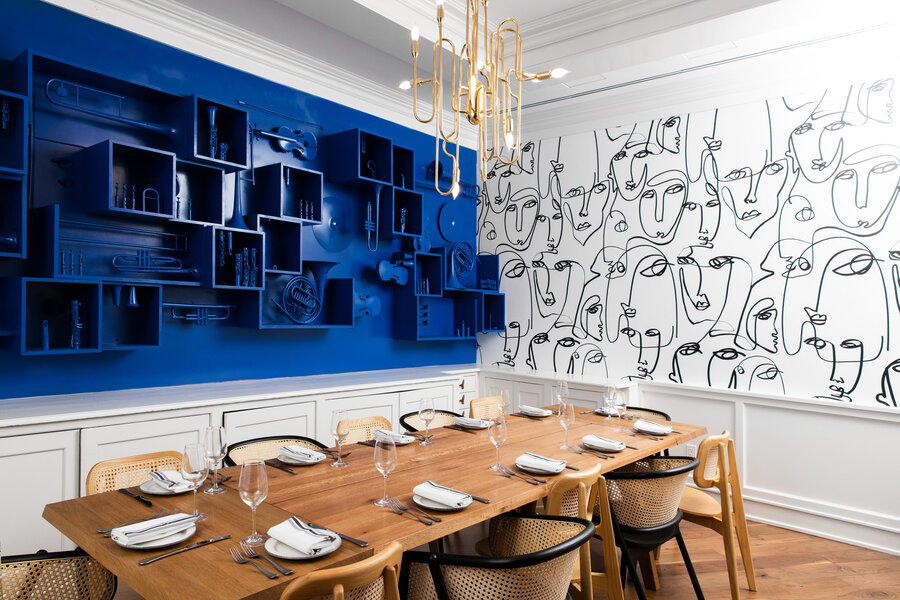
French Brasserie Culture and the Civic Dining Tradition
The brasserie format has always been tied to institutional life. In Paris, the great brasseries grew up around railway termini, opera houses, and covered markets, places where people moved in coordinated waves and needed reliable, well-executed food on a schedule. That rhythm translated to the United States through a handful of cities willing to build the infrastructure to support it: New York around Lincoln Center, Chicago near the Lyric, and in Los Angeles, the Music Center complex on Bunker Hill, where Kendall's Brasserie has operated at 135 N Grand Ave as part of the civic dining fabric that the performing arts campus requires.
Los Angeles's relationship with classical French dining has always been complicated. The city's restaurant culture pulled decisively toward California cuisine in the 1980s, then toward global fusion and tasting-menu formalism in the 2000s, and more recently toward a genuinely pluralistic scene where Kato holds a Michelin star for New Taiwanese cooking and Hayato holds two for Japanese kaiseki. French technique, in that context, tends to appear refracted through other traditions rather than as its own destination, which makes a direct brasserie format a rarer proposition than it might seem.
The Brasserie in Its Bunker Hill Setting
Bunker Hill has functioned as Los Angeles's attempt at a civic center since the Music Center opened in 1964. The Dorothy Chandler Pavilion, the Ahmanson Theatre, and the Walt Disney Concert Hall together draw an audience that skews toward pre- and post-performance dining at predictable hours, a demand profile that rewards French brasserie conventions precisely because those conventions were built for exactly this kind of institutional adjacency. The clockwork service model, the menu's range from light first courses to full main plates, the reliable wine list structured for quick decisions: these are not incidental features of the format but its core logic.
That civic positioning also places Kendall's Brasserie in a different competitive frame from the fine-dining houses that define much of the conversation about serious eating in Los Angeles. Properties like Somni or Providence operate on reservation cycles and tasting-menu commitments that are incompatible with a concert ticket. The brasserie's value, in this part of the city, is its capacity to accommodate a two-hour window without theatrical conceit, a proposition that remains genuinely scarce in Los Angeles's dining options, where the middle register between casual and ceremonial has historically been thin.
French Technique in an LA Context
The broader tradition the brasserie draws from is worth placing clearly. Classical French brasserie cooking, onion soup built on long-reduced stock, steak frites relying on proper resting and sauce technique, duck confit requiring days of curing before service, represents a set of preparations that are relatively unforgiving of shortcuts and that reward kitchens willing to maintain the labour-intensive standards the format demands. In a city where kitchen economics push many operators toward simpler execution, the brasserie format is a deliberate choice about what kind of cooking to sustain.
That conversation about French culinary tradition in American cities has played out at a range of registers. At the haute end, Le Bernardin in New York City represents what French technique looks like at maximum formality. At the other end, bistro cooking has proliferated as a casualised French register across most major American cities. The brasserie sits between those poles, more convivial than haute cuisine, more technically committed than a bistro, and Los Angeles has historically had fewer examples of the format than comparable American cities.
Internationally, the French brasserie template has travelled well wherever there is sufficient institutional density to support it. 8 1/2 Otto e Mezzo Bombana in Hong Kong demonstrates a related dynamic in a different register: a European fine-dining format sustained by a city with enough international traffic and cultural infrastructure to support European culinary formalism. The mechanism is the same even if the cuisine differs, institutional context creates a viable audience for cooking with classical European roots.
Los Angeles Fine Dining: Where Kendall's Fits
The dining tier in Los Angeles has consolidated around a set of addresses that share an emphasis on tasting menus, premium ingredient sourcing, and long booking windows. Osteria Mozza occupies the a la carte Italian end of serious dining with consistent critical recognition; Somni operates at the molecular and progressive end; and the broader California fine-dining conversation includes references like The French Laundry in Napa and Single Thread Farm in Healdsburg as regional benchmarks. Kendall's Brasserie does not compete in that tier, its comparable set is defined by the brasserie format, the pre-theatre function, and the Music Center's institutional gravity rather than by tasting-menu ambition.
That distinction is not a limitation so much as a different purpose. Other American cities have demonstrated that this kind of culturally-anchored brasserie can develop its own following independent of awards infrastructure. Emeril's in New Orleans and Lazy Bear in San Francisco both illustrate how city-specific institutions can build durable identities through consistent execution and clear positioning rather than through Michelin accumulation.
Planning a Visit
The restaurant sits at 135 N Grand Avenue within the Music Center complex, which puts it in the heart of the Bunker Hill performing arts district. For those attending events at the Dorothy Chandler Pavilion or Walt Disney Concert Hall, the proximity makes it a logical pre-performance choice, though the brasserie format means it functions equally well as a standalone destination for anyone working in or visiting the downtown civic core. The Music Center campus is accessible from the 110 freeway, and validated parking is typically available through the Music Center structure. Reservations are advisable on performance evenings, when demand from the Music Center audience compresses into a narrow window before curtain.
Recognition Snapshot
Comparable venues nearby, for context on price, style, and recognition.
| Venue | Cuisine | Price | Notes |
|---|---|---|---|
| Kendall's BrasserieThis venue — the venue you are viewing | Modern French Brasserie | $$$ | Not listed |
| Cafe Stella | Classic French Bistro | $$$ | Sunset Junction |
| Electric Bleu | Modern French Bistro | $$$ | Mar Vista |
| L'APPART by AIR FOOD | French Bistro | $$$ | Gallery Row |
| Regalade | Classic French Bistro | $$$ | Beverly Grove |
| Mr. T | Modern French Bistro with Global Street Food Influences | $$$ | Hollywood |
Continue exploring
More in Los Angeles
Restaurants in Los Angeles
Browse all →
Bars in Los Angeles
Browse all →

Hotels in Los Angeles
Browse all →
Wineries in Los Angeles
Browse all →

At a Glance
- Lively
- Elegant
- Modern
- Sophisticated
- Brunch
- Group Dining
- Special Occasion
- Private Dining
- Hotel Restaurant
- Craft Cocktails
- Extensive Wine List
- Farm To Table
- Local Sourcing
Light, expressive interior with large murals, expansive bar, and bright airy setting evoking Parisian streets.