Kae Sung Kimchi Market
"The tendency to romanticize the food cooked by our grandmothers runs through every culture, and Korean culture is no exception. At Kae Sung Market, an actual grandmother, Sook Jae Cho, spends her days brining and fermenting the vegetables that make up her kimchi, famous among in-the-know neighborhood locals. Cho has been living in LA. for over forty years and started selling her homemade kimchi as a side business in the ’80s. (The mart is named for her North Korean hometown, Kae Sung.) This side hustle has turned into a full-day market, and on any given day there are up to ten kinds of kimchi on offer, including kosher and vegan-friendly varieties. The signage is entirely in Korean, so look out for the yellow storefront on the corner of St. Andrew’s Place and West Olympic, or just ask a bystander, chances are anyone you ask in the area will know how to get there."
Pearl is the En Primeur Club membership app — saves, bookings, and concierge access live there. Same editors, same standards.
- Address
- 1010 S St Andrews Pl, Los Angeles, CA 90019
- Phone
- +1 323 737 6565
- Directions
- Get directions
 Saves & bookings on Pearl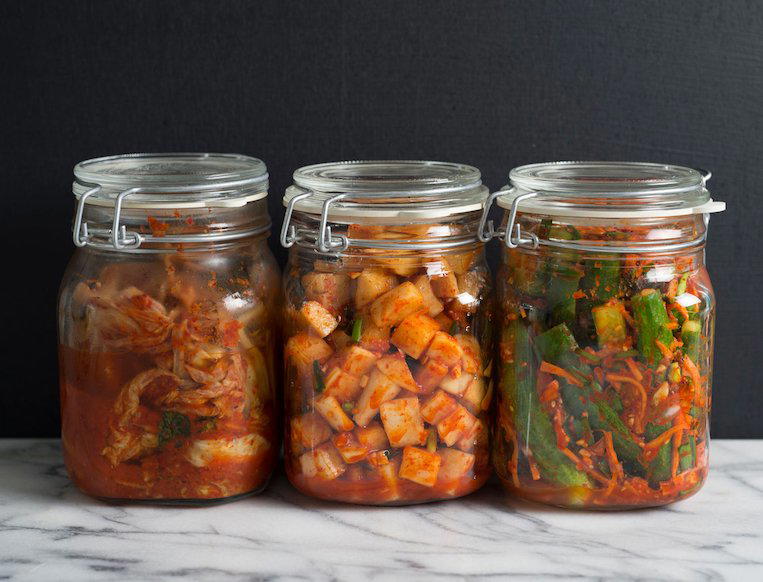
Kimchi as Cultural Artifact: Los Angeles and the Korean Fermentation Tradition
On South St Andrews Place, in the stretch of Mid-City that bleeds into Koreatown's western edge, the air outside Kae Sung Kimchi Market carries the unmistakable sharpness of brine and fermented cabbage. It is a smell that, for much of Los Angeles's Korean-American community, functions as a kind of homecoming. For everyone else, it is an introduction to one of Korea's most consequential culinary traditions: the practice of kimchi-making, or kimjang, recognized by UNESCO as Intangible Cultural Heritage of Humanity since 2013.
Los Angeles holds one of the largest Korean populations outside the Korean peninsula, and Koreatown — the dense, 24-hour neighborhood roughly bounded by Olympic Boulevard and Third Street — operates as the most commercially concentrated Korean community in the United States. Within that context, a dedicated kimchi market occupies a specific and important position. Where most Korean restaurants treat kimchi as a banchan, a side dish that arrives automatically, a kimchi-focused market places the ferment at the center of the transaction. That distinction matters culturally and practically.
What Kimchi Markets Represent in the Broader LA Korean Food Scene
The Korean food scene in Los Angeles has diversified sharply over the past decade. At one end, tasting-menu formats at places like Kato and highly technical Japanese counters like Hayato operate in the $$$$ tier with advance bookings and elaborate multi-course progressions. At the other end, market-format vendors and specialty producers serve a daily, utilitarian need: stocking home kitchens with the fermented and preserved foods that anchor Korean cooking at its most foundational level.
Kimchi markets sit firmly in that second category, but their cultural weight is disproportionate to their commercial format. Kimchi is not a condiment in the Western sense. It is a preservation system, a probiotic staple, and a vehicle for regional identity. The variety of kimchi a household makes or buys, the heat level, the ratio of jeotgal (fermented seafood), the length of fermentation, these are markers of regional origin and family tradition. A kimchi market that takes this seriously is, in effect, selling something closer to a cultural artifact than a grocery item.
This is what separates a specialist kimchi vendor from a supermarket shelf. The scale and context of LA's Korean community means that demand for traditionally produced, regionally specific kimchi is substantial enough to support dedicated operations. That same dynamic supports the depth of the broader Korean food offering across the city, from the banchan-heavy casual spots along Western Avenue to the soju-forward late-night venues that make Koreatown's nightlife distinct.
The Address in Context: Mid-City and Koreatown's Western Fringe
The 1010 South St Andrews Place address places Kae Sung Kimchi Market at the western boundary of what most Angelenos mean when they say Koreatown. This fringe zone has a particular character: less dense with signage than the Olympic corridor, more residential in feel, with a mix of Korean-owned businesses and multi-ethnic neighborhood infrastructure. It is the kind of block where a specialist food producer operates for the community rather than for foot traffic from passersby.
That positioning is typical of how kimchi production and retail has historically worked in Los Angeles. The highest-volume operations tend not to occupy prime commercial frontage. They rely on word of mouth, community networks, and repeat customers who understand what they are purchasing. This is a useful reference point for any visitor: the address signals a functional, community-facing operation rather than a curated dining destination in the mode of, say, Somni or Osteria Mozza.
Korean Fermentation in the Wider American Fine Dining Conversation
It is worth placing LA's kimchi culture in the broader American dining context. Korean fermentation has moved from niche to reference point in serious kitchens across the country. Chefs at tasting-menu restaurants from Atomix in New York City to Smyth in Chicago have integrated Korean fermentation logic into their programs, borrowing the underlying principles of controlled lacto-fermentation and layered umami that kimchi-making represents. The same intellectual interest in fermentation that drives programs at Blue Hill at Stone Barns or Single Thread Farm in Healdsburg has a direct, if uncredited, ancestor in the kimjang tradition.
That refined profile has not fundamentally changed the economics or format of a neighborhood kimchi market. But it has created a broader audience of curious, food-literate visitors who approach these producers with a level of interest that would have been less common fifteen years ago. For that visitor, a market like Kae Sung operates as a primary source, the place where the tradition is practiced for its own community rather than translated for outside consumption.
The contrast with the more internationally referenced end of American dining is instructive. A meal at The French Laundry in Napa or Le Bernardin in New York City involves considerable institutional architecture around the experience. A kimchi market involves almost none of that. What it does involve is accumulated expertise in a specific fermentation tradition, and in Los Angeles that expertise is available in a density that few other American cities can match. Other cities have their own specialist producers worth seeking out, from Frasca Food and Wine in Boulder to Addison in San Diego, but none sit within a Korean community of equivalent scale and continuity.
For visitors approaching Los Angeles from a food perspective, the kimchi market category represents a tier of the city's culinary identity that formal restaurant guides tend to underrepresent. Our full Los Angeles restaurants guide covers the breadth of the city's dining, but the specialist producers and market vendors of Koreatown deserve consideration on their own terms.
What to Expect When You Visit
The practical reality of a kimchi market visit differs substantially from a restaurant booking. There is no reservation system, no tasting menu, no dress code. The interaction is transactional in the leading sense: you are there to purchase fermented product, and the quality of what you find reflects the producer's accumulated practice rather than any front-of-house performance. Bring cash as a default, arrive with some familiarity with the range of kimchi varieties (baechu-kimchi from napa cabbage, kkakdugi from radish, oi-sobagi stuffed cucumber kimchi), and expect to make decisions based on what is available that day.
Know Before You Go
- Address: 1010 S St Andrews Place, Los Angeles, CA 90019
- Neighborhood: Mid-City / Koreatown western edge
- Format: Market / retail producer
- Reservations: Not applicable
- Phone / Website: Not publicly listed at time of writing, confirm current hours locally before visiting
- Getting There: Street parking is available along St Andrews Place; the location is accessible from the 10 Freeway via Arlington or Crenshaw exits
- Ideal time to visit: Weekday mornings typically see the freshest stock in Korean market-format operations; weekend afternoons draw higher community traffic
How Kae Sung Kimchi Market Los Angeles compares with similar nearby venues.
| Venue | Cuisine | Price |
|---|---|---|
| Chosun Galbee | Korean Barbecue, Korean | $$$ |
| Dha Rae Oak | Korean | $$ |
Continue exploring
More in Los Angeles
Restaurants in Los Angeles
Browse all →
Bars in Los Angeles
Browse all →

Hotels in Los Angeles
Browse all →
Wineries in Los Angeles
Browse all →
At a Glance
- Rustic
- Casual Hangout
Current opening hours
- Monday
- 8 AM–6 PM
- Tuesday
- 8 AM–6 PM
- Wednesday
- 8 AM–6 PM
- Thursday
- 8 AM–6 PM
- Friday
- 8 AM–6 PM
- Saturday
- 8 AM–5:30 PM
- Sunday
- Closed
Hours can change for holidays and private events. Last verified .
Know Before You Go
- Getting there
- 1010 S St Andrews Pl, Los Angeles, CA 90019