
Ichioka 45 belongs to Osaka’s small-counter chicken-dining tier, where the appeal sits in proximity: counter seating, smoke, stock, sake, and a narrow focus on poultry rather than a broad izakaya spread. Its 2025 Tabelog 100 selection for chicken cuisine gives it a clear credential within a city better known internationally for street food, okonomiyaki, and late-night drinking.
Pearl is the En Primeur Club membership app — saves, bookings, and concierge access live there. Same editors, same standards.
- Address
- 大阪府大阪市北区堂島2-2-33 RES堂島 1F
- Phone
- +81661316935
- Website
- tabelog.com
 Saves & bookings on Pearl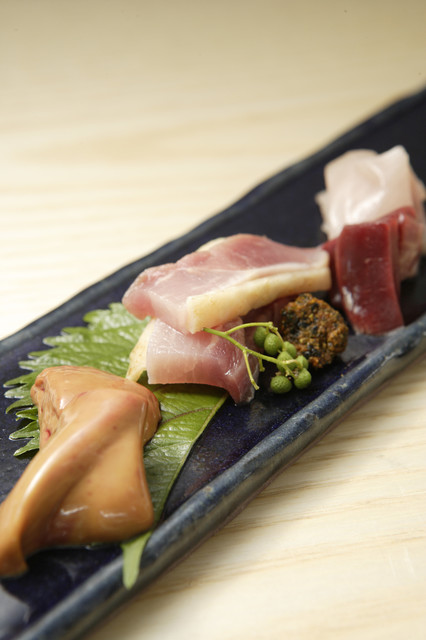
Dojima changes character after office hours. The district’s polished daytime face gives way to smaller rooms, counter lights, and the low percussion of chefs working close to guests. In that setting, chicken cookery makes sense: it is direct, aromatic, and difficult to hide behind. Ichioka 45 sits inside this narrower Osaka tradition, where poultry is treated with the seriousness that sushi counters give to fish and kappo rooms give to seasonality.
Osaka’s dining reputation abroad is often flattened into takoyaki, okonomiyaki, and market snacking. That misses a more adult layer of the city: compact restaurants built around one ingredient, one counter, and a clientele that understands repetition as discipline. Chicken cuisine in Japan is not a single format. It can mean skewers over charcoal, mizutaki with broth as the measure of technique, or oyako-don, where egg texture and rice management decide the meal. A room devoted to those categories asks the diner to pay attention to small differences rather than spectacle.
Chicken cookery, narrowed to counter distance
The strongest argument for this style is proximity. An eight-seat counter changes the rhythm of dinner: the kitchen is not background theatre, it is the room’s operating system. Sound carries, timing becomes visible, and the meal feels less like a procession than a sequence of adjustments. That intimacy also raises the stakes. There is less room for decorative abundance, and less cover for imprecise heat.
Ichioka 45’s Tabelog 100 selection for chicken cuisine in 2025 places it within a national category that rewards specialism rather than breadth. In Osaka, that matters. The city has countless places to eat well without ceremony, but the more interesting question is where craft survives without becoming stiff. This is the lane occupied by small counters in Kitashinchi and Dojima: controlled, adult, and usually better suited to two people than a roaming group.
Compared with Yakitori Matsuri, the nearby reference point for a more explicit yakitori frame, Ichioka 45 reads as a broader poultry house: chicken dishes, mizutaki, and oyako-don define the category rather than skewers alone. Against Iroha, which sits in a wider Japanese-dining register, the appeal is narrower and more ingredient-led. San Bettei Kitashinchi ten operates at a higher dinner spend, while London Tea Room Doujima honten and Watanabe Curry Umeda honten speak to Dojima and Umeda’s daytime and casual-meal traffic. The comparison is useful because it shows how compressed the area is: within a short radius, Osaka moves from curry and tea to counter-led dinner rooms with serious intent.
Dojima's after-dark restraint
Dojima and Kitashinchi carry a particular kind of Osaka polish. The neighbourhood is not the city’s loudest eating zone, and that is precisely the point. It is built for controlled evenings: business dinners, date-night counters, and rooms where sake and shochu sit naturally beside grilled or simmered food. In this context, a chicken-focused counter does not need to announce itself loudly. The signal is the format, the adult-only policy, and the emphasis on Japanese drinks rather than a sprawling beverage list.
The sensory grammar is leaner than in Osaka’s market districts. Expect a room defined by counter proximity, a kitchen-facing perspective, and the quiet concentration that comes when a small number of seats dictates the pace. The food categories point toward warmth and reduction rather than maximalism: grilled chicken cookery for aroma and timing, mizutaki for broth and texture, oyako-don for the comfort register that Japanese poultry restaurants often treat with surprising seriousness. None of those formats rewards distraction.
That makes the restaurant a poor choice for diners seeking a noisy group meal and a strong choice for those who want Osaka at a lower volume. The city is often sold as extroverted, but its more compelling meals frequently happen in rooms like this: not hushed in a formal Western sense, but precise, close, and alert to rhythm.
How to place it in an Osaka itinerary
For travellers, the restaurant works less as a standalone trophy meal than as a correction to the usual Osaka script. It shows the city through ingredient discipline rather than excess. A day might begin with bakery or coffee culture at 52CHO-ME BAKERY or .cafe, pass through the everyday pull of 551 Horai (551蓬莱), and end in Dojima with a counter meal that narrows the city’s appetite into one ingredient family. For a different European register, 99 Pizza Napoletana Gourmet and a canto (Italian) show how Osaka absorbs foreign formats without losing its appetite for informality.
The broader planning frame matters. Use Our full Osaka restaurants guide to build meals by neighbourhood rather than reputation alone, then pair dinner with Our full Osaka bars guide if the night continues in Kitashinchi or Umeda. For the rest of the trip, Our full Osaka hotels guide, Our full Osaka experiences guide, and Our full Osaka wineries guide help separate a food-led stay from a generic city break.
Readers comparing Japanese dining styles beyond Osaka can triangulate the experience against beef sukiyaki at -Grilled beef Sukiyaki- KAMAKURA TANUKIAN 鎌倉 たぬき庵 in Kamakura, charcoal-led tuna dining at. 鮪と炭火焼き うお炭 秋葉原店 in Tokyo, regional dining at.know in Kumamoto, Vietnamese cooking in Japan at (Shoku) Vietnam in Kawasaki, curry specialism at [Curry Senmon Ten] Maruyama Kyoju. in Sapporo, Kyoto’s sharper contemporary register at [ki:] in Kyoto, and the Japanese-food diaspora through Jōdo Saké Bar in Los Angeles and Onigiri Time in Pasadena. The pattern is clear: focused formats travel well, but Osaka’s version keeps its confidence close to the counter.
Budget Reality Check
Comparable venues to calibrate price, style, and recognition.
| Venue | Cuisine | Price | Notes |
|---|---|---|---|
| Ichioka 45This venue — the venue you are viewing | Not listed | $$$ | Not listed |
| Ryobo | Chūō, Yakitori Omakase Counter | $$$ | Not listed |
| Hon Sekiguchi | Not listed | $$$ | Chūō, Traditional Kansai-Style Sukiyaki & Shabu-Shabu |
| Kitashinchi Tentomi | Kita, Seasonal Tempura Omakase | $$$ | Not listed |
| Soba Kappou Soba Fuji | Not listed | $$$ | Toyonaka (Seifu-so residential area), Soba-focused Kappou & Kaiseki |
| Yakiniku Futoro | Kita, Casual Wagyu Yakiniku Counter | $$$ | Not listed |
Recognition history
Dated appearances from independent guides and award organizations, with the underlying list record or original source where available.
Tabelog 100 #25 · No. 25
Tabelog · Tabelog 100 - Chicken cuisine - 2025
Continue exploring
More in Osaka
Restaurants in Osaka
Browse all →




Bars in Osaka
Browse all →




Hotels in Osaka
Browse all →



Wineries in Osaka
Browse all →
At a Glance
- Cozy
- Modern
- Intimate
- Elegant
- Date Night
- After Work
- Special Occasion
- Solo
- Private Event
- Chefs Counter
- Standalone
- Design Destination
- Sake Program
- Farm To Table
- Local Sourcing
A small, adult-oriented hideaway off a Dojima back alley with just an 8-seat wooden counter, calm lighting, and a stylish yet relaxed bar-like atmosphere ideal for quiet dates and lingering over sake.